Condition Report
Contact Information
Lot 13
Lot Description
Abigail Adams Writes to Ensure the Posterity of Her Family History and Reveals the Story of Her Son John Quincy Adams's Name
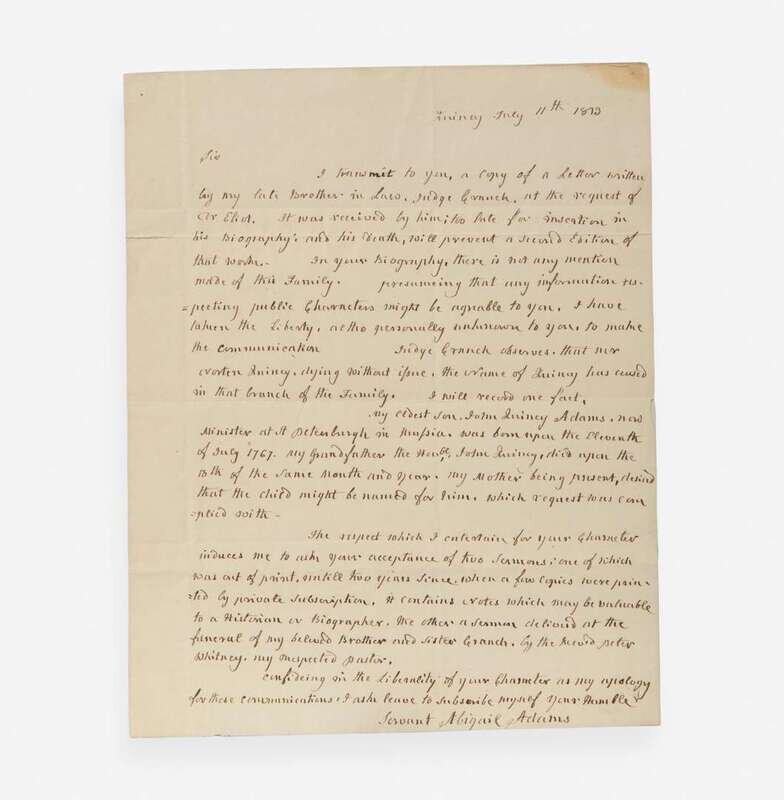
Quincy (Massachusetts), July 11, 1813. One sheet folded to make four pages, 9 7/8 x 7 7/8 (251 x 200 mm). One-page autograph letter, signed by First Lady Abigail Adams to American biographer William Allen, regarding the inclusion of her family history in his biographical dictionary, and revealing to him the origin of her son--future sixth president--John Quincy Adams's name; addressed on integral leaf, docketing to same. Integral leaf mounted to cloth-lined board from old mounting; adhered at top corner of interior pages; creasing from contemporary folds, short separations at edges of upper vertical fold; bottom edge trimmed and just touching flourishes in "g" in Abigail, and "A" in Adams; open tear in integral leaf from where mounted. A undated draft of this letter is held in the Massachusetts Historical Society (#130951).
"Sir
I transmit to you, a copy of a Letter written by my late Brother-in Law, Judge Cranch, at the request of Dr. Eliot. It was received by him; too late for insertion in his Biography; and his Death, will prevent a second Edition of that work. In your Biography, there is not any mention made of this Family. Presuming that any information respecting public Characters might be agreeable to you, I have taken the Liberty, altho personally unknown to you, to make the communication Judge Cranch observes, that Mr. Norton Quincy, dying without issue, the Name of Quincy has ceased in that branch of the Family. I will record one fact.
My Eldest son, John Quincy Adams, now Minister at St Petersburgh in Russia, was born upon the Eleventh of July 1767. My Grandfather the Honbl. John Quincy, died upon the 13th of the same month and year. My Mother being present, desired that the child might be named for him, which request was complied with.
The respect which I entertain for your Character induces me to ask, your acceptance of two Sermons; one of which was out of print, untill (sic) two years since, when a few copies were printed by private subscription. It contains notes which may be valuable to a Historian or Biographer. The other, a sermon delivered at the funeral of my beloved Brother and Sister Cranch, by the Revd Peter Whitney, my respected pastor.
Confideing (sic) in the Liberality of your Character as my apology for these communications, I ask leave to subscribe myself your Humble
Servant Abigail Adams"
Former First Lady Abigail Adams writes to American biographer William Allen (1784-1868), seeking recognition for part of her family in his biographical dictionary, and reveals the origin of her son, the future sixth president, John Quincy Adams's name.
A former assistant librarian at Harvard University and then a Pastor in Pittsfield, Massachusetts, Allen published the first edition of his American Biographical Dictionary in 1809. Considered the first work of general biography published in the United States, it featured hundreds of descriptions of individuals related to the history of colonial America and the founding of the United States. The work included three short entries on members of the prominent Quincy family of Massachusetts--from which Abigail was descended--but no mention of others, including her grandfather, the esteemed Colonel John Quincy (1689-1767), or others like her late brother-in-law, Judge Richard Cranch (1726-1811), husband of her late older sister, Mary (1739-1811). Here, Abigail writes to Allen to gain inclusion of mention of Richard, and includes a copy of a letter from him, as well as two printed sermons (none included here), A Discourse Delivered at Quincy, October 19, 1811: At the Internment of the Hon. Richard Cranch…, and one by the Reverend Jacob Norton (husband of Richard and Mary's daughter, Elizabeth). Prior to this letter, Abigail had similarly written to Unitarian minister and biographer Dr. John Eliot, seeking similar recognition in his 1809 biographical dictionary of New England (A Biographical Dictionary: Containing a Brief Account of the First Settlers, and Other Eminent Characters Among the Magistrates, Ministers, Literary and Worthy Men, in New-England). But, as Abigail informs Allen, the letter arrived too late, and since Eliot died in February of 1813, his volume was unlikely to be updated.
While the content of the Cranch letter originally included here is unknown, based on two other known letters sent by him--one to Abigail, and the other to Elizabeth Quincy Guild (1757-1825)--it quite possibly related to the history of the Quincy family. Those two letters are each dated March 23, 1809 and, according to Founders Online, are practically identical in content. In them Cranch traces the Quincy family lineage, from the 11th century Robert de Quincy up to more contemporary Quincy members.
Significantly, in this letter, Abigail reveals the story of her son John Quincy's naming. As Abigail recounts, since the death of her uncle Norton Quincy (1716-1801), who died childless, the Quincy name ceased in that family line. When John Quincy was born on July 11, 1767, and at the behest of Abigail's mother, Elizabeth Quincy Smith, he was named to honor Abigail's grandfather, John Quincy (1689-1767), who died only two days after John Quincy's birth. While the naming followed a New England tradition, the story of her mother's insistence was likely then little-known outside of the immediate family. During his upbringing the younger Quincy would become very close with the Cranches, as well as his grandparents, Elizabeth, and her husband, the Reverend William Smith, spending time in their care.
Allen responded to Abigail's request four days later, on July 15, thanking her and writing that "The facts, which you have communicated, will contribute to improve the second edition of a work, compiled almost entirely without literary aid,—a circumstance, which will account for the omission, to which you allude. There are yet other omission & defects, for a supply of which from the valuable & abundant stores of your family I should be truly grateful." (Founders Online, National Archives, Allen to Adams, July 15, 1813). The second edition of Allen's Dictionary would not be published for another 19 years, in 1832, and although Abigail died in 1818, Allen would give her family the recognition she worked to attain, with entries on both Rev. Cranch, and the aforementioned Colonel John Quincy, as well as expanding the Quincy entries from the first edition. Later in life, the younger John Quincy, commented on his naming, writing that, "The incident which gave rise to this circumstance is not without its moral to my heart. He (elder John Quincy) was dying when I was baptized; and his daughter, my grandmother, present at my birth, requested that I might receive his name. The fact, recorded by my father at the time, has connected with that portion of my name a charm of mingled sensibility and devotion. It was filial tenderness that gave the name. It was name of one passing from earth to immortality. These have been the strongest links of my attachment to the name of Quincy, and have been to me through life a perpetual admonition to do nothing unworthy of it." (John T. Morse, Jr., John Quincy Adams: American Statesman, 1898).
A fascinating document pertaining to the Adams family lineage.