Condition Report
Contact Information
Lot 12
Lot Description
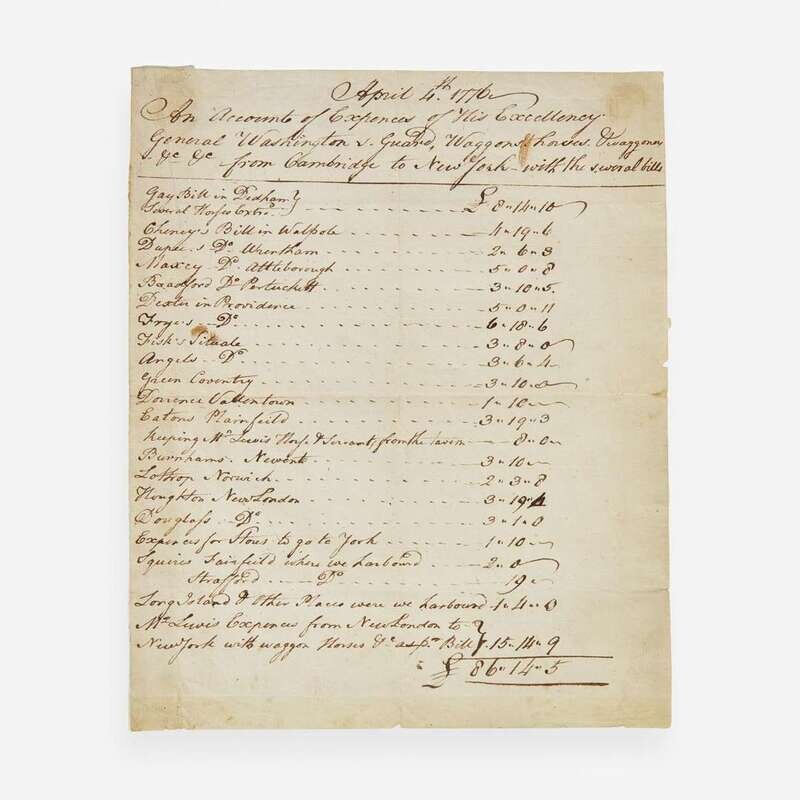
An Unpublished 1776 Expense Report From George Washington's Journey to New York Following the British Evacuation of Boston
No place, ca. April, 1776. One sheet, 9 3/16 x 7 1/2 in. (233 x 190 mm). Manuscript document in a secretarial hand, being "April 4th 1776--An Account of Expences of His Excellency General Washington v. Guard, Waggons, horses, & Waggoners, &c &c from Cambridge to New York--with the several bills"; listing 24 expenses incurred by Washington and his men along the way, with the amount of money spent at each location, listing each town, vendor names, taverns, etc., totaling "£86..14..5." Creasing from old folds; trimmed along edges, with scattered small chipping; remnants from previous mounting in top corners and along left edge verso.
A unique Continental Army report, detailing the expenses from General George Washington's journey from Cambridge, Massachusetts to New York, between April 4-13, 1776, made in anticipation of a British invasion of New York City. Washington's entourage included his aide-de-camps William Palfrey and Stephen Moylan, Adjutant General Horatio Gates, and Washington's personal bodyguard unit, The Life Guards, headed by Captain Caleb Gibbs. On March 11, only a week before the British evacuation of Boston, Washington issued a General Order to Commanding Officers of the Continental Army directing them to select four men from each regiment who would form his personal bodyguard. The following day Gibbs was selected by Washington to command the new unit. He was tasked with organizing the unit whose mission was to protect Washington, the army's money supply and official papers, and to coordinate the security of Washington's headquarters. Washington's nephew, Subaltern Officer George Lewis, was assigned to Gibbs's staff and is mentioned in lines 14 and 23 of this document, the only name besides Washington's mentioned.
Following the British evacuation from Boston on March 17, Washington correctly guessed that they would attempt to take New York City, a strategic location at the mouth of the Hudson River, whose control would effectively bisect the northern and southern colonies. On March 27, Washington wrote Congress informing them of the British evacuation and his plan to dispatch regiments under the command of General John Sullivan to New York, with the remainder of the army to follow in the subsequent days. While the main portion of the Continental Army left Cambridge in the latter days of March, Washington began his journey south to New York beginning on April 4. He traveled on the "lower" road route along the Long Island Sound so as to watch for any incoming British ships and, as this document shows, made stops in Dedham and Walpole, Massachusetts; Providence, Rhode Island, where he is known to have dined with Governor Nicholas Cooke; Plainfield, Norwich, and New London in Connecticut; then to Long Island and New York. The entourage arrived in Manhattan on April 13, and Washington's headquarters was established on lower Broadway, beside the Battery.
William Palfrey maintained an expense account during the journey and recorded costs at taverns and expenses for food and other goods, but because he "neglected to include specific dates in his account and often omitted the names of towns, only a general outline of GW’s journey can be reconstructed from it." (The Papers of George Washington, Vol. 4, 1 April 1776?–?15 June 1776, pp. 40–42.). Our document thus provides its own unique record of Washington and his troops movements, and together with Palfrey's account they offer a much fuller picture of this consequential journey. The Continental Army's move to New York would be the beginning of a critical period that would commence a string of the war's earliest major hostilities and test Washington and his men's stamina and perseverance.