Condition Report
Contact Information
Auction Specialist
Lot 478
Sale 1005 - American Historical Ephemera & Photography
Lots Open
Mar 1, 2022
Lots Close
Mar 8, 2022
Timed Online / Cincinnati
Own a similar item?
Estimate
$400 -
600
Price Realized
$281
Sold prices are inclusive of Buyer’s Premium
Lot Description
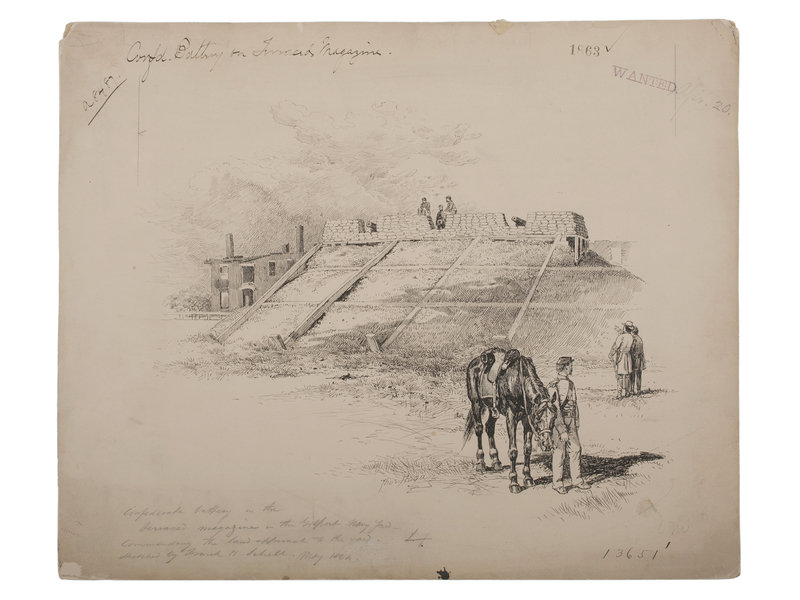
[CIVIL WAR]. HOGAN, Thomas, artist. Confederate Battery on the Terraced Magazine, Gospert Navy Yard, Norfolk, Virginia. Pen and ink sketch.
11 x 13 3/8 in. pen and ink sketch on board, matted. Signed at bottom center, "Thomas Hogan," titled in ink at top left and described in pencil at lower left, "Confederate battery in the terraced magazine in the Gospert Navy Yard [Norfolk, VA] - Commanding the land approach to the yard. May 1861" (or 1862). After a wartime sketch by Frank H. Schell. Published in Battles and Leaders of the Civil War, Vol. 2, p. 191; The American Heritage Century Collection of Civil War Art, p. 365, plate 52. Provenance: The David L. Hack Civil War Art Collection.
Thomas Hogan had a 30-year partnership in lithography with Frank. H. Schell, and together they recreated numerous war-date renderings, many of naval battles, relying on hastily done sketches that were produced on site.
While the photographic process evolved rapidly from its inception in 1839 and the wet plate process of taking photographs was coming into widespread use by the start of the Civil War, it was a cumbersome process in the field as well as the studio. More significantly, at that time the photographs themselves could not be reproduced as illustrations accompanying written reports of the war.
As a result, publishers of newspapers and other periodicals in major cities, primarily in the North, employed a number of sketch artists who traveled with armies to draw the scenes that they witnessed. These sketches, most frequently pencil on paper with brief identifications of people and places, were then sent back by courier to the periodical publishers. The battlefield sketches received by the publishers were then copied by engraving artists onto wooden blocks, which were used in printing presses to illustrate printed articles covering the war.
Unlike the photographers of the day, who were limited to capturing the aftermath of battles, the sketch artists had the advantage of recording what they were witnessing as the events occurred before their eyes.