To request further details about this lot, please email fineart@freemansauction.com
Please email fineart@freemansauction.com for any additional information or questions you may have
Sale 6643
| New York
| New York
To request further details about this lot, please email fineart@freemansauction.com
Please email fineart@freemansauction.com for any additional information or questions you may have
Estimate$150,000 – $250,000
We are grateful for the research conducted by Susan Weininger, Professor Emerita, Roosevelt University.
Provenance:
Trilby Bentley, acquired from the Artist, 1960.
Private Collection, Chicago, by 1980.
Thence by familial descent to the present owner.
Exhibited:
Chicago, Old Town Art Fair, 1957.
Chicago, Hyde Park Art Fair, 1957.
Lot Note:
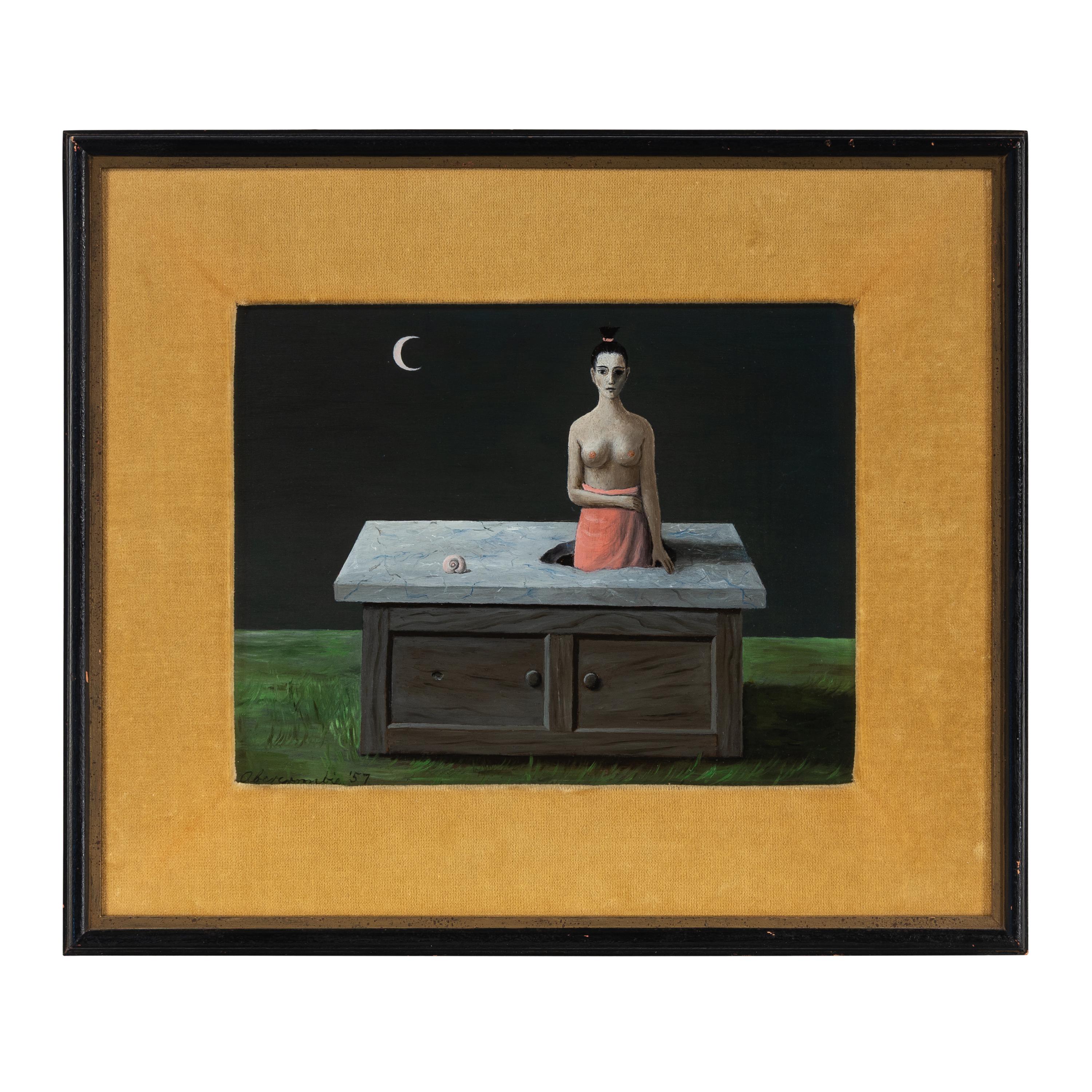
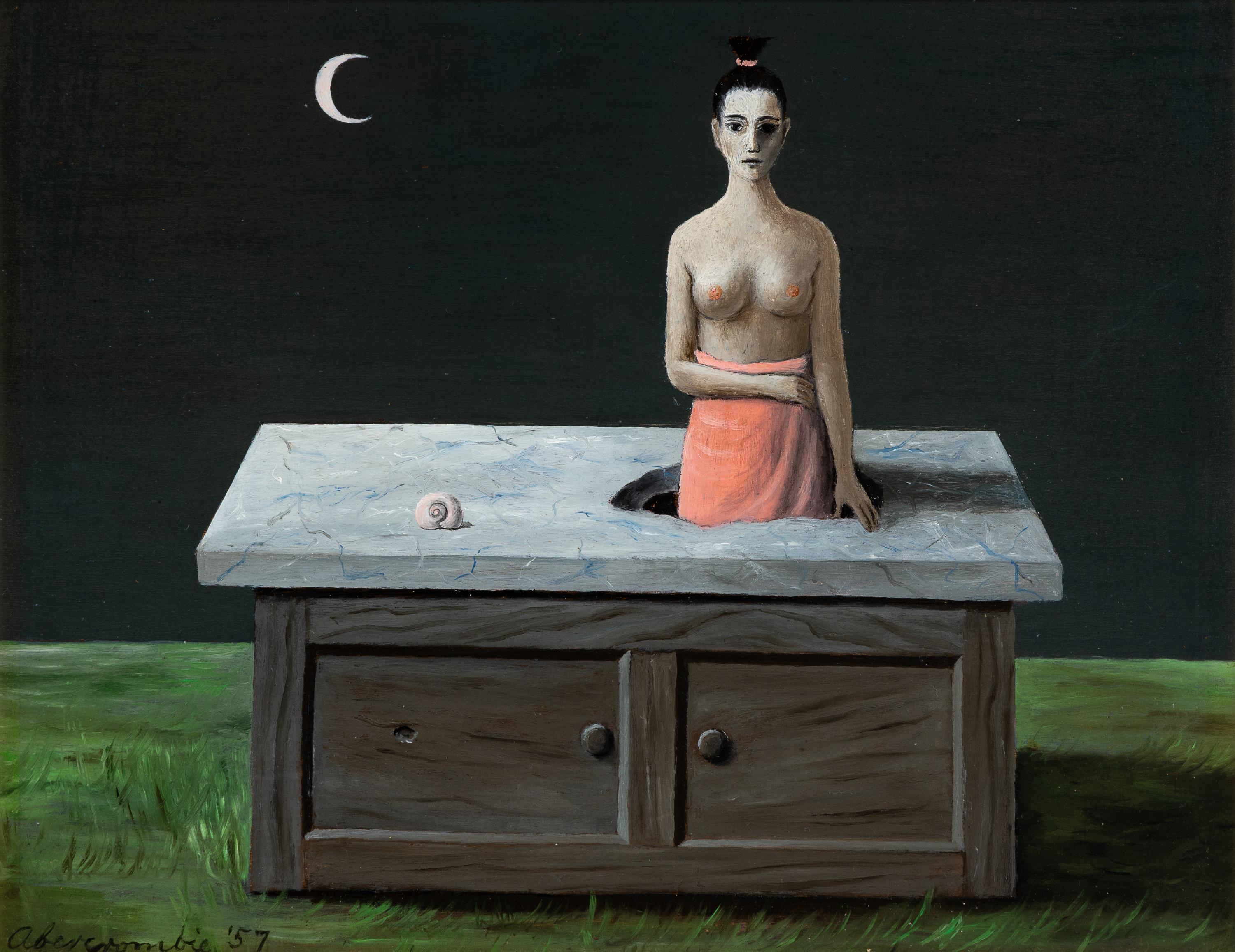
Marble Top Mystery #3 is a beautifully rendered version of a recurring theme in Gertrude Abercrombie’s oeuvre. The artist owned a rectangular marble top table, about which she tells a story that embodies the magical power that pervaded her life and art. In 1952, she told the writers Ron Offen and D. Shigley:*
The strange thing is, once I paint something, it usually turns up in real life. For example, that marble-topped counter there. It popped up in a painting I did. Then, a few weeks later I saw it in a shoemaker’s shop. Naturally, he had to sell it to me. After all, I had painted it!
Although the earliest two portrayals of this piece of furniture in her work, Marble Top Mystery #1 and #2, date to 1952 (location is unknown for both of these works) and painted just months apart, it is possible that she passed the shoemaker’s shop immediately after painting the first version; or perhaps there is an unknown earlier version. Whatever the timing of her amazing discovery of the table, it appears in many paintings right up until the end of her active career as painter. Examples include the apparently unfinished painting, Marble Top Table, Tree, Owl, Woman, and Lighthouse (Illinois State Museum Collection), a large work dominated by a very elongated rectangular table with a hole in its center from which a woman (Abercrombie) emerges; a dead tree with an owl emerges from a second hole on the left side of the painting and what may be an erupting volcano is in the right background. The Magician, 1964 (Illinois State University Center for the Visual Arts, Normal, Illinois) is also centered around the table behind which Abercrombie is seen with an array of objects frequently in her work—an owl, a cat, a shell, a black hat, a white stoneware vase on the table, and a crystal ball on the floor. Another way in which the table is used magically is seen in Levitation, 1967 (Private Collection) in which a man with black clothing and a black top hat stands stiffly behind the table while the Abercrombie-esque woman levitates above the table in front of him. The association of this table with mystery and magic is inescapable.
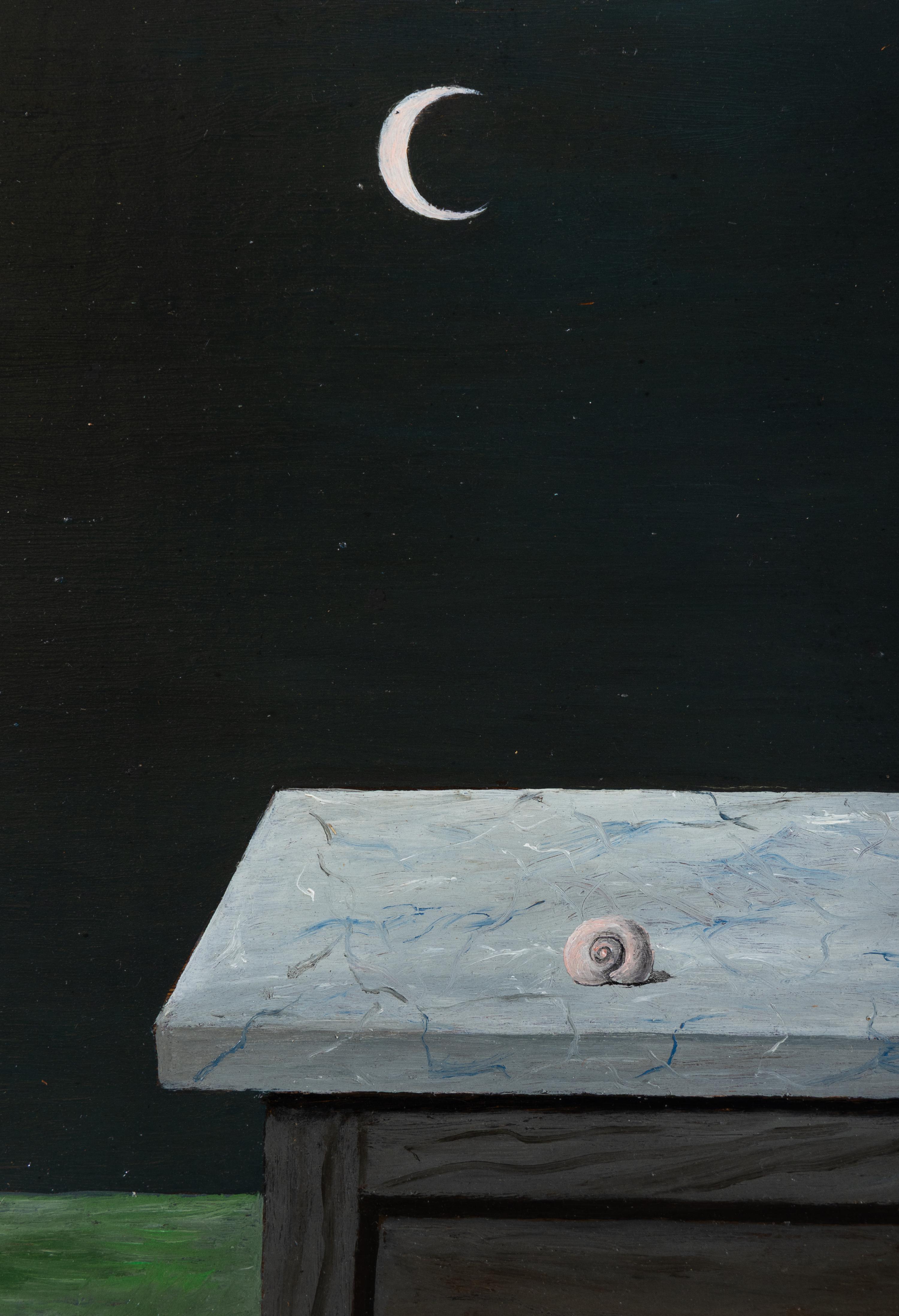
The present work, Marble Top Mystery #3, shows a young and pretty woman, nude from the waist up, emerging from a hole on the right side of the marble tabletop. The table itself, which rests on a surface of green grass, is much smaller than that in The Magician and Marble Top Table, Tree and Owl, with a small pink snail shell is set on the left side of the table and a pinkish crescent moon is in the black sky above. The composition is closely related to Marble Mystery #1 and #2, as well as a version painted in 1961 (Private Collection). In each of them the half nude woman emerges from a hole in the marble on the right side of the painting, but each of them looks quite different, and the details surrounding them are different as well. In #1, the table rests on a wood floor, two shells lay upon the table, there are two supporting panels with knobs, and a crescent moon hangs in the sky. In #2, there are three panels supporting the table that rests on grass, and the only other detail is a carnation (Abercrombie’s personal flower) that sits in a small hole in the supporting panel furthest from the woman. The woman is much larger in relation to the table, and she reaches down to pet a tiny cat sitting on the tabletop. Of these meticulously rendered marble tabletop paintings, Abercrombie wrote to her friend and fellow artist John Wilde: "Jonathan, holy cow I got such a stiff neck from doing that careful realism. May have to change back. Doing a lady coming up thru a marble top table. Semi-naked.”**
Throughout her life, Abercrombie was interested in enclosures, from the austere, impenetrable rooms she painted from the beginning of her career to the tents and shells she painted later. These are psychic self-portraits, which convey her own inescapable sense of loneliness and insecurity. She created a number of images of a woman emerging from a giant snail shell, and like the snail, is unable to fully come out without facing mortal danger. Another related theme is seen in images titled Daphne or Tree Lady in which a woman is seen appearing from a hollow tree trunk, another enclosure that prohibited true freedom. The Marble Top Mystery images resonate with these, offering no possibility of real escape from the prison created by the table. In Marble Top Mystery #3, the poignant image of a beautiful, trapped woman reminds us of the sense of isolation that Abercrombie felt that could not be overcome by crowded parties, adoring friends, or a successful career. The repetition of the pinkish color of the shell, the moon, the ribbon in her hair, the wrap, and even her nipples, as well as the shape of the shell, the moon, the breasts, the knobs and even the tiny crack in the wood paneling, pull the deceptively simple, but beautifully balanced composition, together.
The ability of Abercrombie to create images that combine fantasy, magic, and wit with profound personal feelings that resonate deeply with the viewer is what makes her work so mesmerizing. This characteristically imaginative painting links the magical idea of a woman confined in a durable and strong marble table (a table born of a dream) with the poignancy of her inability to survive, like the artist herself, outside its strong confines.
*“Artist’s Eyes: Gertrude Abercrombie,” Southeast Economist, 8 March 1972, 12.
**Robert Cozzolino, “The Sorceress in the Center of Everything,” Gertrude Abercrombie, New York, 2018.
Framed: 12 1/4 x 14 1/2 in.
Please contact fineart@freemansauction.com for a detailed condition report.
The physical condition of lots in our auctions can vary due to age, normal wear and tear, previous damage, and restoration/repair. All lots are sold "AS IS," in the condition they are in at the time of the auction, and we and the seller make no representation or warranty and assume no liability of any kind as to a lot's condition. Any reference to condition in a catalogue description or a condition report shall not amount to a full accounting of condition. Condition reports prepared by Freeman's staff are provided as a convenience and may be requested from the Department prior to bidding.
The absence of a posted condition report on the Freeman's website or in our catalogues should not be interpreted as commentary on an item's condition. Prospective buyers are responsible for inspecting a lot or sending their agent or conservator to inspect the lot on their behalf, and for ensuring that they have requested, received and understood any condition report provided by Freeman's.
Please email for any additional information or questions you may have regarding this lot.