To request further details about this lot, please email Antiquities@freemansauction.com
Please email Antiquities@freemansauction.com for any additional information or questions you may have
Sale 6523
| Chicago
| Chicago
To request further details about this lot, please email Antiquities@freemansauction.com
Please email Antiquities@freemansauction.com for any additional information or questions you may have
Estimate$80,000 – $120,000
Provenance:
Private Collection, France, 1960-1970.
Tajan, Paris, Archéologie-Arts Premiers-Art Aborigene, 17 March 2010, Lot 125.
[With French Export License]
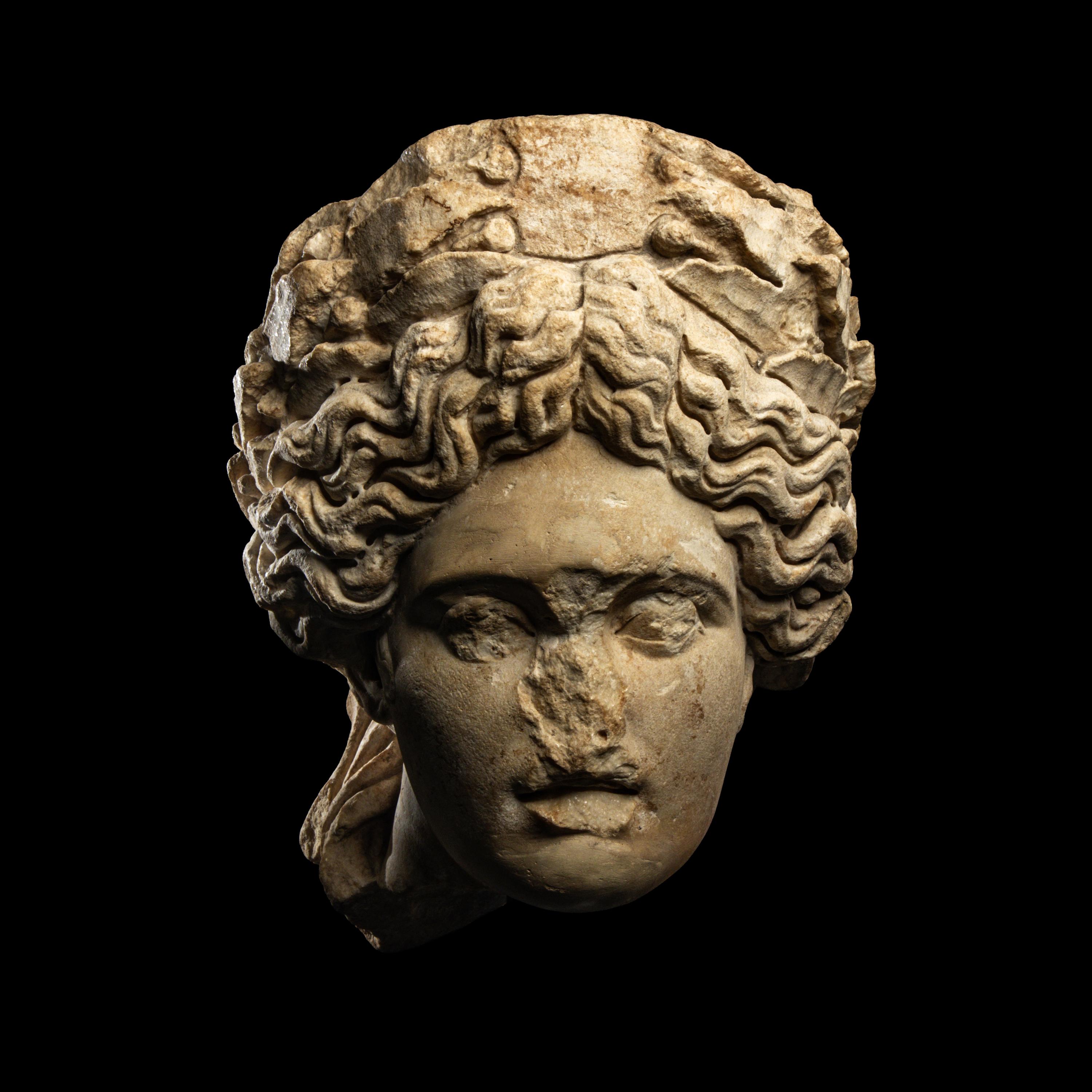
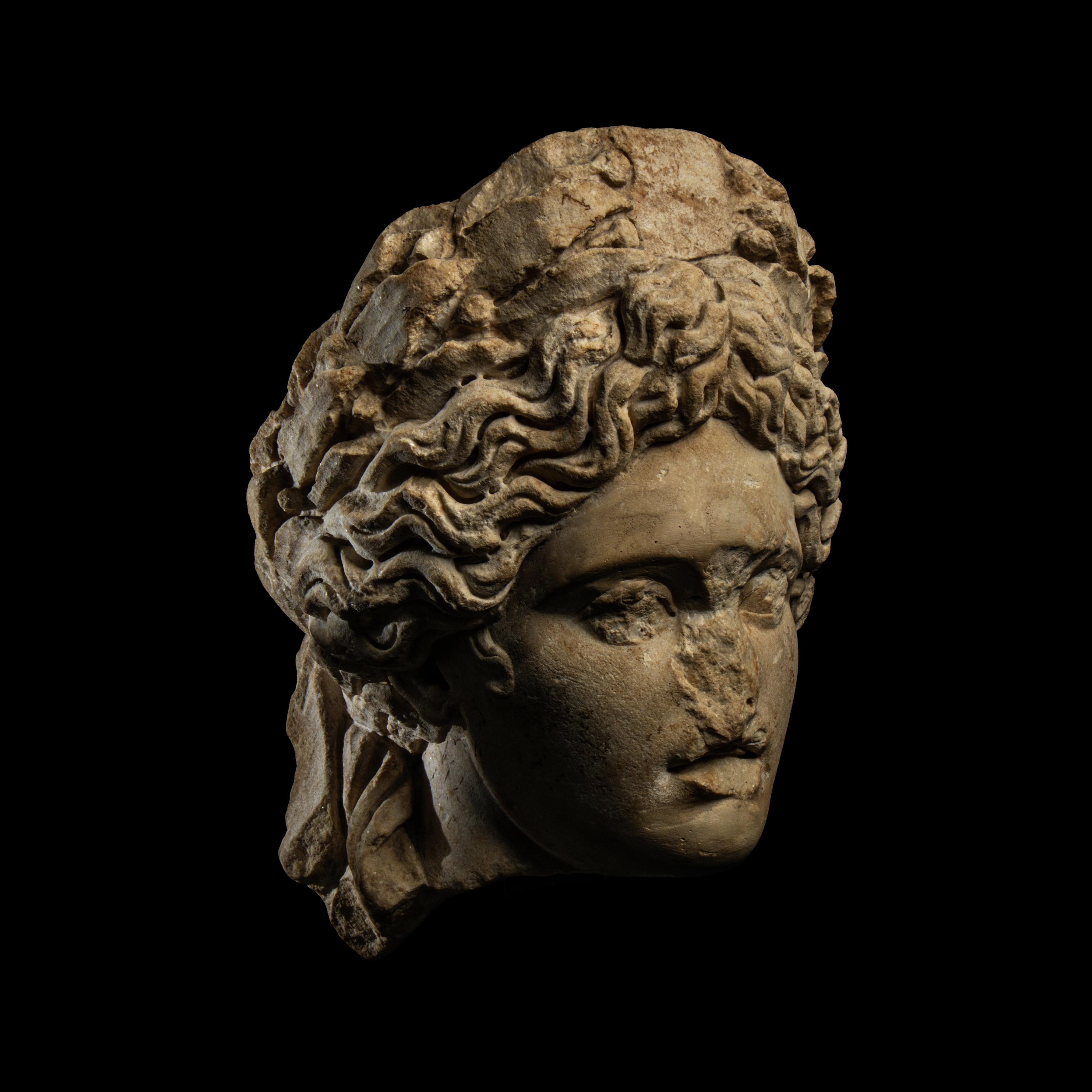
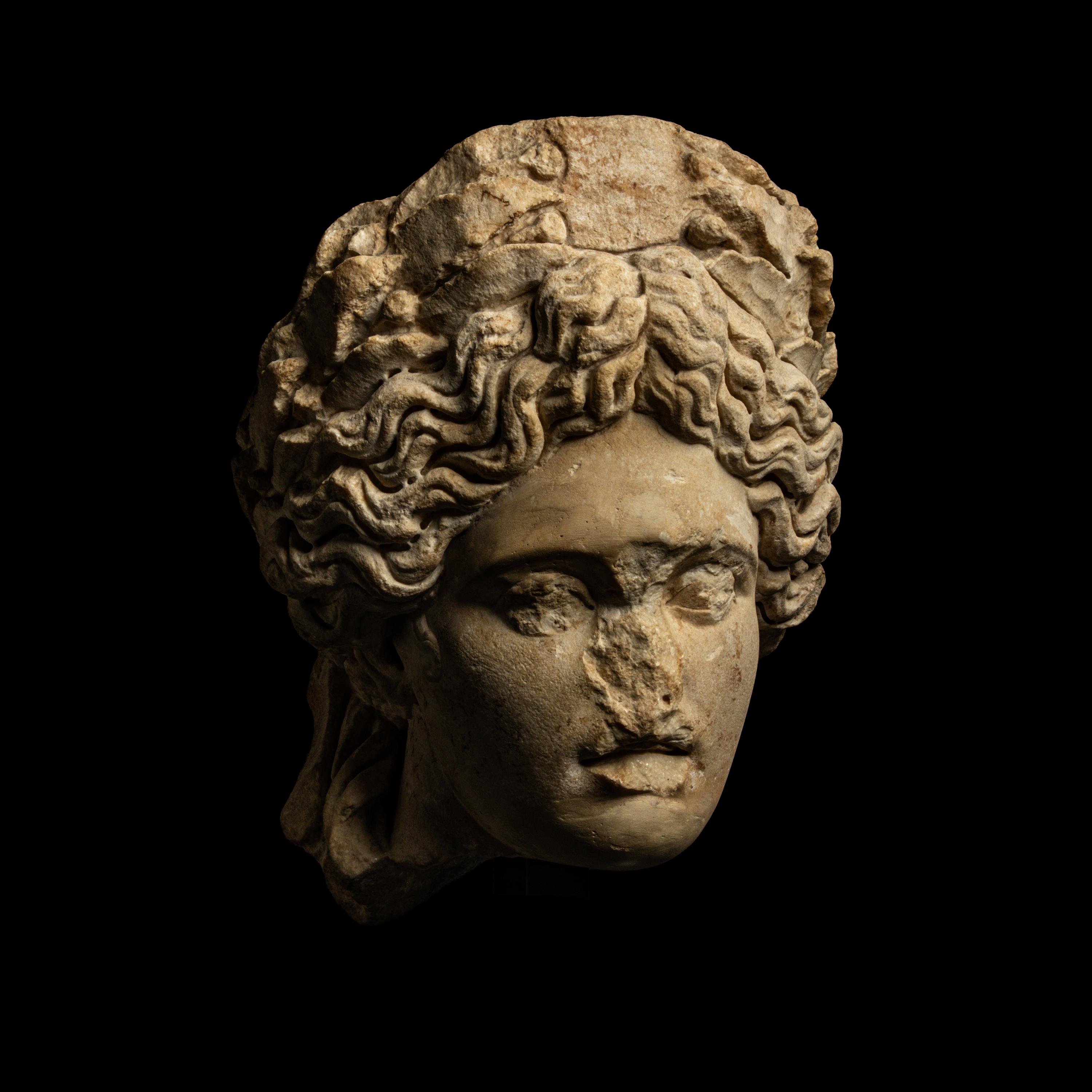
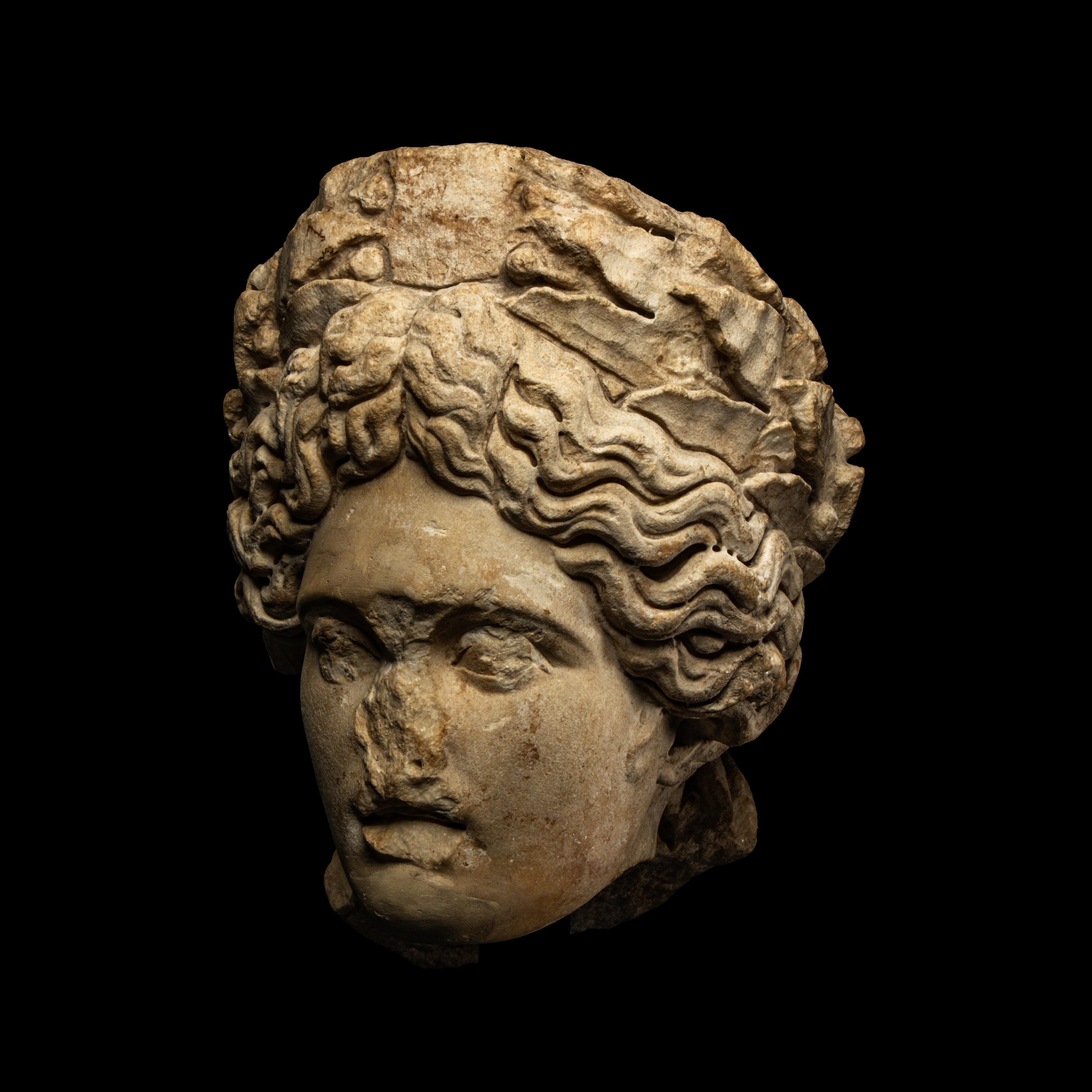
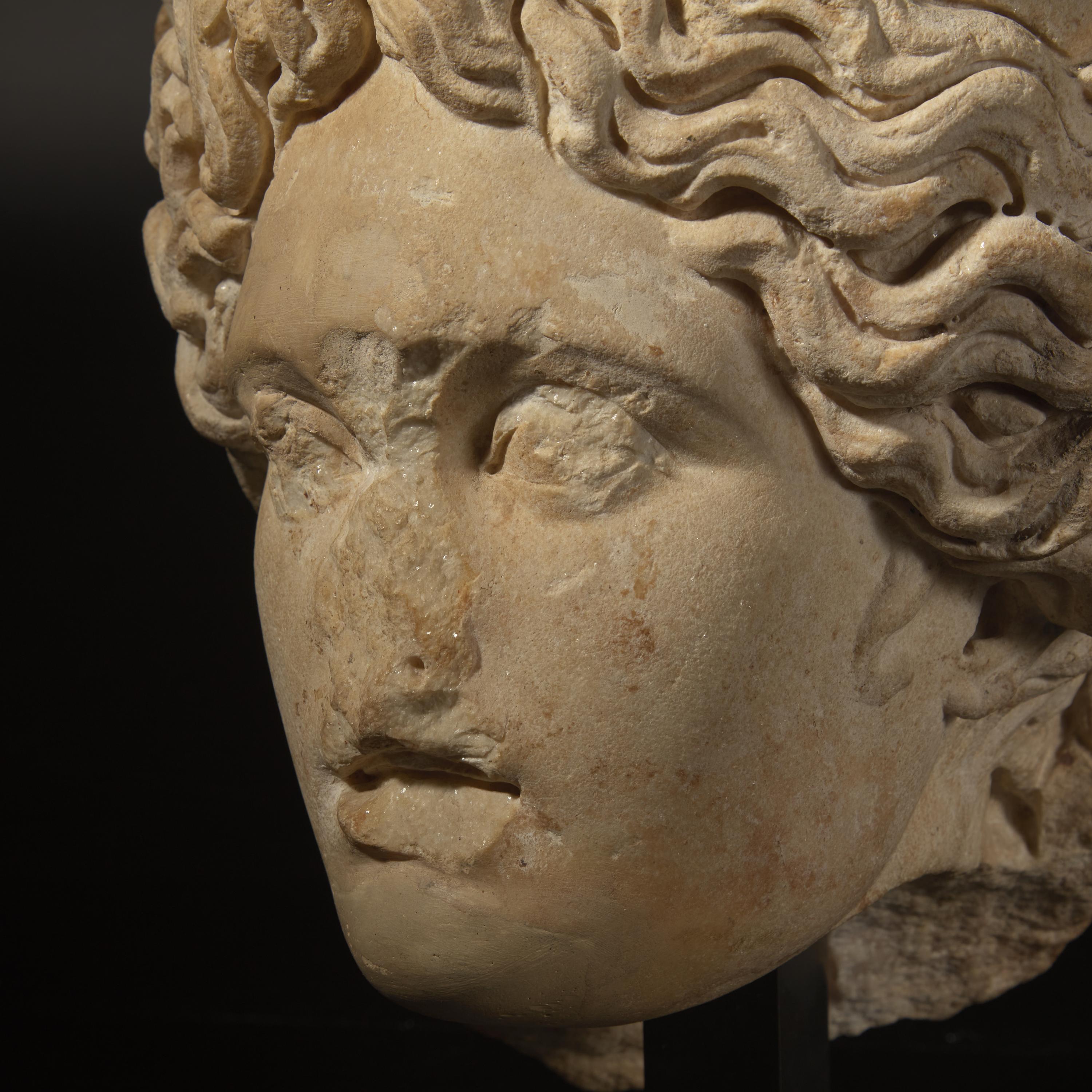
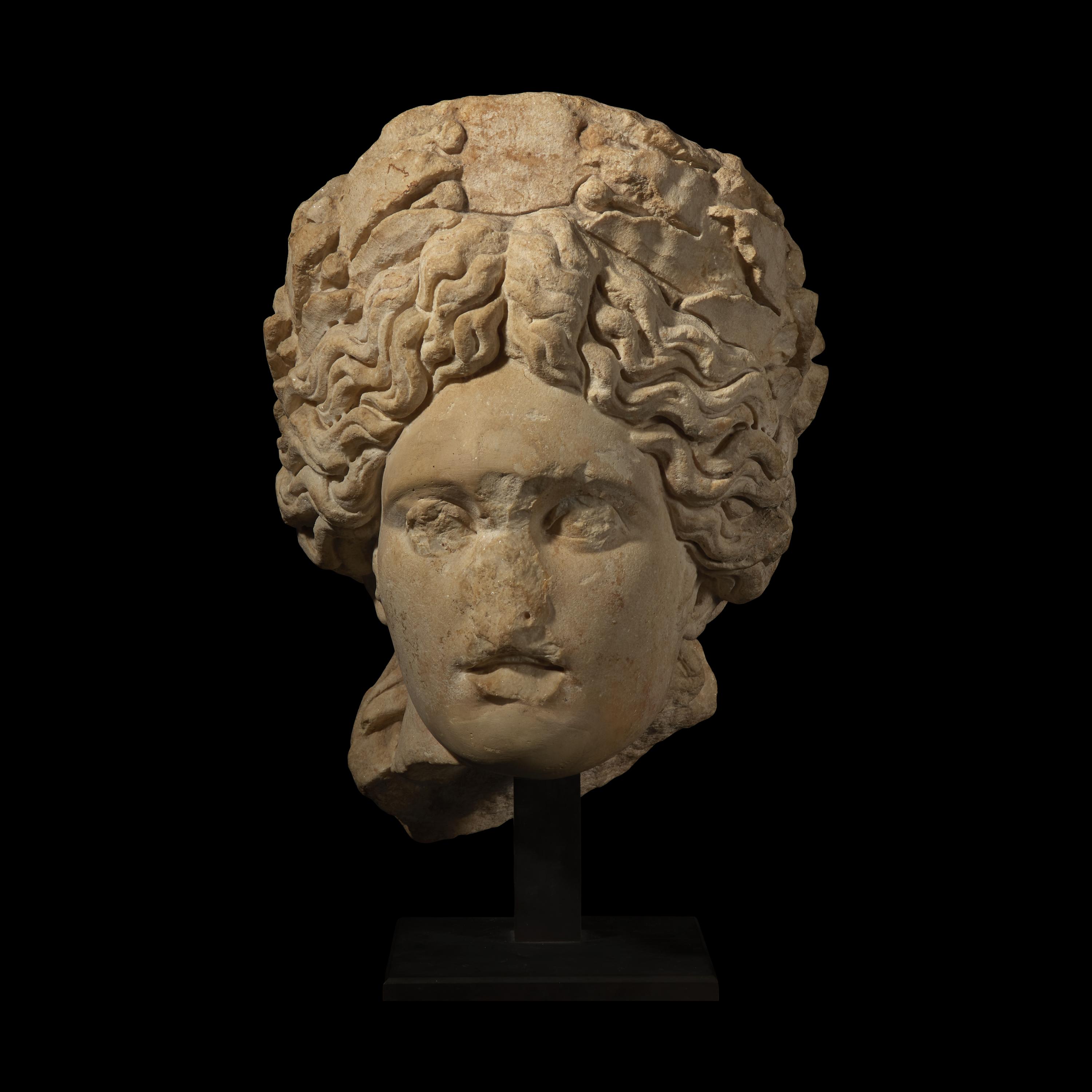
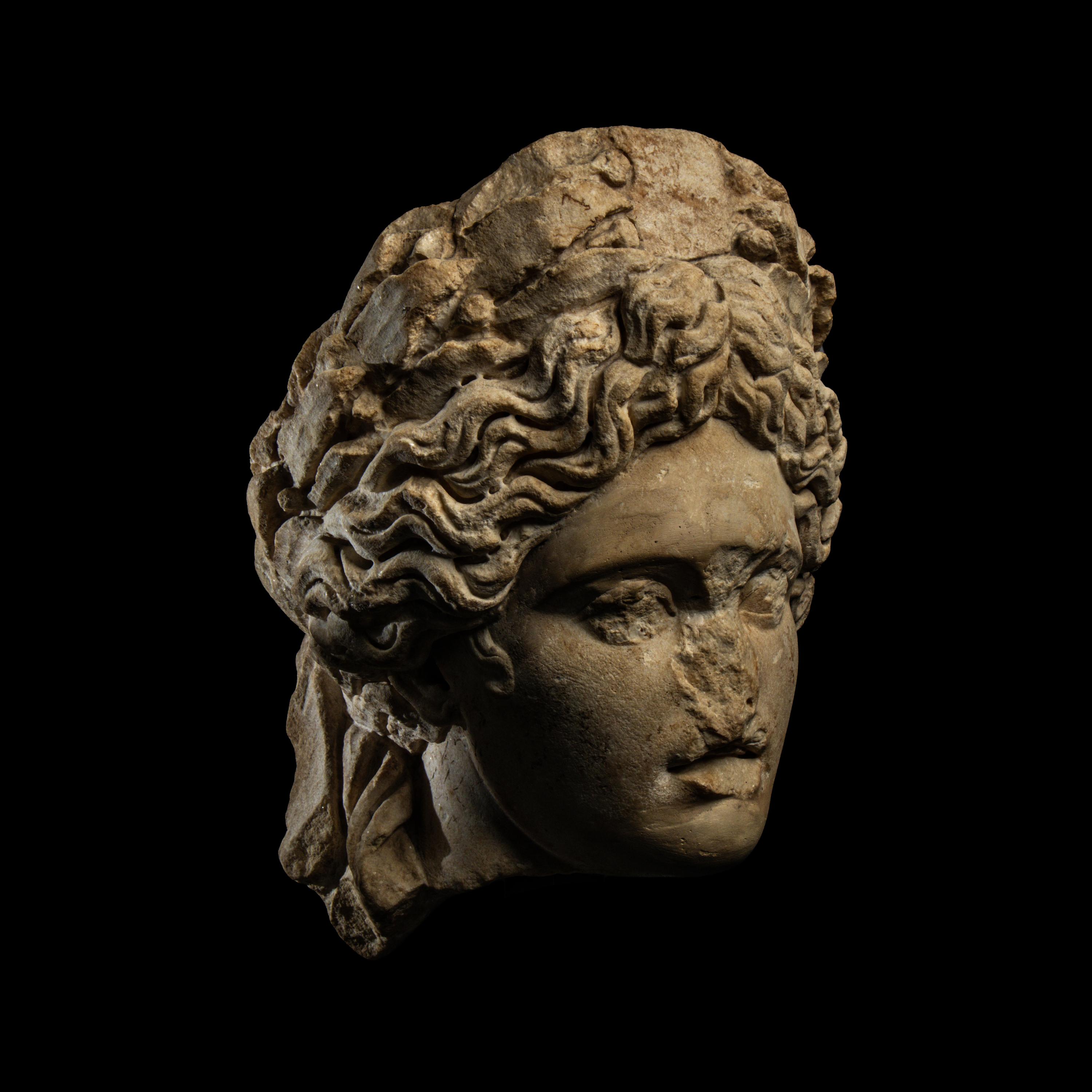
This commanding, over-life-sized marble head once formed part of a colossal cult statue of Apollo. The god is crowned with a tall laurel wreath--its branches, leaves, and berries arranged in careful symmetry from each side toward a central medallion positioned above the brows--secured at the back by a broad fillet. The hair is parted at the center and swept back in long, undulating waves to the nape, where it is gathered into a bun; loose locks, along with the trailing ends of the fillet, spill over both shoulders. A distinctive topknot rises above the forehead, formed from strands drawn up from the crown of the head, lending the coiffure its most characteristic accent.
This elaborate hairstyle made its earliest known appearance in Late Classical Greek representations of Apollo, specifically in the sculptural type referred to as the Lycean, or Lykeios, Apollo--a statue associated, though not with certainty, with either Praxiteles or Euphranor, and recorded as having stood in the Lyceum gymnasium in Athens during the fourth century B.C. Surviving replicas show a nude, youthful god resting against a support with one arm raised to his head, a gesture traditionally read as an expression of divine epiphany.
The prototype gave rise to several variants in the Hellenistic and Roman periods. In these later adaptations--collectively known as the Citharoedus type--Apollo appears holding or playing the lyre or cithara, rendered standing or seated, nude or dressed in a long chiton and belted peplos, and frequently leaning against a pillar or tree trunk. The topknot remains a consistent hallmark across these versions, at times accompanied by a laurel wreath whose central medallion might be painted, carved in relief, or inset with a stone. Colossal statues of this period were often composite works, their components--marble, gilded or painted wood, bronze, and colored stones such as porphyry--fashioned separately and assembled into a unified whole.
Despite its damaged condition, the head retains the serene, idealized beauty associated with the eternal youth of the god. The carving is of exceptional quality: slightly parted lips and precisely articulated eye corners animate the face, while the deeply cut channels separating each strand of hair--bridged by delicate struts-- produce a vivid interplay of light and shadow.
The identification of this head as an Apollo Citharoedus gains further weight when considered alongside the discovery of companion Muse statues found near Tivoli, now in the Vatican collections. Together, these works point to the original existence of a multi-figure group depicting Apollo Musagetes--Apollo as Leader of the Muses--installed in the sculptural program of a grand Roman villa.
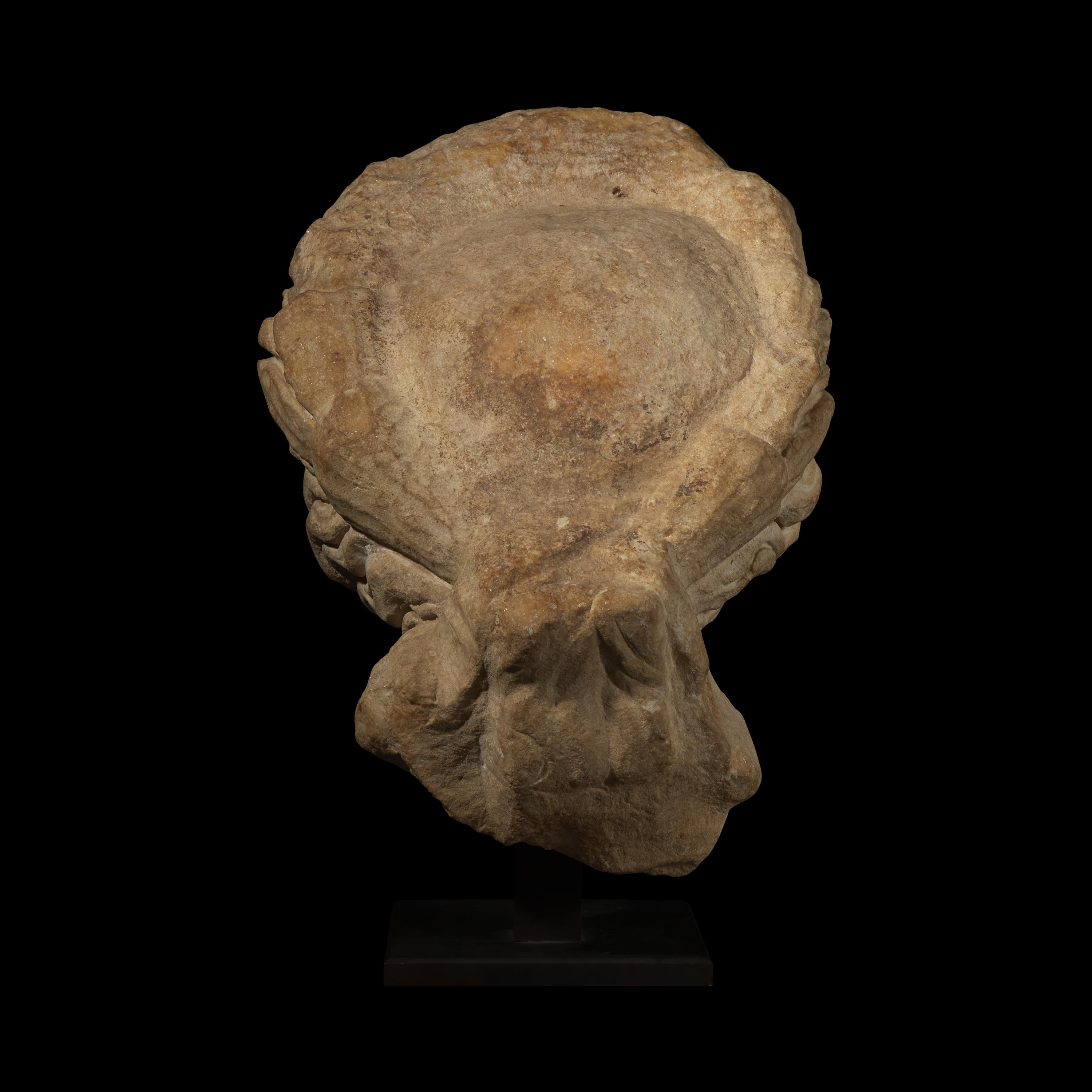
Inspected under UV light and 10x loupe. Restoration present to the chin and brow/forehead. Root marks, staining, and encrustations throughout the surface typical of age. Some loss to the diadem. Back is left unsculpted. An uneven break at the neck. Remnants of a former pinhole drilled at underside. Recessed niche at the top of the crown. Not permanently affixed to stand. Overall in very fine and attractive condition. See additional images. Head 40.6 cm (16 inches) x 29.2 cm (11 1/2 inches) x 25.4 cm (10 inches). Height with stand 17 3/4 inches (45 cm).
The physical condition of lots in our auctions can vary due to age, normal wear and tear, previous damage, and restoration/repair. All lots are sold "AS IS," in the condition they are in at the time of the auction, and we and the seller make no representation or warranty and assume no liability of any kind as to a lot's condition. Any reference to condition in a catalogue description or a condition report shall not amount to a full accounting of condition. Condition reports prepared by Freeman's staff are provided as a convenience and may be requested from the Department prior to bidding.
The absence of a posted condition report on the Freeman's website or in our catalogues should not be interpreted as commentary on an item's condition. Prospective buyers are responsible for inspecting a lot or sending their agent or conservator to inspect the lot on their behalf, and for ensuring that they have requested, received and understood any condition report provided by Freeman's.
Please email Antiquities@freemansauction.com for any additional information or questions you may have regarding this lot.