To request further details about this lot, please email Fineart@freemansauction.com
Please email Fineart@freemansauction.com for any additional information or questions you may have
Sale 6500
| New York
| New York
To request further details about this lot, please email Fineart@freemansauction.com
Please email Fineart@freemansauction.com for any additional information or questions you may have
Estimate$15,000 – $25,000
Provenance:
Metro Pictures, New York
Acquired from the above by the present owner in 2014
Lot Note
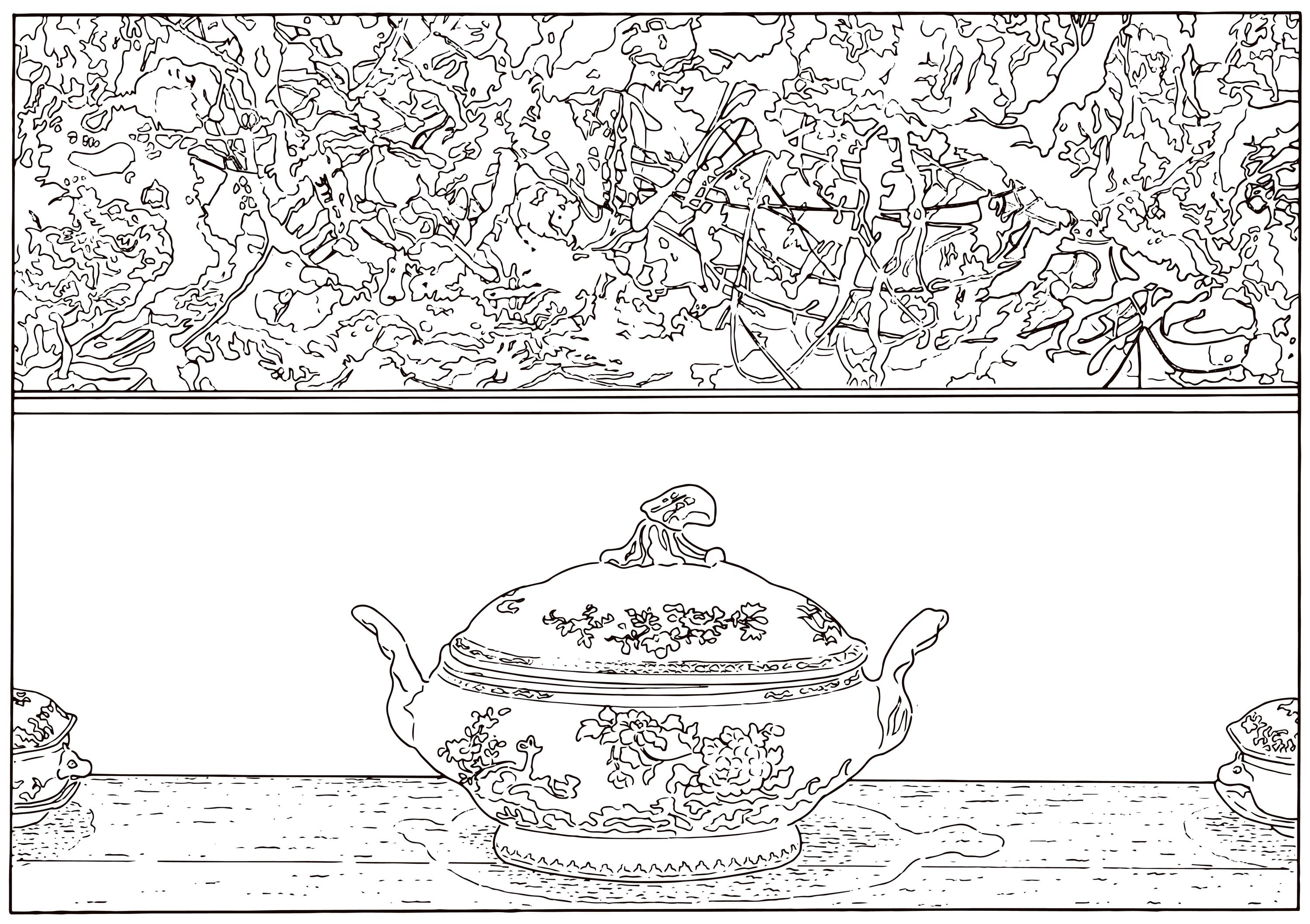
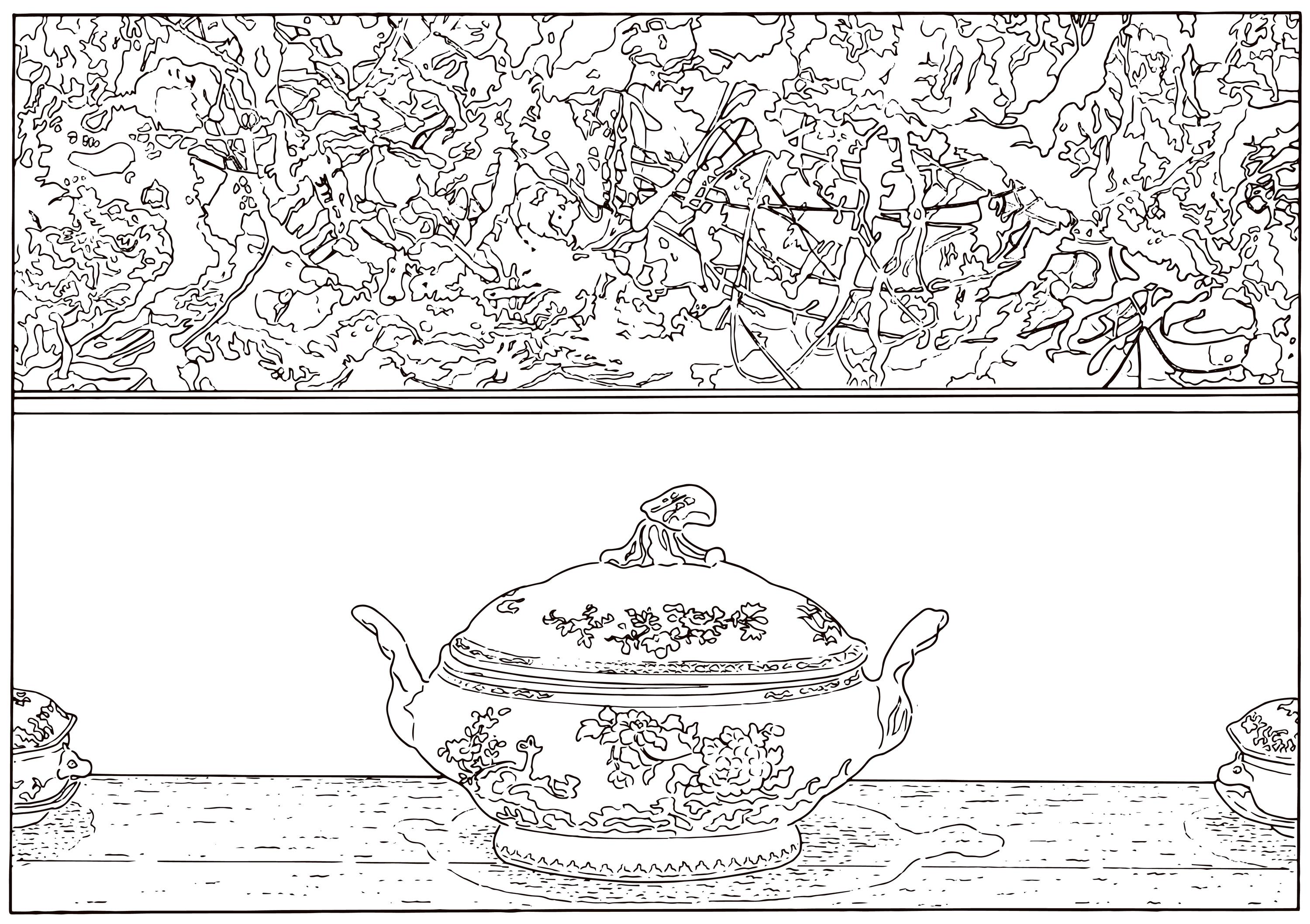
Executed in 1984 and reimagined in 2013, Pollock and Tureen (Traced) by Louise Lawler stands as a meditation on the conditions of art’s display, circulation, and meaning across the late twentieth and early twenty-first centuries. The work originates from Lawler’s seminal photograph Pollock and Tureen (1984), taken in the Connecticut home of prominent collectors Mr. and Mrs. Burton Tremaine, which was a setting that proved formative for her practice. Granted rare access to this private interior, Lawler captured a fragment of a painting by Jackson Pollock in close dialogue with an ornate porcelain tureen, collapsing distinctions between high modernist abstraction and decorative domestic objects.[1]
This seemingly incidental juxtaposition reveals Lawler’s central preoccupation: the ways in which artworks accrue meaning not in isolation, but through their physical, social, and economic contexts. Emerging alongside the Pictures Generation, Lawler belongs to a group of artists who interrogated authorship, reproduction, and the circulation of images. Rather than producing autonomous objects, she turned her lens toward artworks already embedded within systems of ownership and display, exposing what she has described as the “arrangements” that shape aesthetic experience.[2] In Pollock and Tureen, the gestural intensity of Pollock’s abstraction is subtly aestheticized- domesticated, even- by its proximity to a refined household object, implicating taste, class, and the collecting impulse itself.[3]
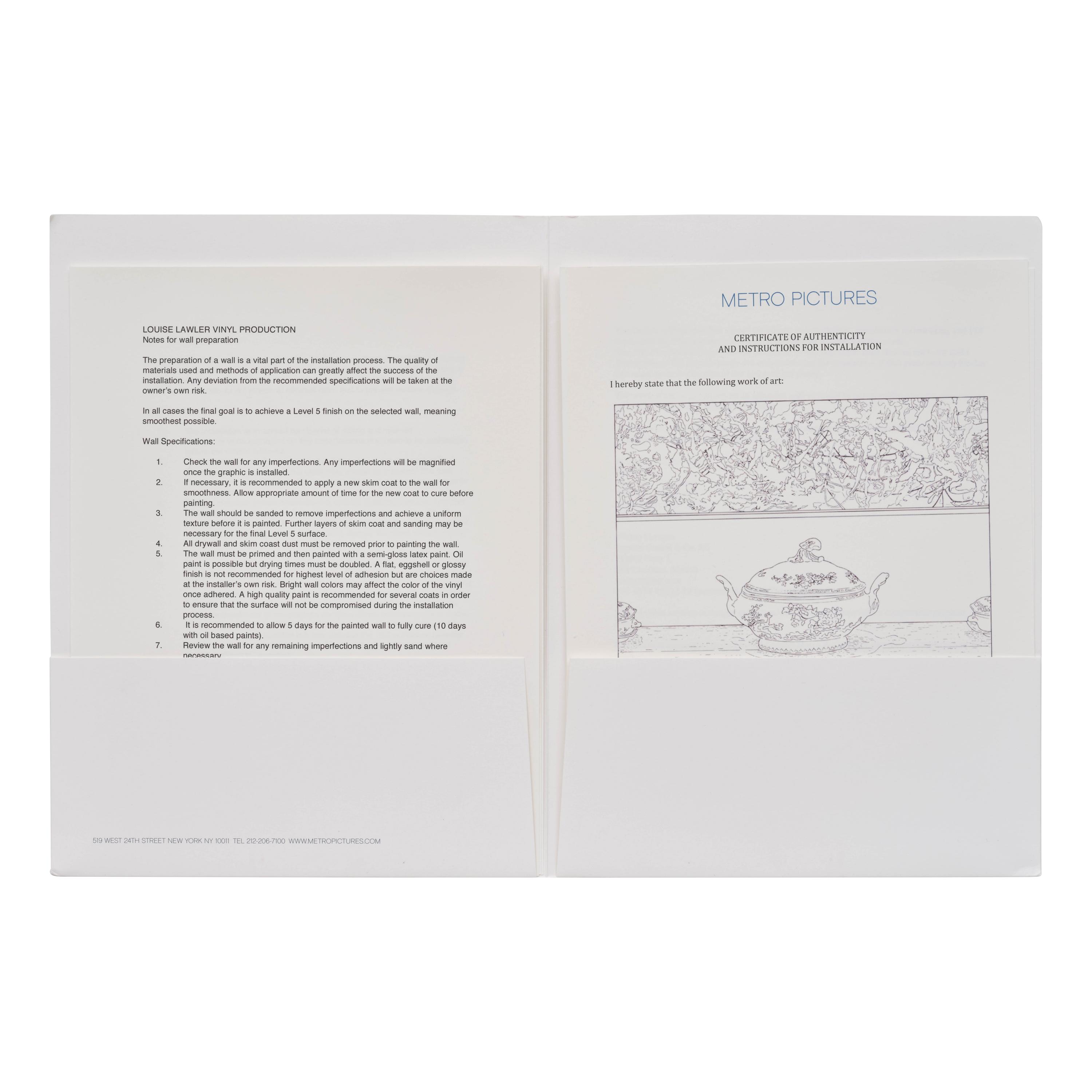
The 2013 “traced” iteration marks a critical evolution in Lawler’s practice. Translated into a large-scale vinyl line drawing, the image is stripped of tonal nuance, color, and photographic specificity, leaving behind a ghostly outline of the original composition. This act of reduction both distances and reactivates the earlier work: removed from its site-specific origins, the image becomes newly mobile, adaptable to architectural space, and open to reinterpretation.[4] Lawler’s tracings underscore her long-standing interest in the fluidity of images- their capacity to be reformatted, resized, and recontextualized over time- while simultaneously foregrounding questions of authorship and originality in an era of mechanical and digital reproduction.
Situated within a broader framework of institutional critique associated with figures such as Marcel Duchamp, Lawler’s practice is distinguished by its restraint and precision. Rather than overtly dismantling systems of display and value, she renders them visible through subtlety and visual wit in framing and juxtaposition. Pollock and Tureen (Traced) reflects this approach, engaging with conditions that now define contemporary art- global circulation, the primacy of installation context, and the fluid afterlives of images across media.[5]
Today, as artworks are increasingly encountered through screens, art fairs, and digitally mediated platforms, Lawler’s practice feels especially resonant. The “traced” format anticipates a dematerialized visual culture in which images are endlessly translated and re-presented, often detached from their original settings. In this light, Pollock and Tureen (Traced) is not merely a reflection on the art world of the 1980s, but a work that continues to speak to present-day questions of value, visibility, and the constructed nature of aesthetic experience. Both historically significant and strikingly contemporary, it encapsulates Lawler’s enduring contribution to a critical understanding of how- and where- we encounter art.
[1] The Museum of Modern Art, Louise Lawler: Pollock and Tureen (Traced), 2013; The Metropolitan Museum of Art, collection notes on Lawler
[2] Douglas Crimp, “Pictures,” October, 1977; MoMA exhibition materials on Lawler
[3] The Metropolitan Museum of Art
[4] Ibid.
[5] Alexander Alberro, Conceptual Art and the Politics of Publicity, 2003; The Museum of Modern Art
The physical condition of lots in our auctions can vary due to age, normal wear and tear, previous damage, and restoration/repair. All lots are sold "AS IS," in the condition they are in at the time of the auction, and we and the seller make no representation or warranty and assume no liability of any kind as to a lot's condition. Any reference to condition in a catalogue description or a condition report shall not amount to a full accounting of condition. Condition reports prepared by Freeman's staff are provided as a convenience and may be requested from the Department prior to bidding.
The absence of a posted condition report on the Freeman's website or in our catalogues should not be interpreted as commentary on an item's condition. Prospective buyers are responsible for inspecting a lot or sending their agent or conservator to inspect the lot on their behalf, and for ensuring that they have requested, received and understood any condition report provided by Freeman's.
Please email Fineart@freemansauction.com for any additional information or questions you may have regarding this lot.