To request further details about this lot, please email Fineart@freemansauction.com
Please email Fineart@freemansauction.com for any additional information or questions you may have
Sale 6500
| New York
| New York
To request further details about this lot, please email Fineart@freemansauction.com
Please email Fineart@freemansauction.com for any additional information or questions you may have
Estimate$100,000 – $150,000
Provenance:
Leo Castelli Gallery, New York
Dwan Gallery, Los Angeles
Private Collection, Santa Monica, 1966
[Garrick Fine Arts, c/o S. Gary Hoffman, Director]
Private Collection, Philadelphia, 1975
Exhibited:
Los Angeles, California, Dwan Gallery, Rauschenberg at Dwan, April - May 1965
Seattle, Washington, University of Washington, Henry Gallery, Drawings by Americans: Recent Works by Thirteen Contemporary Artists, February 12 - March 19, 1967
Literature:
Henry Gallery and Junior League of Seattle, Drawings by Americans: Recent Work by Thirteen Contemporary Artists, The Gallery, 1967 (illustrated, pg. 43), exh. cat.
Lot note:
One of the most influential figures in Post-War American art, Robert Rauschenberg (1925–2008) first experimented with the solvent transfer technique during a trip to Cuba in 1952. By 1958, this experiment became a fully developed practice that would define much of his early career, lasting through 1969.
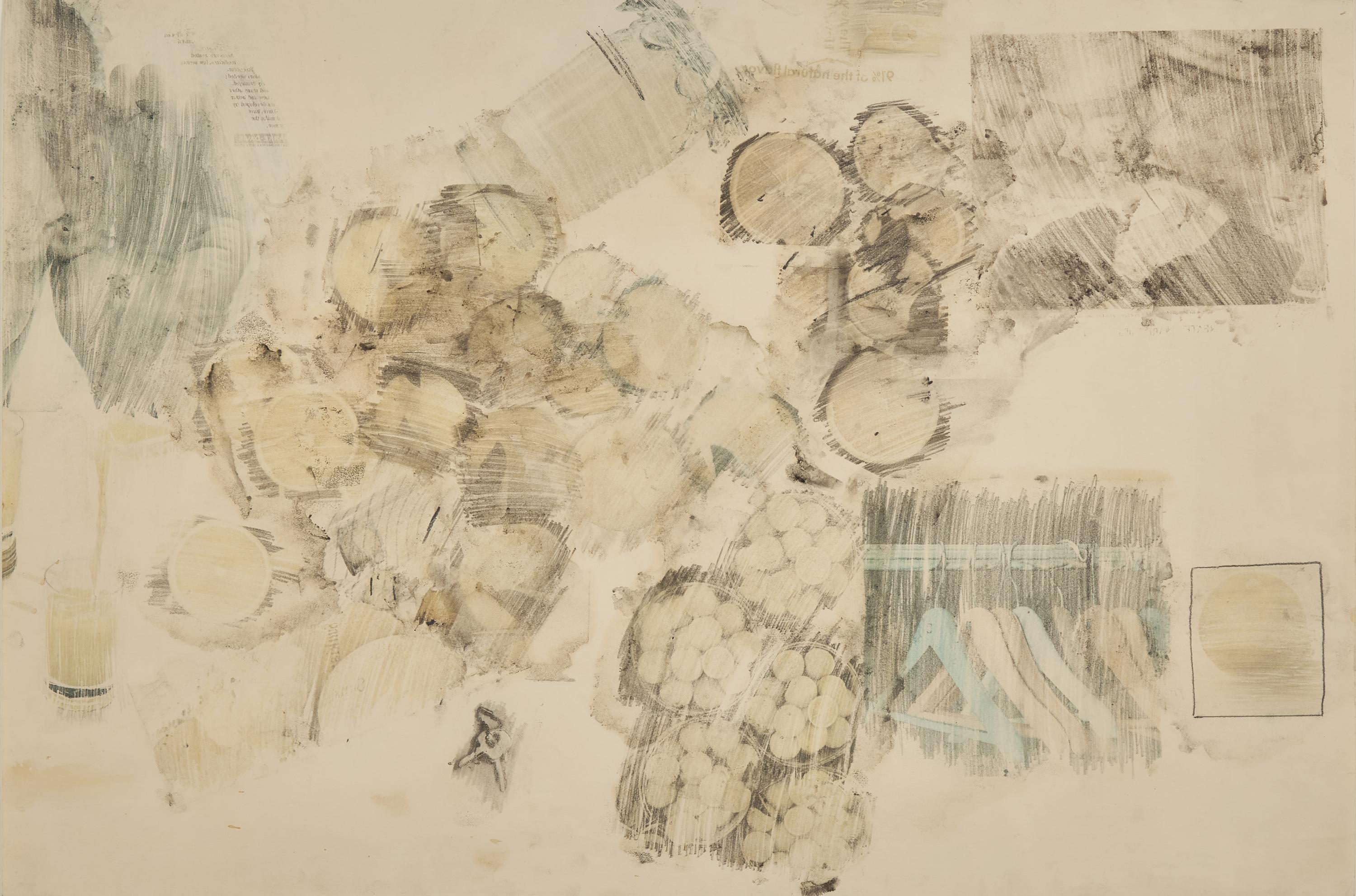
The method involved soaking printed media images in turpentine or lighter fluid, placing them face down on paper, and rubbing across the back with a dry pen nib or pencil to release the image. The results collapse the handmade and the readymade into a single surface. This dynamic was precisely what Rauschenberg was after — as he explained: "I felt I had to find a way to use collage in drawing, to incorporate my own way of working on that intimate scale."
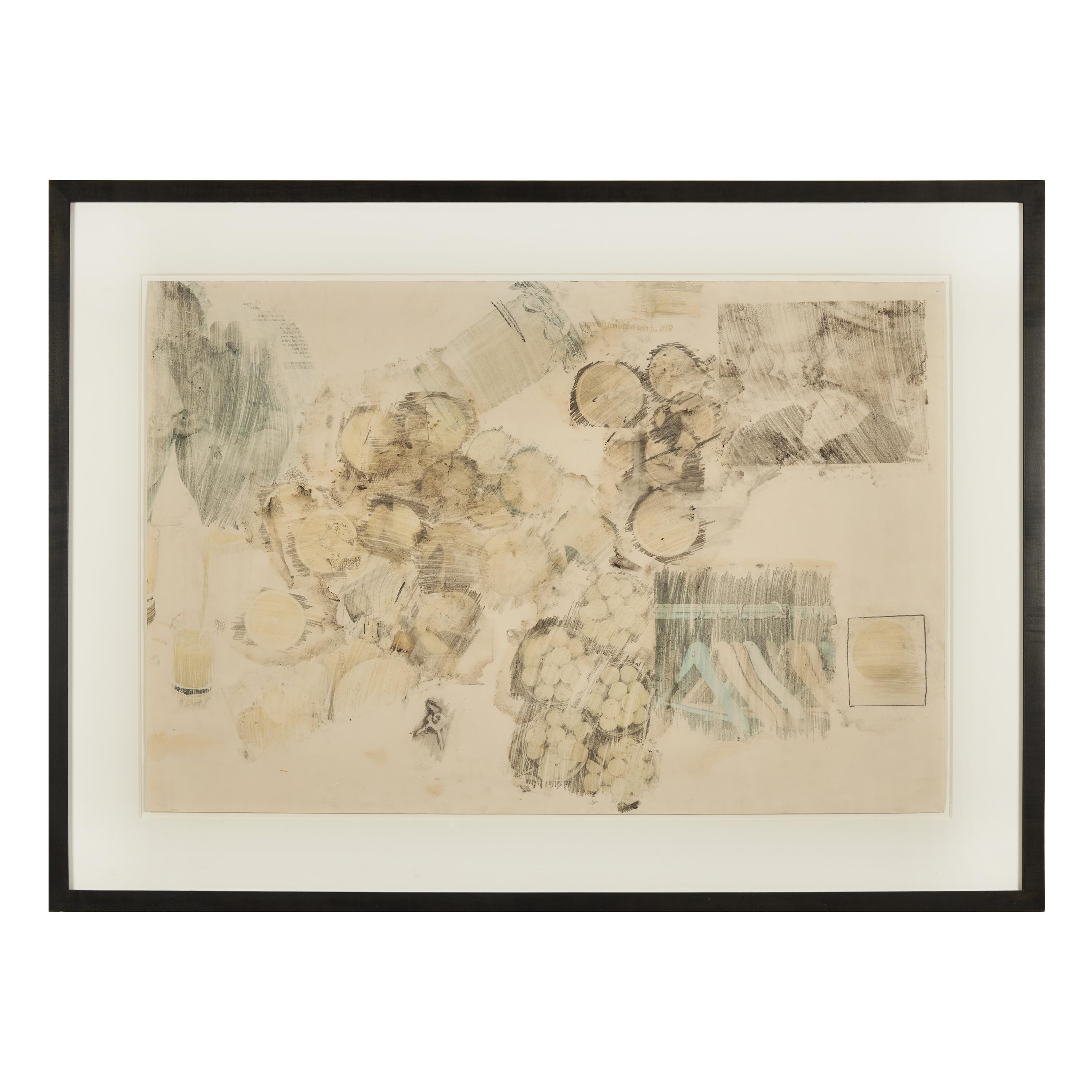
Battery (1965) is a compelling example of this technique at its most playful and associative. Scattered across the sheet, citrus fruits mingle with fragments of everyday objects like keys and hangers, while vigorous pencil strokes animate the surface, leaving the trace of Rauschenberg's hand unmistakably present. The source imagery is characteristically sly: a partial bottle label reading "91% of natural flavors" quietly reveals itself in the upper center, while at the upper left, an image of a hand cupping an ear, as if in anticipation of a whispered secret, is accompanied by a fragmented text bearing the pharmaceutical company name "Parke-Davis."
Rauschenberg regularly chose verbally ambiguous titles for his artwork, encouraging both a literal and a metaphoric reading of the imagery in his work. The present title, Battery, invites a comparison between the acidity of citrus fruits and that of battery acid, or more symbolically, citrus as a source of bodily energy and acid as a charge — fruit, in other words, as its own battery.
Framed: 33 x 45 inches.
Please contact fineart@freemansauction.com for a detailed condition report.
The physical condition of lots in our auctions can vary due to age, normal wear and tear, previous damage, and restoration/repair. All lots are sold "AS IS," in the condition they are in at the time of the auction, and we and the seller make no representation or warranty and assume no liability of any kind as to a lot's condition. Any reference to condition in a catalogue description or a condition report shall not amount to a full accounting of condition. Condition reports prepared by Freeman's staff are provided as a convenience and may be requested from the Department prior to bidding.
The absence of a posted condition report on the Freeman's website or in our catalogues should not be interpreted as commentary on an item's condition. Prospective buyers are responsible for inspecting a lot or sending their agent or conservator to inspect the lot on their behalf, and for ensuring that they have requested, received and understood any condition report provided by Freeman's.
Please email Fineart@freemansauction.com for any additional information or questions you may have regarding this lot.