To request further details about this lot, please email adriannewolkenberg@freemansauction.com
Please email adriannewolkenberg@freemansauction.com for any additional information or questions you may have
Sale 6494
| New York
| New York
To request further details about this lot, please email adriannewolkenberg@freemansauction.com
Please email adriannewolkenberg@freemansauction.com for any additional information or questions you may have
Estimate$50,000 – $80,000
The present lot will be included in the catalogue raisonné of Gabriele Münter 's paintings published by the Gabriele Münter and Johannes Eichner Foundation, under No. 19b.
Provenance:
Dalzell Hatfield Galleries, Los Angeles, California.
Exhibited:
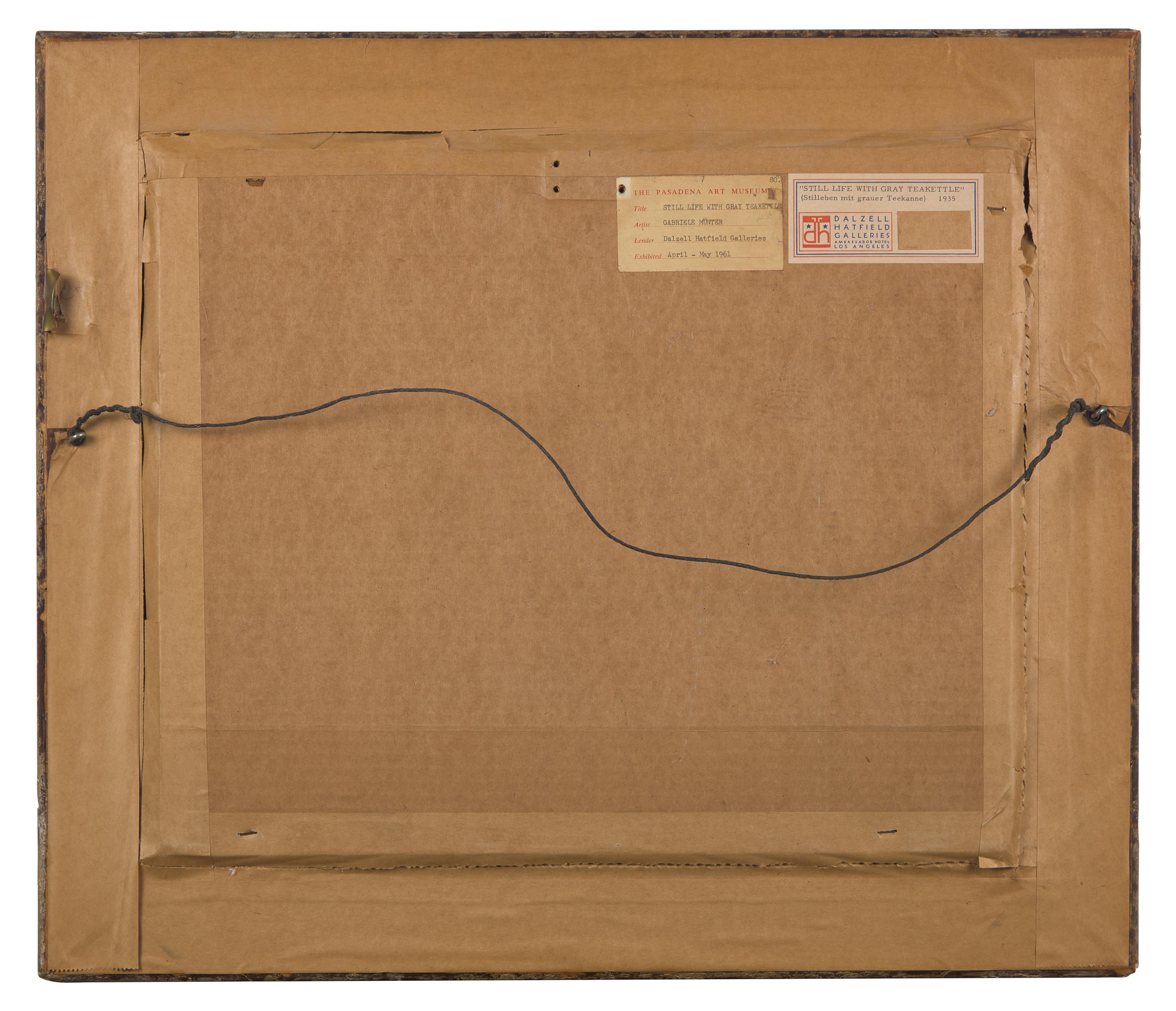
Pasadena, California, The Pasadena Art Museum, German Expressionism, April 23 - June 4, 1961.
Lot Essay:
Gabriele Münter was once described by Johannes Eichner, her companion from the late 1920s onwards, as an artistic tabula rasa, "not burdened by the prejudices of tradition or by the passing taste of times" (Kandinsky und Gabriele Münter: Von Ursprüngen moderner Kunst, Munich, 1957). This statement not only emphasizes Münter as committed to a self-developed stylistic vocabulary, but also as an artist keen to distill inner truth and personal reality from the mundane and the ordinary. Alongside fellow artists Marianne von Werefkin, Alexej von Jawlensky, and Wassily Kandinsky, Münter was a founding member of The New Artists' Association in Munich in 1909. It was here that the artist adopted her individualistic approach to subject matter, concentrating on still-life and portraiture in a scale that depicted the every day, rather than the grand metaphysical interpretations expressed by the other members of the group.
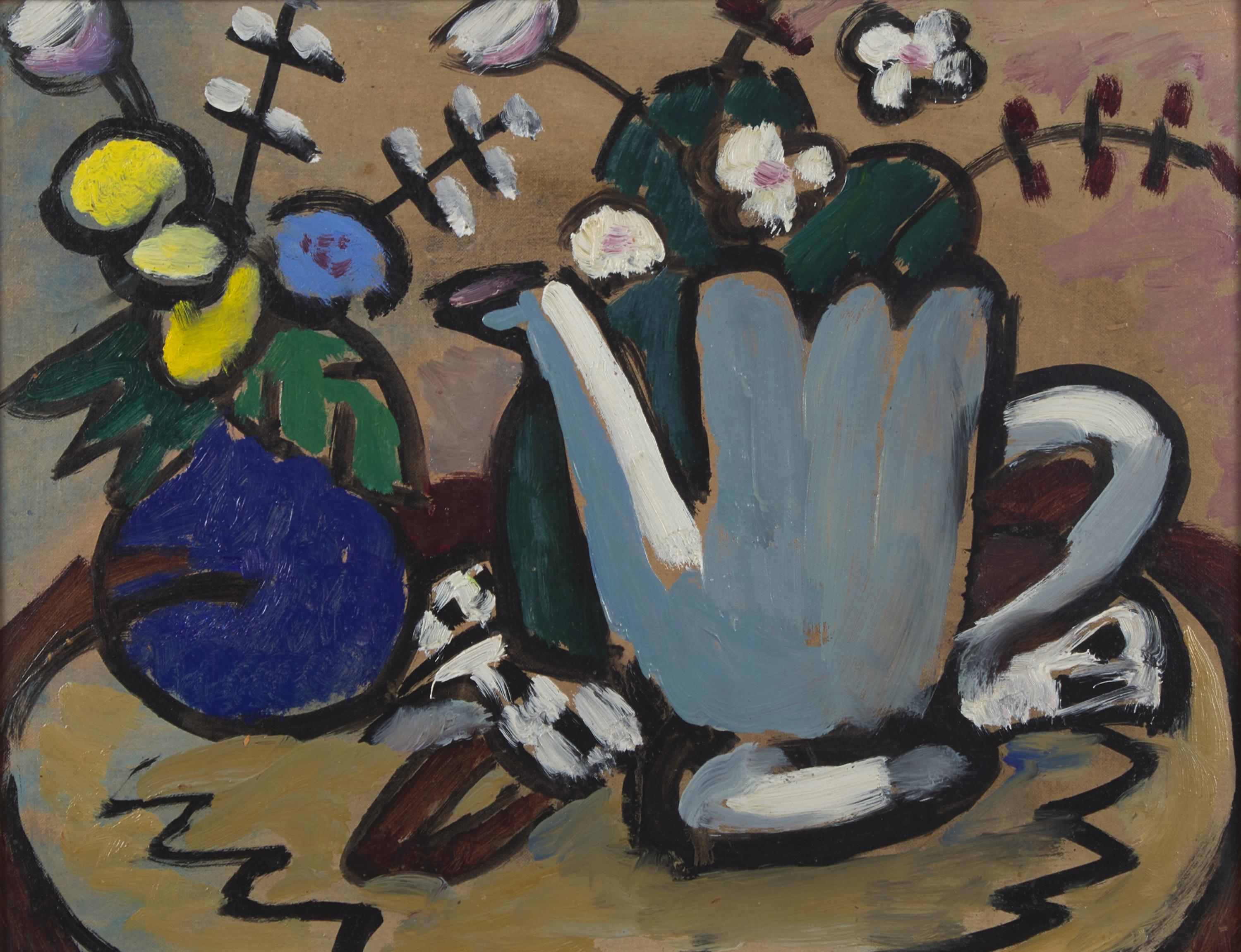
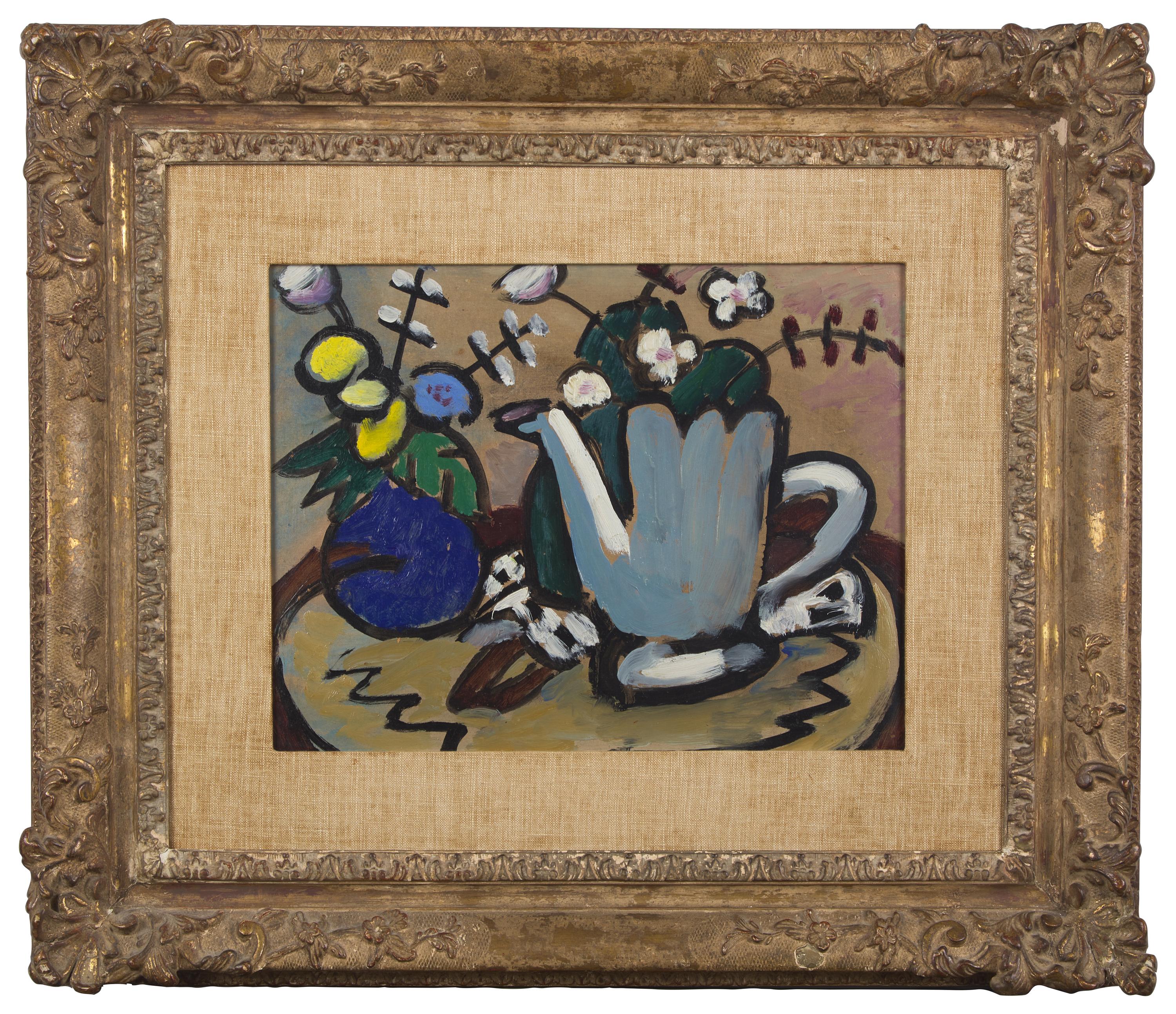
Still Life with Gray Teakettle (Stilleben mit grauer Teekanne), 1935, is a noteworthy example of how the still life was integral to Münter's oeuvre. Traditionally, the still life was viewed as a feminine genre, a view that the artist challenged, inspired perhaps by the great role still life played in contemporary French avant-garde painting. She absorbed the influences of Henri Matisse, Vincent van Gogh, and Paul Gauguin to create similar effects, but in her own style. Additionally, in Murnau, where she had a house from 1931 onwards, the artist found a source of inspiration for her still lifes in the local naïve art of reverse glass paintings particular to the area. The simple forms and bold outlines characterized by the reverse glass painting, combined with the influence of both the Expressionists and the Impressionists, translated into Münter’s unique use of flattened forms and the encapsulation of color with heavy black line.
In the present work, the thick black lines bring the tea kettle, flower arrangements, and table into unusual visual focus, with each item gaining a form of independent existence. Drawing from Der Blaue Reiter belief in the symbolic nature of color, the everyday objects, with their vibrant, pulsating palette of blues, yellows, grays, and greens in a thickly worked impasto, stand apart from each other not through perspective but by subtle variations in the musicality – the “essence” – of their tone. It is a demonstration of Münter's unique ability to produce visionary poetry gleaned from the most ordinary of possessions.
Framed: 20 x 23 1/2 x 2 1/2 in.
In overall very good condition, with minor deposits of surface dirt and dust (heavier deposits on the framing materials). The corners of the board are very slightly creased (only truly visible when the work is unframed). Slight abrasions along the upper right edge and upper center (again, only noticeable when the work is framed - due to frame rubbing likely). With a very bright, luminous palette overall, thinly applied throughout. The whites are very pure. The background is textured (due to the board itself) and slightly shiny. We notice some rubbing, and very minor pinpoints of surface soiling (in the upper left quadrant in between the branches of the still life). Examination under UV does not reveal any sign of inpainting. We notice light areas of fluorescence, which are due to the pigments used by the artist rather than a sign of any restoration. Additional images available upon request.
The physical condition of lots in our auctions can vary due to age, normal wear and tear, previous damage, and restoration/repair. All lots are sold "AS IS," in the condition they are in at the time of the auction, and we and the seller make no representation or warranty and assume no liability of any kind as to a lot's condition. Any reference to condition in a catalogue description or a condition report shall not amount to a full accounting of condition. Condition reports prepared by Freeman's staff are provided as a convenience and may be requested from the Department prior to bidding.
The absence of a posted condition report on the Freeman's website or in our catalogues should not be interpreted as commentary on an item's condition. Prospective buyers are responsible for inspecting a lot or sending their agent or conservator to inspect the lot on their behalf, and for ensuring that they have requested, received and understood any condition report provided by Freeman's.
Please email adriannewolkenberg@freemansauction.com for any additional information or questions you may have regarding this lot.