To request further details about this lot, please email madalinalazen@hindmanauctions.com

Madalina Lazen
VP Head of Department, Old Masters & 19th Century European Art
Sale 6335
| Chicago
| Chicago
To request further details about this lot, please email madalinalazen@hindmanauctions.com
Madalina Lazen
VP Head of Department, Old Masters & 19th Century European Art
Estimate$60,000 – $100,000
We are grateful to the Galerie Brame & Lorenceau for having confirmed the authenticity of the work. It will be included in the upcoming digital catalog critique of the artist.
Provenance:
The Collection of Joseph Raymond Fazzano, Providence, Rhode Island, acquired circa 1950s
By descent in the family to the present owner
Lot essay:
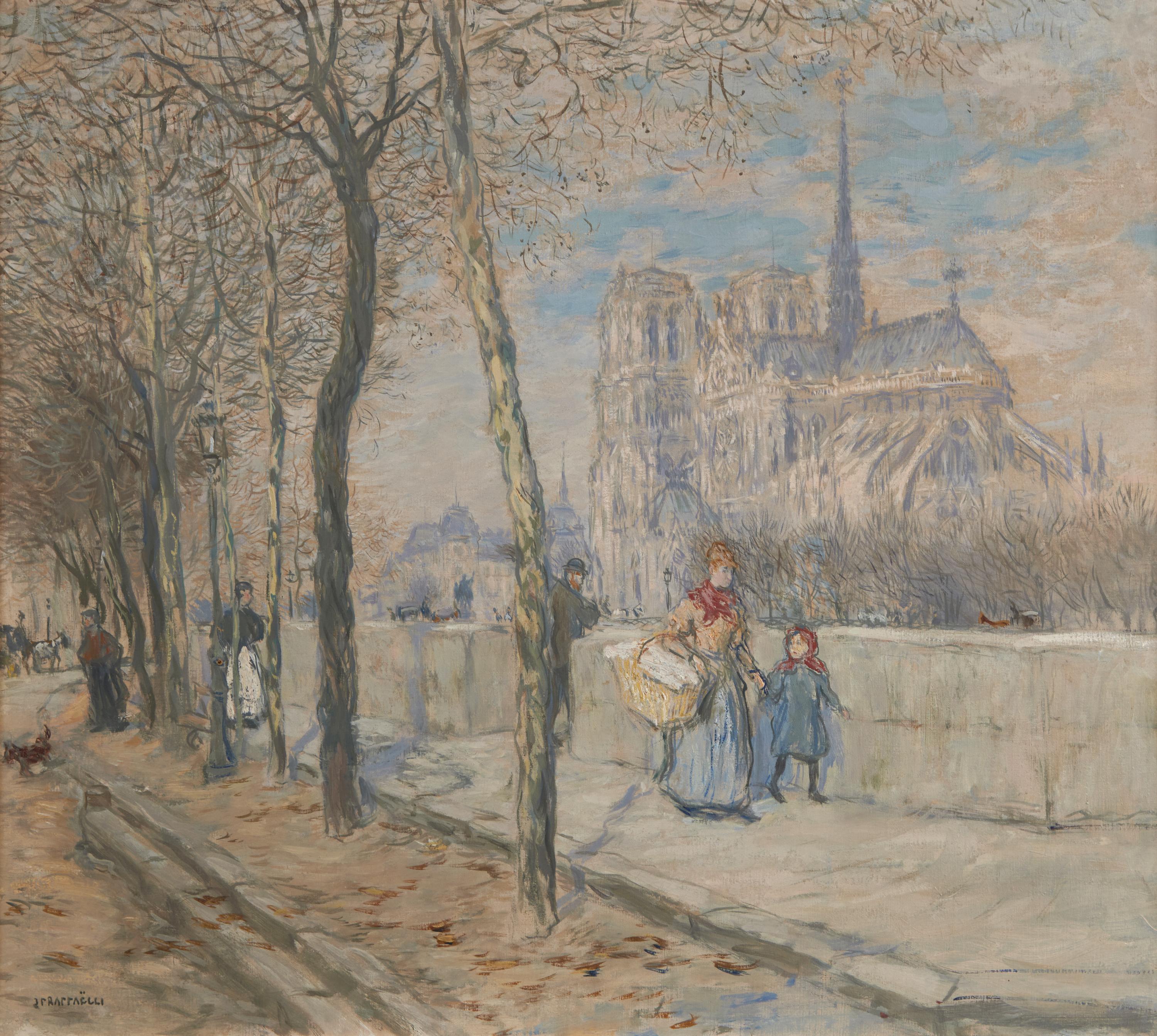
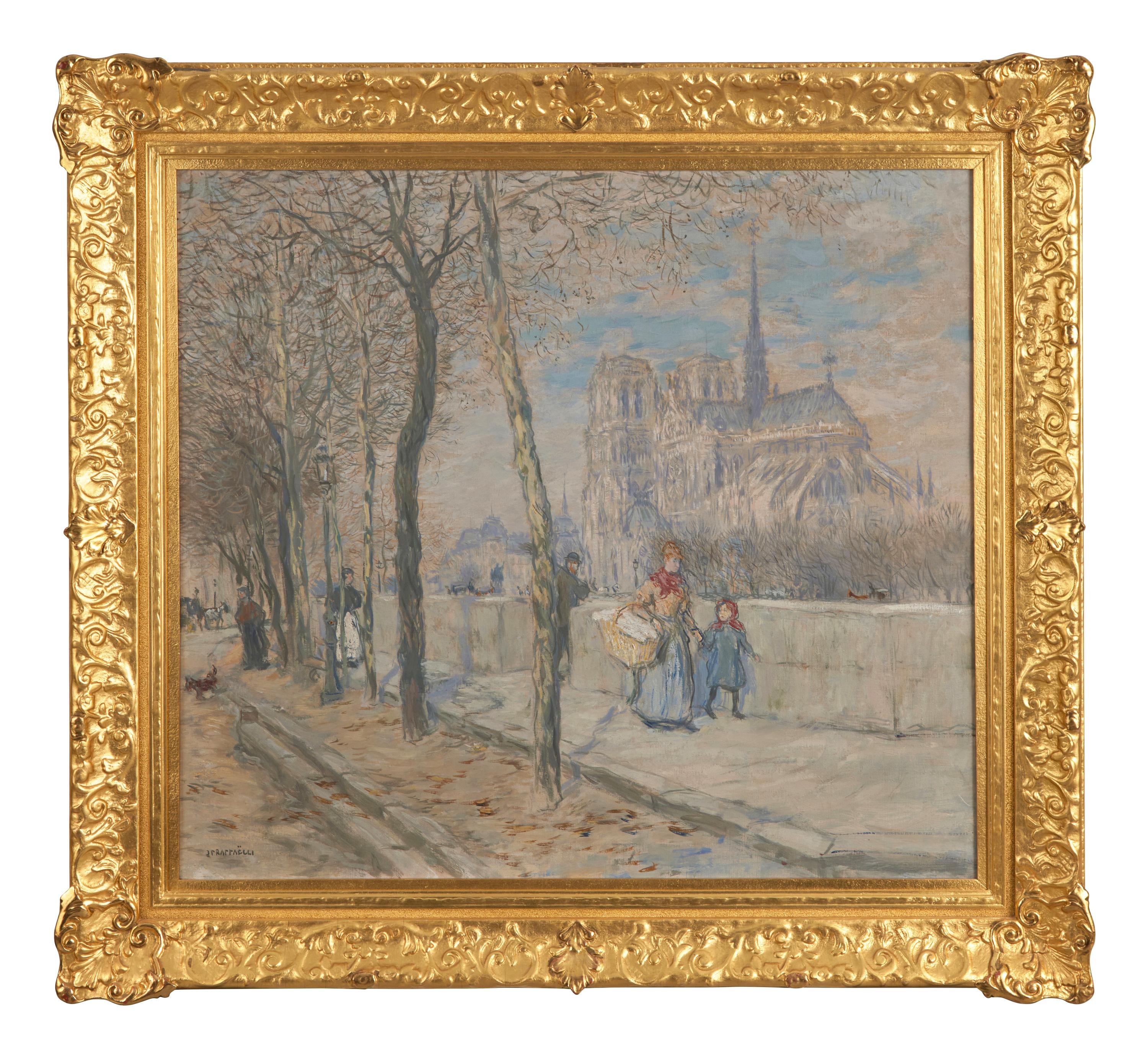
Notre-Dame de Paris, Quai de Tournelle is a superb example of the distinctly unique style that Jean François Raffaëlli developed during a long and illustrious career. A multi-faceted artist interested in all forms of expression, Raffaëlli was an accomplished actor, musician, printmaker, draftsman, sculptor and author as well as an innovative painter. His oeuvre is not easily classified, as the artist did not consider himself a part of any one movement. However, he was above all a realist whose central belief was that an artist’s duty was to render the essence of the contemporary society in which he lived. “My subject is all Paris, I aim to paint the beauty of Paris as well as its wretchedness” ('A Talk by Mr. Raffaëlli,’ The Art Amateur, April 1895, p. 135).
Originally taught as a singer and actor, in 1870, Raffaëlli submitted a landscape painting that was accepted for exhibition at the Salon. Following this success, in 1871, he studied for three months under Jean-Léon Gérôme at the École des Beaux-Arts, his only formal artistic training. Later that decade, Raffaëlli became involved with the Impressionists who gathered at the Café Guerbois. It was here that he met Edgar Degas, who encouraged him to exhibit with that group in 1880 and 1881, despite having little affinity with the movement. With its subject matter that drew on the lives of the downtrodden and executed in a realist manner with a dark palette, his contributions ran counter to the Impressionist aesthetic. In reviewing the 1881 Impressionist exhibition, Le Petit Parisien noted, ‘M. Raffaëlli seems to us to differ noticeably from the artists known as Impressionists: he paints with an extreme meticulousness, leaves out no detail…,” while the reviewer for L’Art commented that the artist “does not content himself with the approximate. He pursues to the very end what he undertakes” (quoted in M. Young, ‘Heroic Indolence: Realism and the Politics of Time in Raffaëlli’s Absinthe Drinkers,’ Art Bulletin, June 2008, vol. XC, no. 2, pp. 237-238).
After spending a large part of the 1870s and 1880s living in the Paris suburbs and painting realist interpretations of the inhabitants, Raffaëlli returned to Paris in the early 1890s and focused on the city's most well-known monuments and boulevards. The present work is likely from this period, and as with most works by the artist, the viewer knows where they are in Paris. The view depicted is of Quai de la Tournelle on Paris’s Left Bank, facing the buttressed southeast end of Notre Dame, and the imposing Prefecture of Police to its west. Raffaëlli deploys all his talent as a draughtsman, taking care to individualize each of the figures occupying the scene. In the foreground walk a young girl and a woman holding a laundry basket, and behind them can be seen a street cleaner heading down the stairs to the embankment. A servant, identified by her black dress and white apron, is further along to the left and partially hidden by the trees that line the quai. These trees and their architectural setting are also carefully delineated, with thin, brushy brushstrokes. The pink, soft light of the sky, as well as the overall blue and beige tones, create a work with delicate nuances that is equally skillfully constructed. With its vantage point at ground level, the artist is able to better focus on specific landmarks and draw the viewer into the spirit and mood of life in the French capital. It is a work of with verve and finesse, providing a showcase for Raffaëlli’s confident brushwork and sophisticated palette.
In 1889, Raffaëlli was made a Chevalier of the Légion d’Honneur and in the same year was awarded a gold medal at the Exposition Universelle. In 1906 he was made Officier of the Légion d’Honneur. He was also a member of the Société Nationale des Beaux-Arts. It is likely it was this success that caused the artist’s shift in subject and palette, from painting the “wretchedness” of Paris to more bucolic views of the city later in his life. As Raffaëlli explained: “My life has not been an easy one for I was brought up in luxury until I was fifteen, when within a few years my family lost its entire fortune and I became acquainted it the most grinding poverty. Then came the war of ’70, to throw its veil of mourning over all the young men were just at the outset of their careers. At that period I painted with the greatest sincerity my hopelessness, my bitterness, my anger, my madness…But as the years rolled by they brought great changes into my life…my artistic successes have been such that all bitterness has fled…after all the storms of youth I have gradually arrived at some degree of serenity…” (quoted in Catalogue of the Works of Jean François Raffaëlli: Paintings, Drypoints, and Etchings Printed in Color, The Art Institute of Chicago, exh. cat., January 10-25, 1900, pp. 12-13). With the greater acceptance of his work, which brought him increased prosperity, Raffaëlli was able to cement his enduring and timeless artistic appeal.
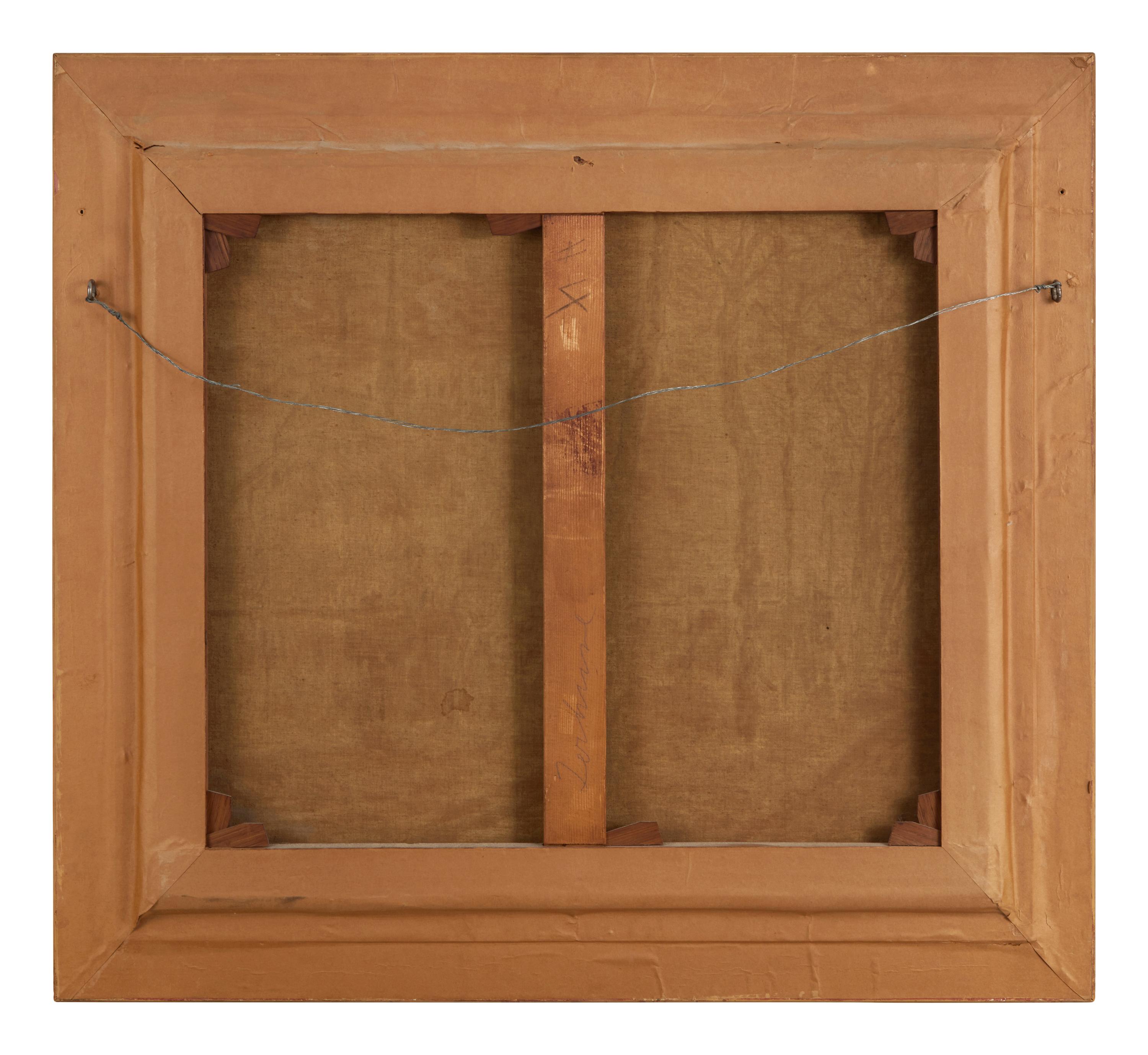
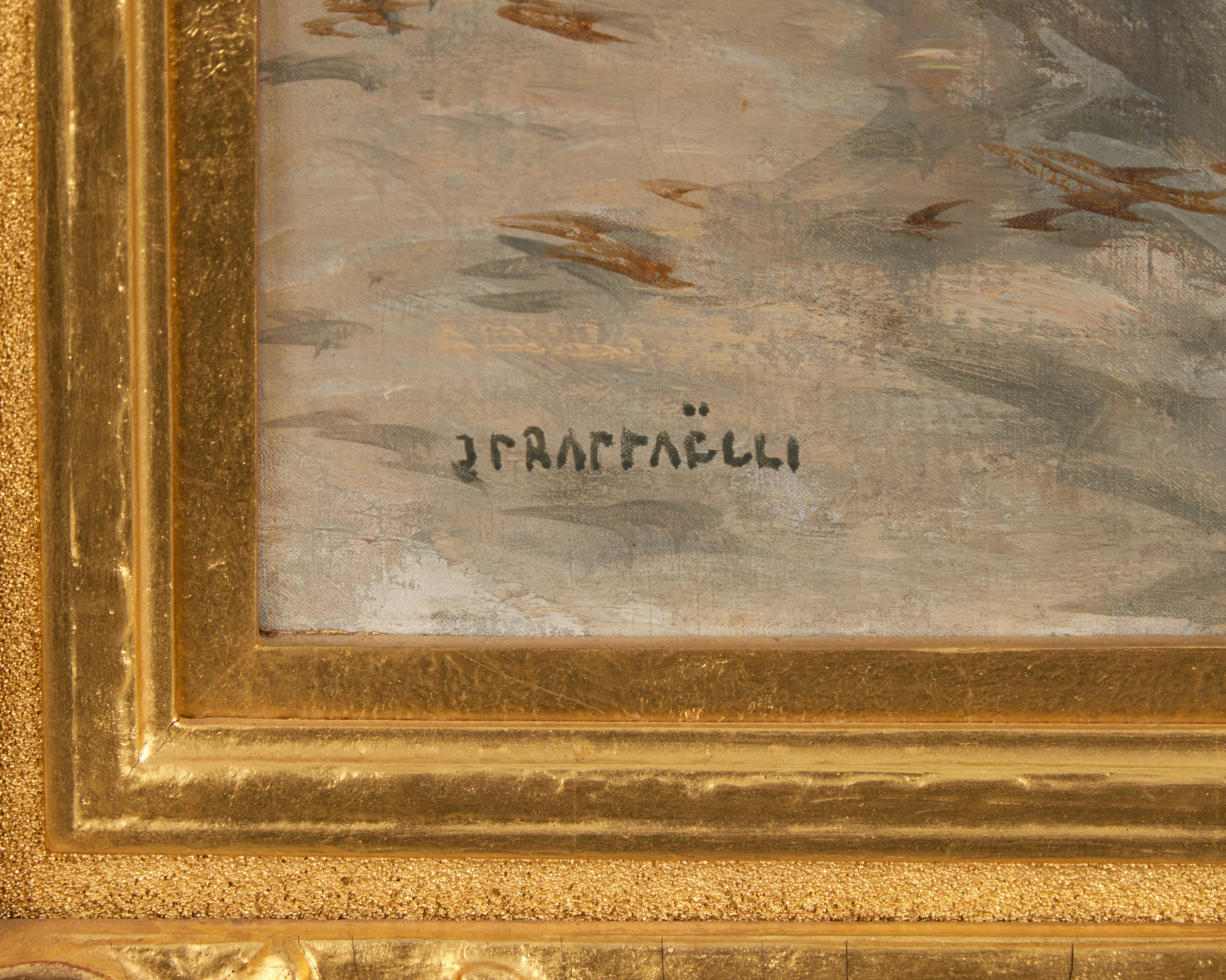
The unlined canvas is in generally very good condition. Four spots of minor scattered soiling present at upper right corner. Puncture to canvas present at lower left on lamppost. Small loss to paint present just above puncture measuring approximately .5cm. No apparent issues under UV. Please see specialist photos for details.
The physical condition of lots in our auctions can vary due to age, normal wear and tear, previous damage, and restoration/repair. All lots are sold "AS IS," in the condition they are in at the time of the auction, and we and the seller make no representation or warranty and assume no liability of any kind as to a lot's condition. Any reference to condition in a catalogue description or a condition report shall not amount to a full accounting of condition. Condition reports prepared by Freeman's staff are provided as a convenience and may be requested from the Department prior to bidding.
The absence of a posted condition report on the Freeman's website or in our catalogues should not be interpreted as commentary on an item's condition. Prospective buyers are responsible for inspecting a lot or sending their agent or conservator to inspect the lot on their behalf, and for ensuring that they have requested, received and understood any condition report provided by Freeman's.
Please email madalinalazen@hindmanauctions.com for any additional information or questions you may have regarding this lot.