To request further details about this lot, please email conditionreports@freemansauction.com
Please email conditionreports@freemansauction.com for any additional information or questions you may have
Sale 2720
| Philadelphia
| Philadelphia
To request further details about this lot, please email conditionreports@freemansauction.com
Please email conditionreports@freemansauction.com for any additional information or questions you may have
Estimate$30,000 – $50,000
We wish to thank Mr. Xavier Tricot for his kind assistance in cataloguing the present lot, which will be reproduced, and commented upon, in the author's forthcoming publication, James Ensor: La Gamme d'Amour, Pandora Publications, Antwerp, 2024.
Sidney Rothberg had a passion for theatre. A father and grandfather to two women who at one point in their lives worked in the entertainment industry, it is not at all surprising to count James Ensor among the artists he collected, especially through the rediscovery of these two set designs and four character studies, which reveal a lesser-known (yet important) facet of the Belgian artist’s personality.
Ensor’s fascination for theatre began early, before he embarked on a career as a painter. From his grandmother’s eccentric penchant for dressing up in strange costumes, through the sale of exuberant props in his family’s souvenir shop in Ostend, to the cacophonous annual Carnival celebration, the artist was enthralled by theatre’s many possibilities. He was particularly interested in masks, which regularly appear in his œuvre. For Ensor, masks were both able to disguise identity and reveal inner truth. He said: “The masks mean to me: freshness of color sumptuous decoration, wild unexpected gestures, very shrill expressions, exquisite turbulence.”
At fifty, Ensor built on his passion for theatre and produced his own show, La Gamme d’Amour (Flirt pour les Marionettes), which the libretto describes as a “one-act Ballet Pantomime in two tableaux.” Composed solely on the black keys of a harmonium (he feared the white keys) between 1906 and 1911, La Gamme d’Amour debuted as a musical performance on January 17, 1920 to coincide with Ensor’s exhibition at the Galerie Georges Giroux in Brussels, before premiering as a proper ballet at the Antwerp Opera on March 27, 1924.
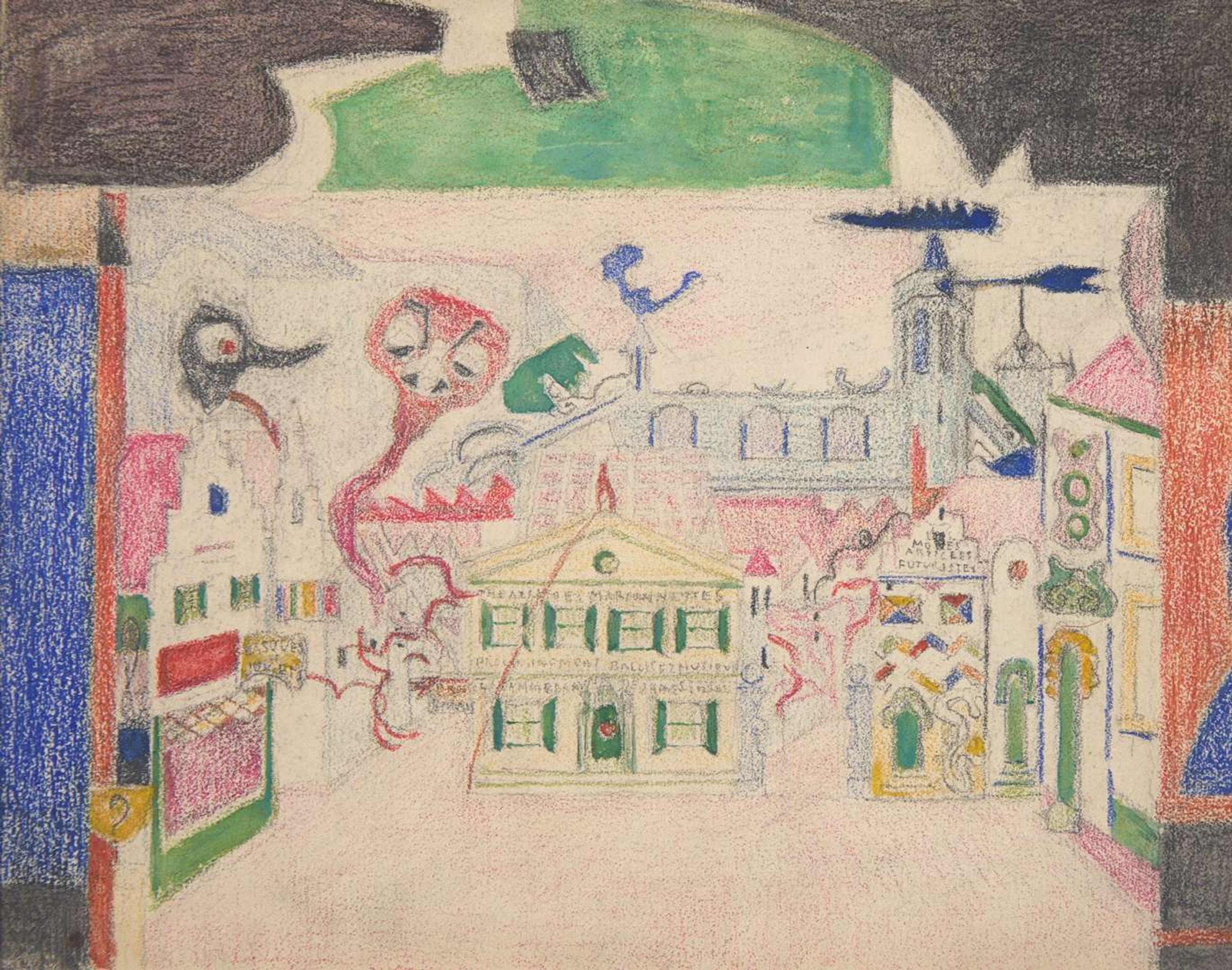
Set during the Ostend carnival, the play opens in Grognelet’s shop, filled with masks, puppets, and other theatrical props, reminiscent of Ensor’s parents’ boutique. The first scenes introduce the main protagonists, love-interests Fifrelin and Miamia, whose passion is compromised by their quarreling families. By the end of the first tableau, however, the two characters are engaged, and the second tableau is devoted solely to preparing a festive wedding march in the town square.
The present works (Lots 37-42), all rediscovered for the most part, present two different sets: the initial boutique, absent of actors, and the final Ostend square which will host the happy wedding. Aside from three unique deities, Luminism, Futurism and Etching, are supporting characters Ombreuse (Miamia’s best friend), Chandelette and a Cymbalist.
A handwritten note, drafted by Ensor between 1911 and 1913 lists of a total of forty-eight characters in La Gamme d’Amour, each drawn (not necessarily alone, as sometimes several characters appear on the same sheet) and joined by “a beggar, a poor child, musicians, heralds, dancers, masks, dolls, puppets, wooden soldiers.”
Most of the drawings, all pierced at the corner to make a later lithographic folio, belonged to François Franck, while others (mostly the horizontal ones) were part of Blanche Hertoge’s stock, a gallery owner in Ostend. The first two drawings on offer here belonged to Auguste Taevernier, a close friend of Brussels bookseller Paul van den Perre, who personally knew Ensor’s niece.
Collection of Auguste Taeverier, Ghent, Belgium.
The Collection of Sidney Rothberg, Philadelphia, Pennsylvania.
In overall very good, close to excellent original condition. The sheet is affixed to the underman via two pieces of old brown tape at upper left and upper right corners. The sheet presents well, and lays relatively flat. Slightly toned. With remnants of white paper tape running along the top outer edge of the sheet verso (it slightly sticks up on the front). The edges of the sheet are regular. With a few scuffs in the bottom left corner. With a small brown spot on the verso of the bottom left corner (it is not see through). Without any sign of tear, repair or restoration. Please see Specialist's pictures for more details.
Please note the work was framed for the exhibition.
To know more about this Lot, or to receive additional images, please email Specialist Raphael Chatroux at rchatroux@freemansauction.com
The physical condition of lots in our auctions can vary due to age, normal wear and tear, previous damage, and restoration/repair. All lots are sold "AS IS," in the condition they are in at the time of the auction, and we and the seller make no representation or warranty and assume no liability of any kind as to a lot's condition. Any reference to condition in a catalogue description or a condition report shall not amount to a full accounting of condition. Condition reports prepared by Freeman's staff are provided as a convenience and may be requested from the Department prior to bidding.
The absence of a posted condition report on the Freeman's website or in our catalogues should not be interpreted as commentary on an item's condition. Prospective buyers are responsible for inspecting a lot or sending their agent or conservator to inspect the lot on their behalf, and for ensuring that they have requested, received and understood any condition report provided by Freeman's.
Please email for any additional information or questions you may have regarding this lot.