Back
American Art and Pennsylvania Impressionists
|
- Sale 2780
Live
| Philadelphia
Dec 3 | 2:00 PM EST
Live
| Philadelphia
Sale 2780
| Philadelphia
| Philadelphia
Estimate$30,000 – $50,000
Born in Cincinnati, Ohio, Isabel Bishop spent her childhood in Detroit, Michigan, raised in a very proper and respectable family of intellectuals. She moved to New York at the young age of 16 to hone her burgeoning drawing skills at the New York School of Applied Design, with the intention of working in the illustration field during the auspicious time known then as the 'Golden Age of Illustration.’ Two years later, however, she switched to studying painting at the Art Students League. The loose organization of the school allowed Bishop to work under various professors and explore different styles and influences. Following a complicated relationship with Max Weber, who deprecated her work, Bishop went on to study under Kenneth Hayes Miller, who would become a lifelong mentor and friend.
Bishop instantly fell in love with New York when she moved there as a teenager, and grew enthralled by the chaotic, yet beautiful movement of large crowds traversing the city streets and avenues. The artist recalls the awakening she felt as she came back to New York after a brief interlude in Maine: "I was struck by the beauty, drama, and miraculous effects of a crowd of people in motion. It seemed magical. It seems as though the movement involved more than I could take in with my eyes because the air became solid–it was like a continuum, this ambiance in which this beautiful interchange took place." Although she exclusively executed her oils in her Fourteenth Street Studio, Bishop regularly ventured around Union Station in search of inspiration. Considered a haven for artists in the 1920s and 1930s, the area had transformed over the years–the mansions, elegant department stores, and fashionable strollers slowly were replaced by small industries, in-and-out restaurants, and workers who poured into the streets at lunchtime or on their way to/from work. Bishop especially liked to paint walking women and to capture their slim silhouettes as they stopped for a quick bite or a refreshment at the local soda fountain.
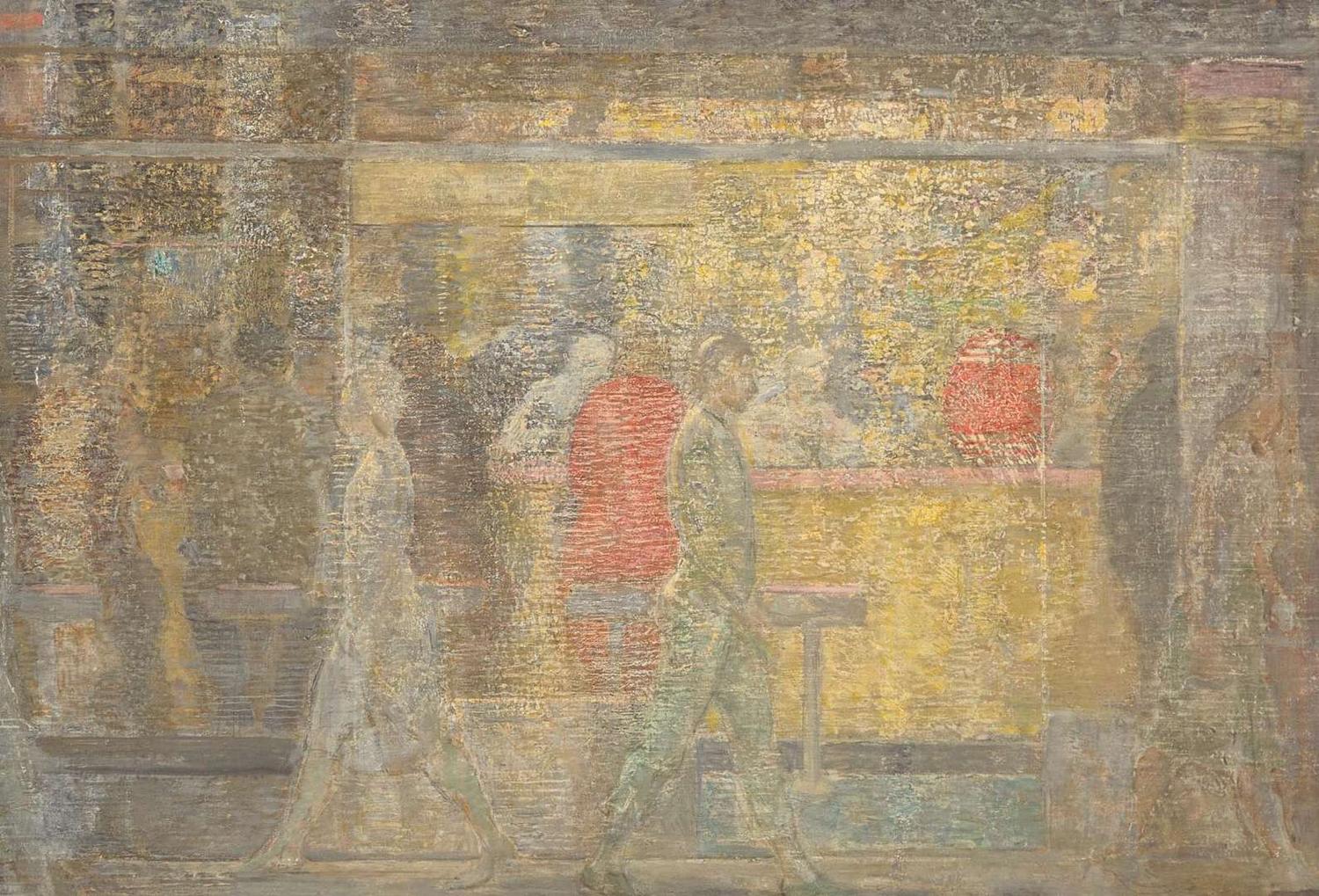
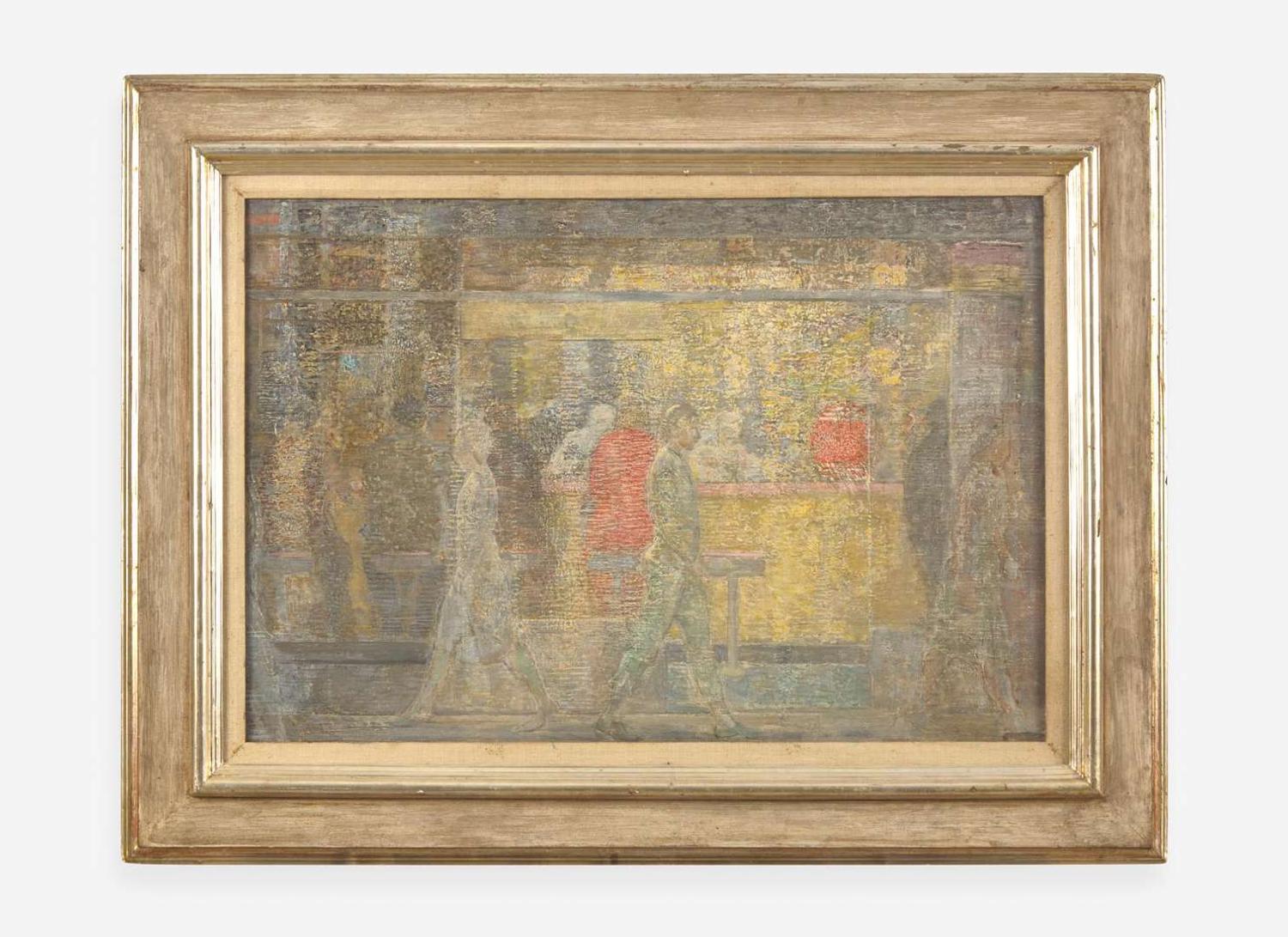
The present painting is an important work by the artist, which perfectly reflects her decade-long obsession with movement, and especially with the motif of people walking in the street. "I have come to think that walking is absolutely beautiful, and I could not tell you why,” Bishop explained. She first explored the theme of small anonymous individuals colliding in a big city in the 1930s and soon made it her speciality, which earned her recognition and representation by the then-new Midtown Galleries, who promoted her until her death in 1988. When painting Soda Fountain with Passersby in 1960, Bishop was most interested in the location depicted. At the center of the composition is the diner at the corner of Twenty-Third Street, which had a “fascinating, beautiful warmth” and lured passersby at lunch and dinner time, as a neon light attracts flies. Bishop especially liked the effects that the electric lights and the glass reflections projected onto the passing crowds, which made them look like phantasmagoric specters idling in the street. About this special effect, Bishop said, "I love it, but I have to make the painting say what I feel about it. How? I don’t know. I’ve been working on it for a couple of months. I’ve made endless small sketches, not, I’m afraid with the aim of making the subject more literally right, but simply to keep the feeling that I have about it alive."
To capture this ephemeral feeling, Bishop devised a tedious method later characterized by scholars as Bishop’s signature “deep frozen technique.” The artist herself acknowledged: “I do use a very complex technique I’m sorry to say. Not because I wanted to be complex, but in an effort to make the painting speak back to me. I’d do anything to get that result." Striving for perfection, Bishop–who was considered the most literate among her peers–researched, embraced, and evolved many preexisting techniques and traditions. One of her influences was Peter Paul Rubens's use of gesso, which is evident here as the painting was layered with several coats of the paint mixture. The series of random vertical and horizontal lines Bishop then drew in gelatin, powdered charcoal, and white lead works to ensnare the drawn figures within a transparent, trembling surface, creating a “web-like, mobile environment,” as Helen Yglesias describes it. The scholar continues to describe Bishop's technique: “The drawing was then added in pencil or ink and black or umber tempera. Then varnish was applied and blotted at once in order to keep the gesso less absorbent of the oil painting that was to be applied over it. Tone upon tone was then overladen this tacky round, the striped underpainting remaining visible through the layers of oil.”
The result is a refreshingly dynamic image, which contrasts with other contemporary views of New York City–such as those by Bishop's friend, Reginald Marsh, and Edward Hopper–that focused on the seedy, solitary, and depressing aspects of city life. Here, Bishop uplifts the viewer: she paints the scene as a scrolling fresco, enlivened by golden hues and sporadic bold touches of color. Although the figures walk alone and don't interact, their relationship to one another, however short-lived, is felt and understood. As passersby, they enter into a very natural, almost instinctive, dance in the concrete jungle, reflecting the artist’s comfort in her environment–the city which pushed her to find a unique stylistic voice that inspired critics like Emily Genauer to dub her “with vehemence and conviction, (…) one of the most important woman painters in America.”
The Artist.
The Artist's Estate.
Midtown Galleries, New York, New York.
Acquired directly from the above in 1961.
Virginia Museum of Arts, Richmond, Virginia (Museum purchase through The John Barton Payne Fund, accession number 61.13).
To request further details about this lot, please email [email protected]
Please email [email protected] for any additional information or questions you may have
The unlined canvas in very good condition. With a slightly broken lump of impasto at upper center along the top outer edge of the canvas. No sign of restoration as seen under UV light (some fluorescence visible at bottom left and along the left outer edge, but definitely due to pigments used by the artist, and not a sign of restoration). See Specialist's pictures for more details.
Framed under glass.
For more information on this Lot, please contact Raphael Chatroux at [email protected]
The physical condition of lots in our auctions can vary due to age, normal wear and tear, previous damage, and restoration/repair. All lots are sold "AS IS," in the condition they are in at the time of the auction, and we and the seller make no representation or warranty and assume no liability of any kind as to a lot's condition. Any reference to condition in a catalogue description or a condition report shall not amount to a full accounting of condition. Condition reports prepared by Freeman's staff are provided as a convenience and may be requested from the Department prior to bidding.
The absence of a posted condition report on the Freeman's website or in our catalogues should not be interpreted as commentary on an item's condition. Prospective buyers are responsible for inspecting a lot or sending their agent or conservator to inspect the lot on their behalf, and for ensuring that they have requested, received and understood any condition report provided by Freeman's.
Please email for any additional information or questions you may have regarding this lot.