
Freeman's Post-War & Contemporary Art Sale to Feature Property from the Brooklyn Museum, Rediscovered Gertrude Abercrombie Masterwork, Rare Alice Neel Courtroom Satires and the Reemergence of Alex Katz Swimmer #2
Sale also highlights a group of Post-War New York works from the Rosenthal Collection of Newtown, Pennsylvania, tied to the legendary Greenwich Village art-supply house that served de Kooning, Pollock, and their circle
Freeman's will present its Post-War & Contemporary Art auction on October 1 in its New York saleroom, an eclectic sale distinguished by several dedicated sections of exceptional depth and provenance. Highlights include a group of deaccessioned sculptural works by Henry Moore from the Collection of the Brooklyn Museum, a rediscovered Chicago Surrealist masterwork by Gertrude Abercrombie, two rare and historically resonant courtroom studies by Alice Neel, and a selection of Post-War New York works from the Rosenthal Collection of Newtown, Pennsylvania — the family behind the storied Greenwich Village art-supply business that outfitted a generation of Abstract Expressionists.

Lot 5 | Alex Katz (American, b. 1927) | Swimmer #2, 1973 | Estimate: $300,000 – $500,000
Speaking to the sale is Zack Wirsum, Senior Vice President, Head of Department, Post War & Contemporary Art. “From the mind-blowing estate sale find of one of Gertrude Abercrombie's first shell paintings, uncovered from the sands of time 75 years after it was last exhibited publicly, to the splashy return to the market of Swimmer #2 by Alex Katz held privately since 1976, to a rare glimpse into Alice Neel's fearless social commentary with her Judge Medina drawings, rediscovery is the defining spirit of the sale.”
Property from the Collection of the Brooklyn Museum: Deaccessioned Sculptures by Henry Moore
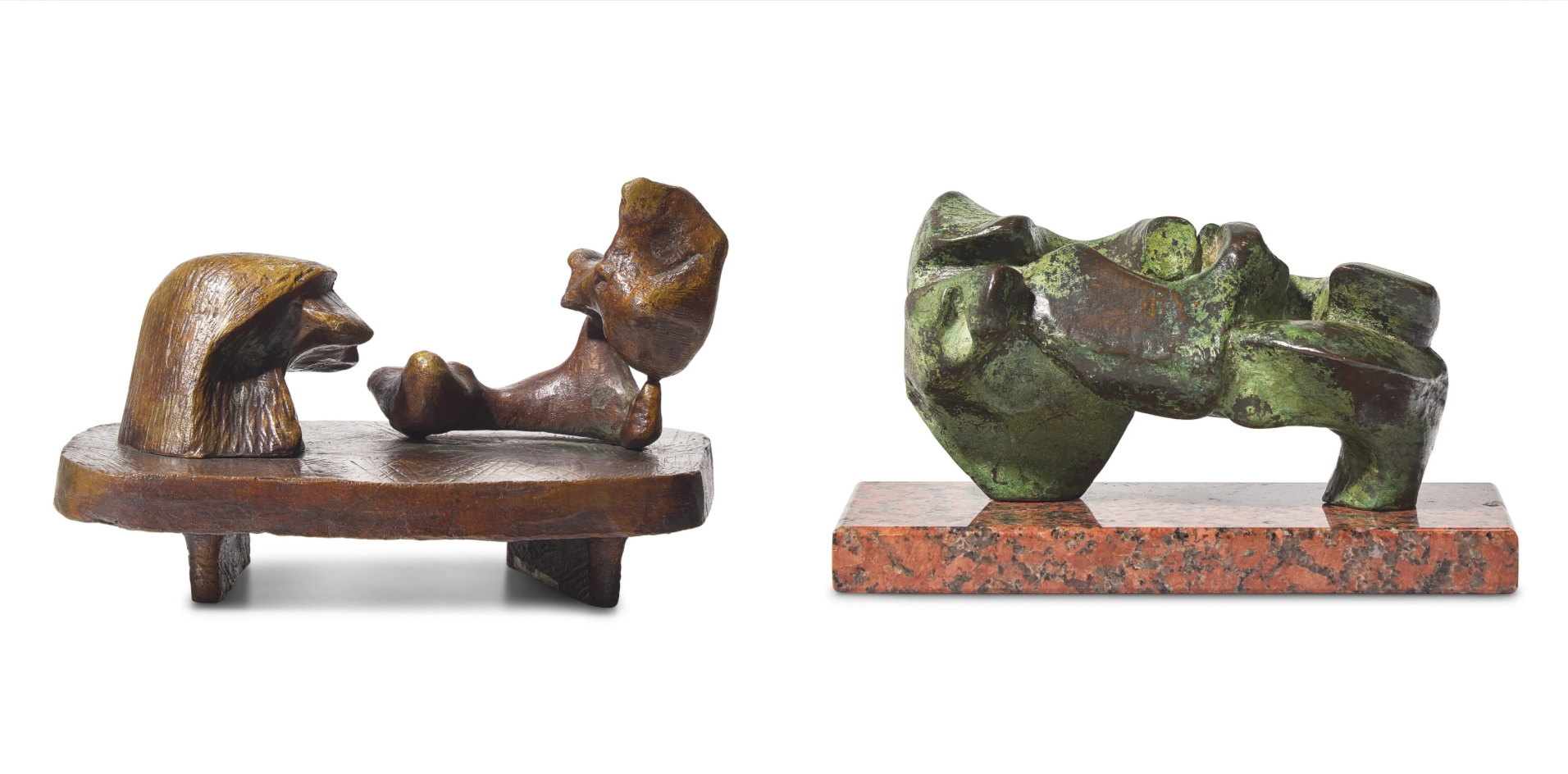
From Left to Right: Lot 54 | Henry Moore (British, 1898-1986) | Two Piece Reclining Figure #6, 1964 | Estimate: $30,000 – $50,000
Lot 55 | Henry Moore (British, 1898-1986) | Slow Form: Tortoise, 1962 | Estimate: $20,000 – $30,000
Property from the Collection of the Brooklyn Museum
The sale includes a dedicated section devoted to Property from the Collection of the Brooklyn Museum, featuring several sculptural works by Henry Moore (British, 1898–1986) deaccessioned from the museum's holdings. All three works come from the same distinguished line of ownership: William K. Jacobs, Jr., a noted New York collector, gave them to the Brooklyn Museum in a 1992 bequest.
Compact in scale but monumental in ambition, these bronzes exemplify the reclining figure and mother-and-child motifs that Moore returned to throughout his career — themes rooted in his deep engagement with the human body, natural form, and the primal, abstracted shapes for which he is celebrated as one of the twentieth century's most important sculptors.
Alice Neel: Anarchic Humanist
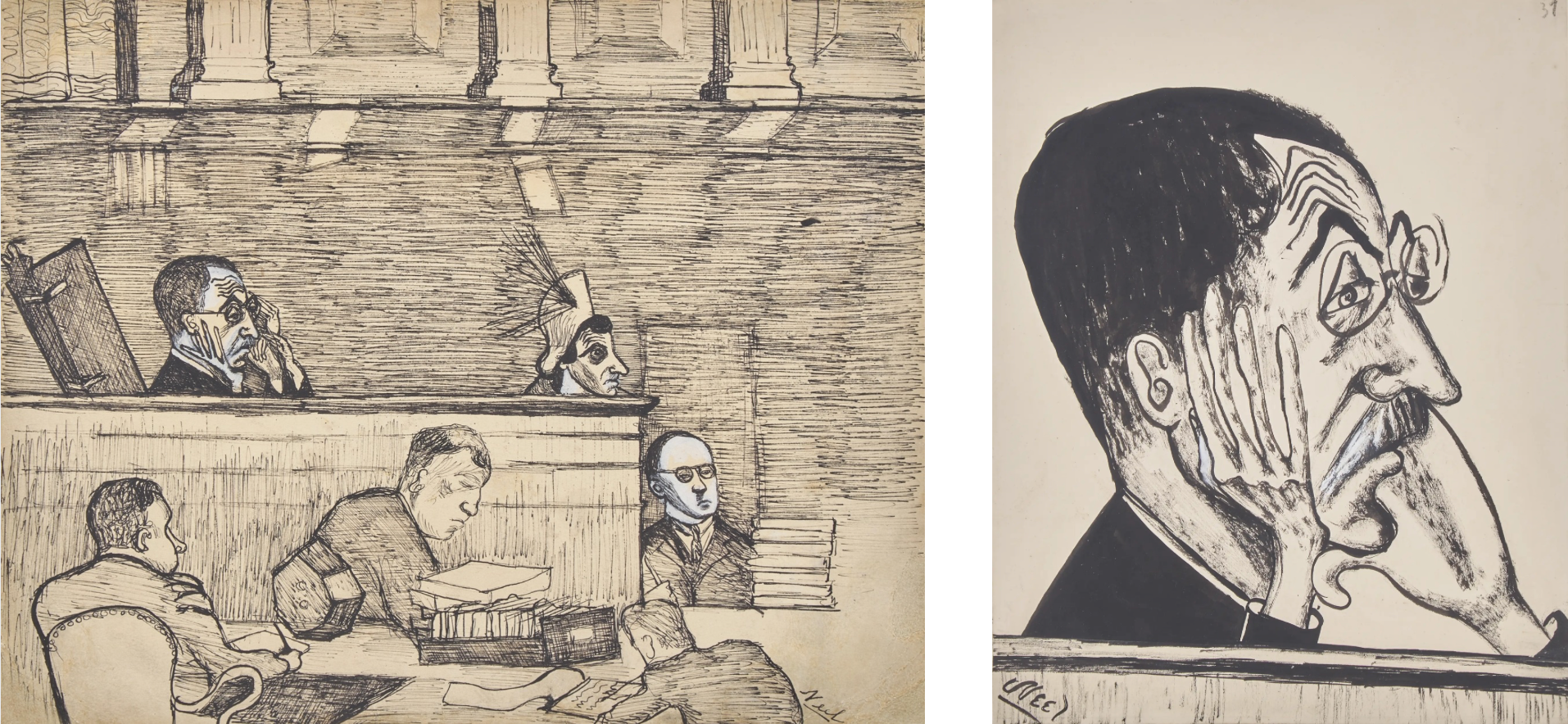
From Left to Right: Lot 90 | Alice Neel (American, 1900-1984) | Judge Medina - Trial Scene, 1951-52 | Estimate: $30,000 – $50,000
Lot 91 | Alice Neel (American, 1900-1984) | Judge Medina, 1949 | Estimate: $30,000 – $50,000
A second dedicated section presents two rare works by Alice Neel (American, 1900–1984): Judge Medina, 1949, and Judge Medina – Trial Scene, 1951–52 — satirical studies born of one of the most notorious trials of the McCarthy era.
In 1949, Judge Harold Medina presided over the nine-month Smith Act trial of Eugene Dennis and ten other U.S. Communist Party leaders, who were convicted of conspiring to advocate the violent overthrow of the government — a decision the Supreme Court upheld in 1951. The raucous, headline-making trial, emblematic of the Second Red Scare, turned Medina into a national hero.
Alice Neel — a Communist Party member since 1935 — covered the trial for the Marxist magazine Masses & Mainstream, producing two studies of Judge Medina and a grisaille group scene that also skewers anti-Communist witness Angela Calomaris, whom Neel called the "stool pigeon." As Neel later recalled to biographer Patricia Hills, the defendants were "tried... for thought," and her drawing of Medina was published in the magazine in 1949; the more elaborate Trial Scene — which slyly inserts likenesses of Richard Nixon and Roy Cohn, both then rising as anti-Communist prosecutors, though neither was actually present at the trial — went unpublished. In the grisaille, Neel gives Medina four busy hands scratching his head, a satirical nod to his real-life habit, recalled in his 1990 New York Times obituary, of rocking in his chair and absent-mindedly scratching his head as defense attorneys shouted him down. Her caricatures invite comparison to Ben Shahn's Sacco and Vanzetti drawings and to Jack Levine's The Trial (1953–54), whose judge Levine acknowledged was modeled on Medina.
Neel's Communist Party affiliation — to this day, a poster of Lenin hangs in her former apartment on West 107th Street — and her devotion to Social Realism, a mode widely out of fashion by the early 1940s, earned her a thick FBI file and years on the margins of the art world. She had gained early recognition in the 1930s for such powerful works as her 1935 portrait of poet Kenneth Fearing (who based a character on her in his novel The Big Clock, later a film) and her portrait of waterfront organizer Pat Whalen, alongside overtly political works including Nazi's Murder Jews, Uneeda Biscuit Strike, Investigation into Poverty of the Russell Sage Foundation, and The Magistrate's Court — a possible forerunner to the Medina caricature — all completed in 1936.
Neel's Communist Party ties and devotion to Social Realism — long out of fashion by the 1940s — earned her a thick FBI file and years on the margins of the art world, even as she held fast to figuration through the height of Abstract Expressionism. "I couldn't give up what I was interested in for what was in fashion," she said, "so I kept right on painting." As Marilyn Schmitt wrote in a 1978 ARTS Magazine review of a retrospective that included the Medina caricature: "There is nothing domesticated about Alice Neel... she has stood outside, and sometimes outrageously beyond—convention, and pursued her freedom with a relentless determination in her art, in her politics and most of all her life." As Neel herself put it: "I'm an anarchic humanist."
A Rediscovered Masterwork: Gertrude Abercrombie's Alderman Merriam's Shells

Lot 3 | Gertrude Abercrombie (American, 1909-1977) | Alderman Merriam's Shells, 1951 | Estimate: $150,000 – $250,000
The sale also brings to auction a landmark rediscovery: Alderman Merriam's Shells, 1951, by celebrated Chicago Surrealist Gertrude Abercrombie (American, 1909–1977), estimated at $150,000–$250,000. Missing from public view for 75 years, the painting resurfaced this past summer at an estate sale in Michigan, where it was found by a longtime hunter of record albums and mid-century furniture, tucked in a dark hallway corner and overlooked by other buyers — purchased for just $30 on the strength of a signature reading "Abercrombie."
That instinct paid off. The new owner, inspired by the discovery, altered a family vacation to visit The Whole World Is a Mystery, the acclaimed Abercrombie retrospective at the Milwaukee Art Museum, and while studying the exhibition catalogue found an archival photograph of the very painting — reproduced from a September 14, 1952, Chicago Tribune review of Abercrombie's exhibition at Newman Brown Gallery, showing the work in its original frame alongside the actual shells it depicts. The painting was subsequently authenticated by leading Abercrombie scholar Dr. Susan Weininger, and the owner, recognizing Freeman's as a sponsor of the Milwaukee exhibition, entrusted the work to the house for its next chapter.
"Little did I know that one of those 'once in a while's would occur less than a month later," said Zachary Wirsum, SVP and Head of Department, Post-War and Contemporary Art at Freeman's, recalling that he had told visitors on an exhibition tour just weeks earlier that Abercrombie paintings occasionally still surface at estate sales. "We could not be more thrilled to now steward this magnificent rediscovery to the next chapter of its fascinating story."
Painted in 1951, during one of the most prolific and formative periods of Abercrombie's career, Alderman Merriam's Shells depicts an arrangement of nine sensitively rendered seashells resting on a stark, slate-gray surface, with a single conical shell suspended by a thread against a black wall, appearing to levitate above the rest. The shells belonged to Robert Merriam, Alderman of Chicago's Hyde Park neighborhood, where Abercrombie lived and worked; the painting is a rare instance of the artist working directly from life, and offers new insight into her celebrated recurring shell motif — the smaller central nautilus shell bears a hole and crack echoed in her later solitary shell paintings, long presumed invented but now confirmed as drawn from direct observation and memory. For Abercrombie, the shell carried deep symbolic weight, serving as a vessel of both protection and confinement and, with its hypnotic spiral form, often functioning as a talisman of friendship gifted to those closest to her.
The painting was exhibited extensively during Abercrombie's lifetime, appearing in six solo exhibitions in 1952 and 1953, including shows at the Newman Brown Gallery and Steven Gross Studios in Chicago, the Edwin Hewitt Gallery in New York, the Bresler Gallery in Milwaukee, the Contemporary Arts Gallery in Evanston, and the Illinois Design Center in Chicago. In early 1952, Abercrombie gave the painting to Dr. John Reynolds of Kalamazoo, Michigan, in exchange for medical services; it remained in his collection for the rest of his life and passed down through his estate, unseen publicly for 75 years until its rediscovery this year.
The Rosenthal Collection of Newtown, Pennsylvania
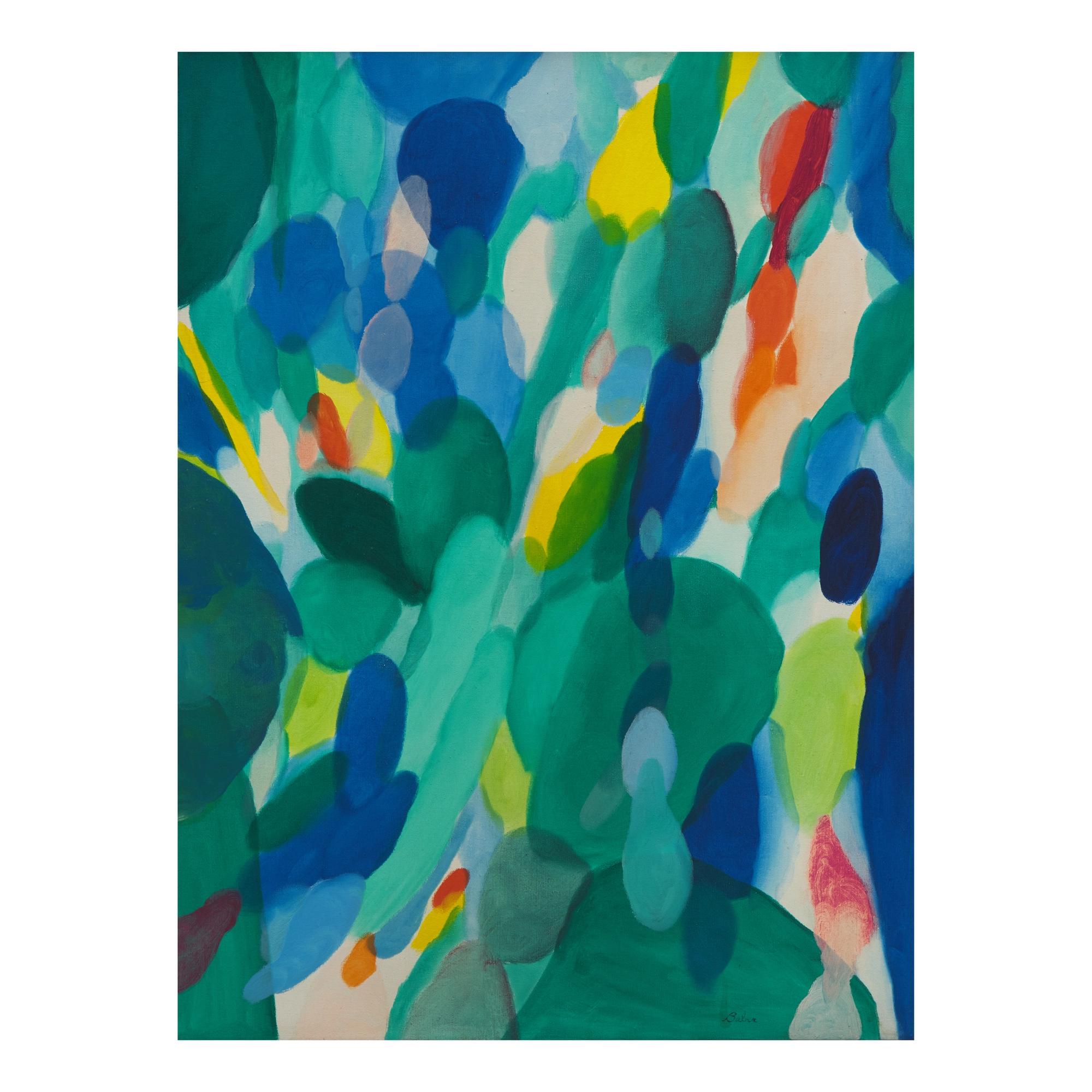
Lot 24 | Alice Baber (American, 1928-1982) | Woodhenge, 1966 | Estimate: $40,000 – $60,000 | Property from the Rosenthal Collection
A further group of works in the sale comes from the Rosenthal Collection of Newtown, Pennsylvania. Those familiar with the Post-War New York art scene may recognize the family name: Louis H. Rosenthal, the patriarch of the collection, was the longtime proprietor of Rosenthal's Art & Hobby Supply Company in Greenwich Village, later continuing at New York Central Art Supply Company. For over four decades, Rosenthal was not only a supplier of materials but a trusted friend and advisor to a generation of artists whose work would come to define the modern and Abstract movements of the twentieth century — among them Willem de Kooning, Jackson Pollock, Alice Baber, Esteban Vicente, Mary Abbott, Milton Resnick, Karel Appel, and Paul Jenkins.
Before their breakthroughs, many artists of the period worked with limited means, and it was not uncommon for them to trade their work with Louis in exchange for the very materials that later shaped their successes. The works offered from the Rosenthal Collection stand as a testament to the family's unique material and personal contributions to the Post-War New York artistic community.
Auction Details
- Sale: Post-War & Contemporary Art
- Date: October 1
- Location: Freeman's New York saleroom, 32 East 67th Street, New York, NY
- Preview:
September 23-25, 10 AM to 5 PM
September 26, 11 AM to 5 PM
September 28-30, 10 AM to 5 PM
How to Bid
The auction will be offered in Freeman's New York saleroom. Bidding will be available in person, over the phone, and via absentee or live online bidding. For more information, please visit freemansauction.com.
About Freeman’s
Freeman’s is a premier American auction house offering services in multiple categories including fine art, jewelry, design, books and manuscripts, furniture, decorative arts, antiquities, couture, and Asian works of art. With 16 regional locations nationwide, the firm provides auctions, appraisals, private sales, and art advisory services, connecting clients to the global art market. Freeman’s strives to bring art, history, and design to life by connecting people with extraordinary objects through exceptional service and expertise.