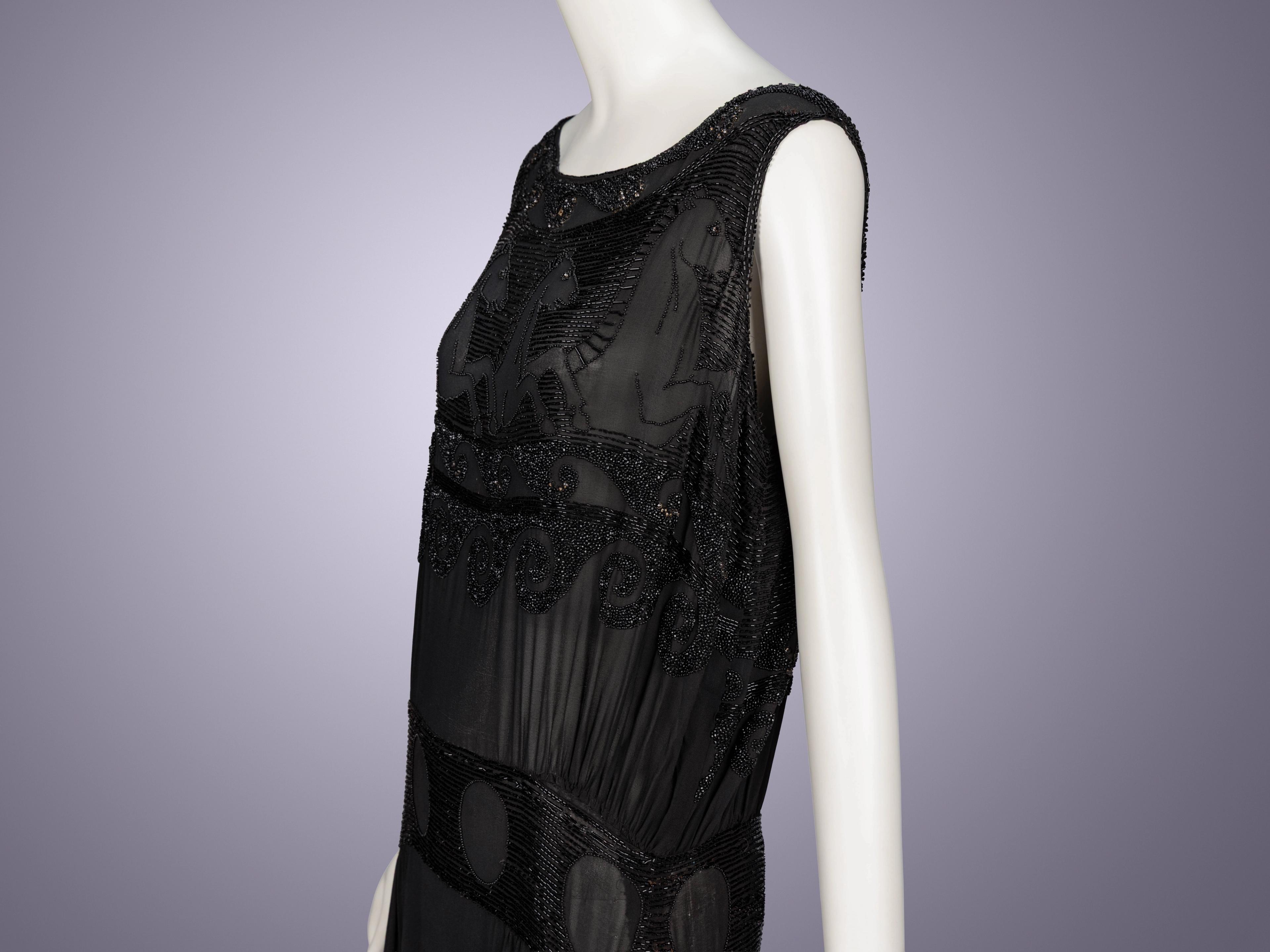
The Little Horses Dress: Madeleine Vionnet's Sculptural Vision in Silk
Tanner Branson, Associate Vice President, Head of Department, Luxury Handbags & Couture
Among the most celebrated creations of the twentieth century, Madeleine Vionnet’s “Little Horses” dress remains an extraordinary expression of the designer’s revolutionary approach to fashion: a harmonious union of art, mathematics, and the human form. Created during the height of Vionnet’s Parisian couture house, the design embodies her lifelong pursuit of purity, balance, and movement, transforming silk, ornament, and construction into a garment that appears almost weightless in motion.
Vionnet (1876–1975) fundamentally changed the language of modern dress. Often described as the “architect of couture,” she rejected restrictive silhouettes in favor of garments that followed the natural contours of the body. Her pioneering use of the bias cut—cutting fabric diagonally across the grain—allowed silk and satin to drape fluidly, creating gowns that moved with the wearer rather than constraining her. Unlike designers who built garments around external decoration, Vionnet began with the body itself, allowing form, proportion, and movement to dictate the design.
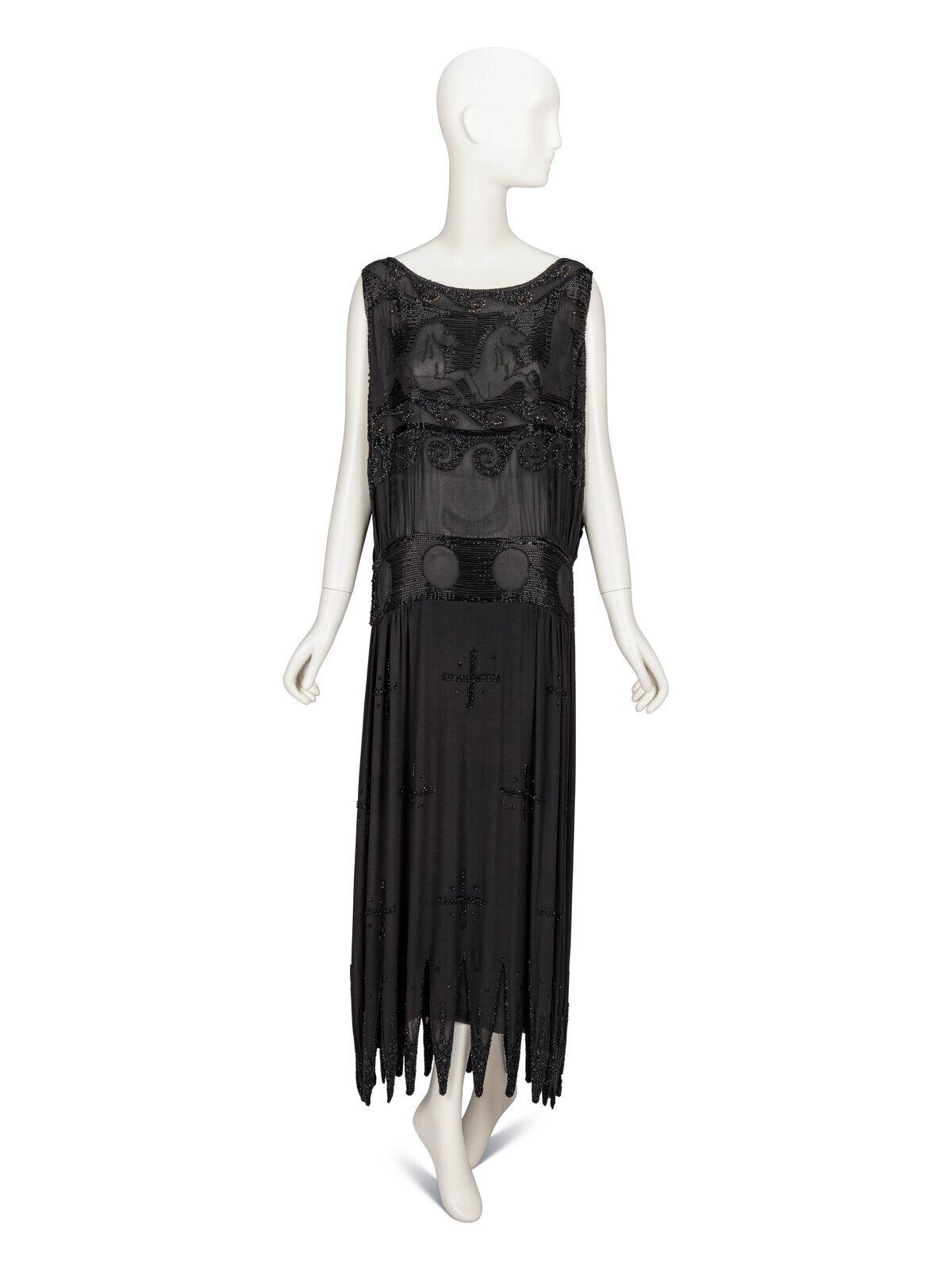
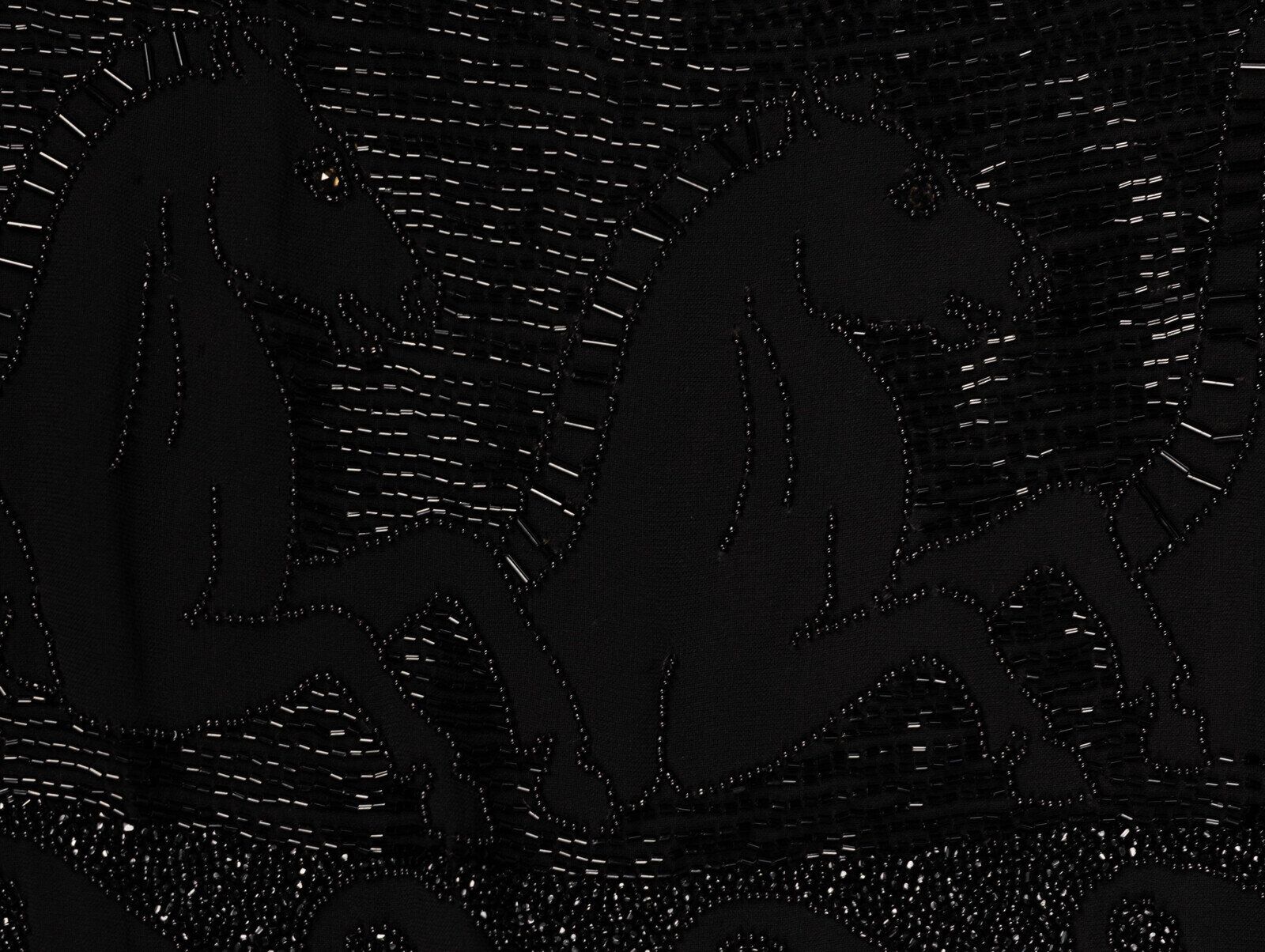
The “Little Horses” dress is among the most recognizable examples of this philosophy. Its design is inspired by classical motifs and the ancient world, reflecting Vionnet’s fascination with Greek sculpture, antiquity, and the timeless relationship between clothing and the body. The circular appliquéd decoration, arranged with rhythmic precision across the surface of the gown, evokes both movement and mythology. The motif suggests a procession of spirited horses in motion—an artistic reference that brings vitality and animation to the otherwise serene simplicity of the silhouette.
The dress demonstrates Vionnet’s extraordinary ability to balance restraint and ornament. The foundation of the gown is characterized by elegant simplicity, allowing the fabric’s drape and the wearer’s movement to become the primary visual elements. Against this refined backdrop, the decorative motifs create a sense of rhythm and harmony, much like a work of modernist sculpture. Every element serves a purpose: the placement of the embellishment follows the architecture of the garment, emphasizing the body while maintaining the purity of the overall composition.
Vionnet’s approach to decoration was never arbitrary. She viewed ornament as an extension of the garment’s structure, carefully considering proportion, placement, and movement. The “Little Horses” motif exemplifies this philosophy, where embellishment becomes inseparable from the design itself. The repetition of the circular forms creates visual cadence, while the dimensionality of the applied elements gives the dress a tactile richness that changes as the wearer moves.
The gown also reflects the broader artistic currents of the 1920s and 1930s. Vionnet worked during an extraordinary period in Parisian fashion, when couture intersected with modern art, theater, and decorative arts. Her designs shared a sensibility with the geometric abstraction of the era, embracing symmetry, repetition, and sculptural form. Yet unlike many modernist designers, Vionnet’s work remained deeply connected to the human figure; her innovations were not about abstraction alone, but about creating harmony between fabric and body.
The enduring fascination with the “Little Horses” dress lies in its ability to transcend fashion history. It represents a moment when couture reached the level of fine art—when a dress could embody technical innovation, artistic vision, and cultural memory simultaneously. The gown is not merely an example of exceptional craftsmanship; it is a testament to Vionnet’s belief that clothing could enhance the natural beauty and movement of the person who wore it.
Today, Madeleine Vionnet’s creations are among the most revered works in the history of fashion. Her influence can be seen throughout modern couture, from designers who continue to explore draping and the relationship between fabric and form to contemporary creators inspired by her timeless elegance. The “Little Horses” dress remains one of her most poetic achievements: a masterpiece of couture engineering that captures the grace, freedom, and artistry at the very heart of Vionnet’s legacy.
A rare surviving example of Vionnet’s visionary approach, the “Little Horses” dress stands as a celebration of innovation and imagination—a garment where architecture becomes movement, ornament becomes expression, and fashion becomes art.