The Conservation of a Gertrude Abercrombie Painting: From Discovery to Auction
As part of our stewardship of this spectacular Abercrombie, we decided with the consignor to have the painting professionally cleaned by Baumgartner Fine Art Restoration to return the painting to as close to the color and finish that Gertrude intended as possible. The painting did not present with any condition issues, but the passage of time had resulted in an accumulation of grime and clouding of the varnish layer that was obscuring the full range of hues and meticulous detail that Abercrombie originally applied to the panel. Sure enough, removing the old varnish layer and the grime with it revealed the magnificent magically realistic paint surface just as Gertrude deemed it complete back in 1951. The following link will take you to a video capturing the conservation process and a conservation about the work between myself and conservator Julian Baumgartner. A longer form version of our conversation can be found here.
View here: Discovering Gertrude Abercrombie
A Discovery Worthy of Abercrombie Herself
The painting's rediscovery reads like something out of Abercrombie's own enigmatic canvases. Its finder, a longtime hunter of record albums and mid-century furniture, arrived late to an already picked-over estate sale this past July. Tucked in a dark corner of a hallway leading to the garage — overlooked by every other buyer that day — hung a quiet, strange still life of seashells. A closer look revealed a signature: Abercrombie. Uncertain but intrigued, the buyer paid $30 to find out.
That instinct paid off. Inspired by the possibility that the painting was genuine, the new owner altered a family vacation to visit The Whole World is a Mystery, the acclaimed Abercrombie retrospective on view at the Milwaukee Art Museum. There, while studying the exhibition catalogue, the owner found an archival photograph of the very painting — a reproduction of a September 14, 1952, Chicago Tribune review of Abercrombie's exhibition at Newman Brown Gallery, illustrated with the painting still in its original frame, the actual shells it depicts arranged in front of it. The find was later authenticated by leading Abercrombie scholar Dr. Susan Weininger. Recognizing Freeman's as a sponsor of the Milwaukee exhibition, the owner contacted the house directly and entrusted the painting to Freeman's for its next chapter.
"Little did I know that one of those 'once in a while's would occur less than a month later," said Zachary Wirsum, SVP and Head of Department, Post War and Contemporary Art at Freeman's, recalling how he had told visitors on an exhibition tour just weeks earlier that Abercrombie paintings occasionally still surface at estate sales. "We could not be more thrilled to now steward this magnificent rediscovery to the next chapter of its fascinating story.”
About the Painting
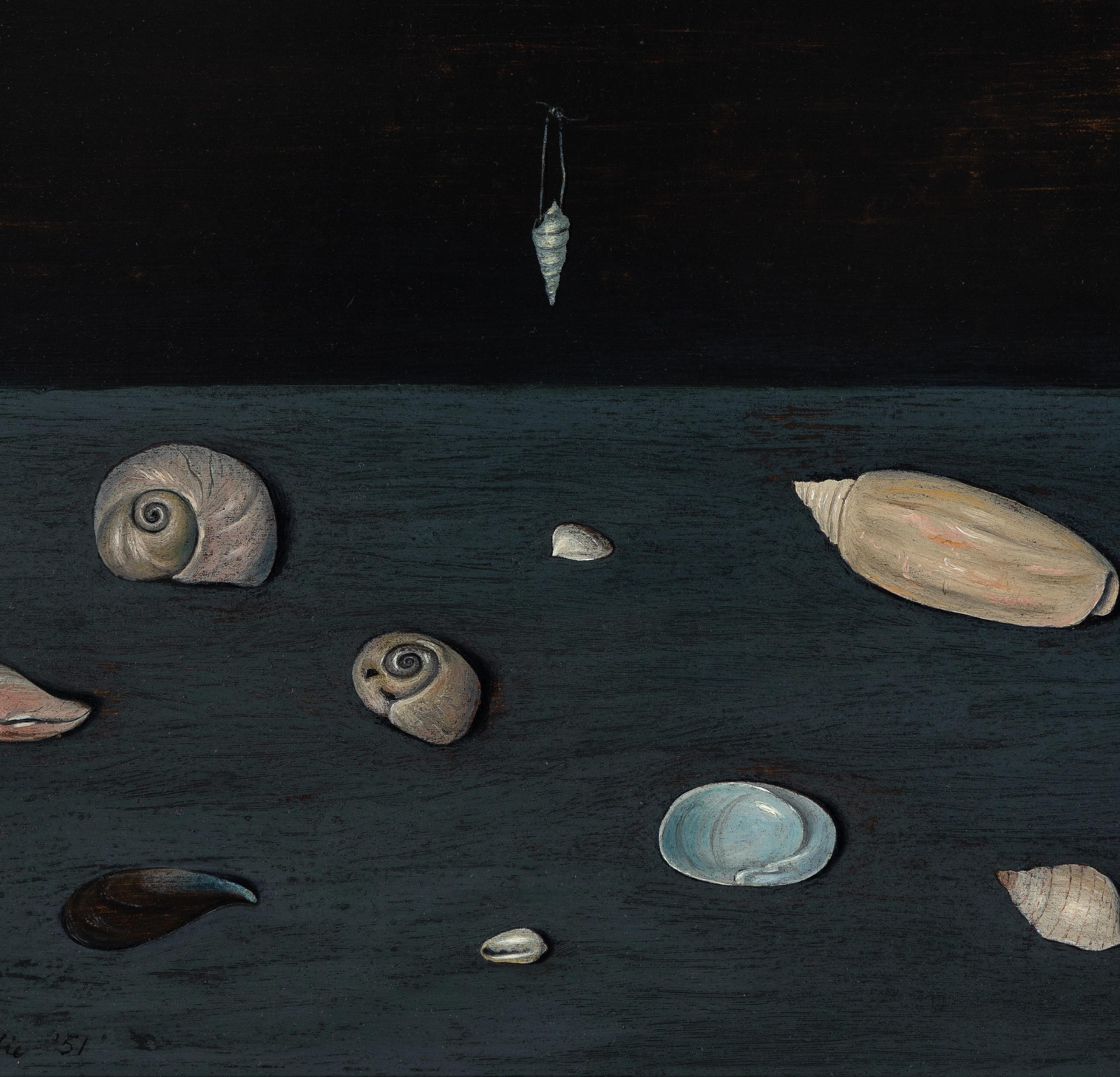
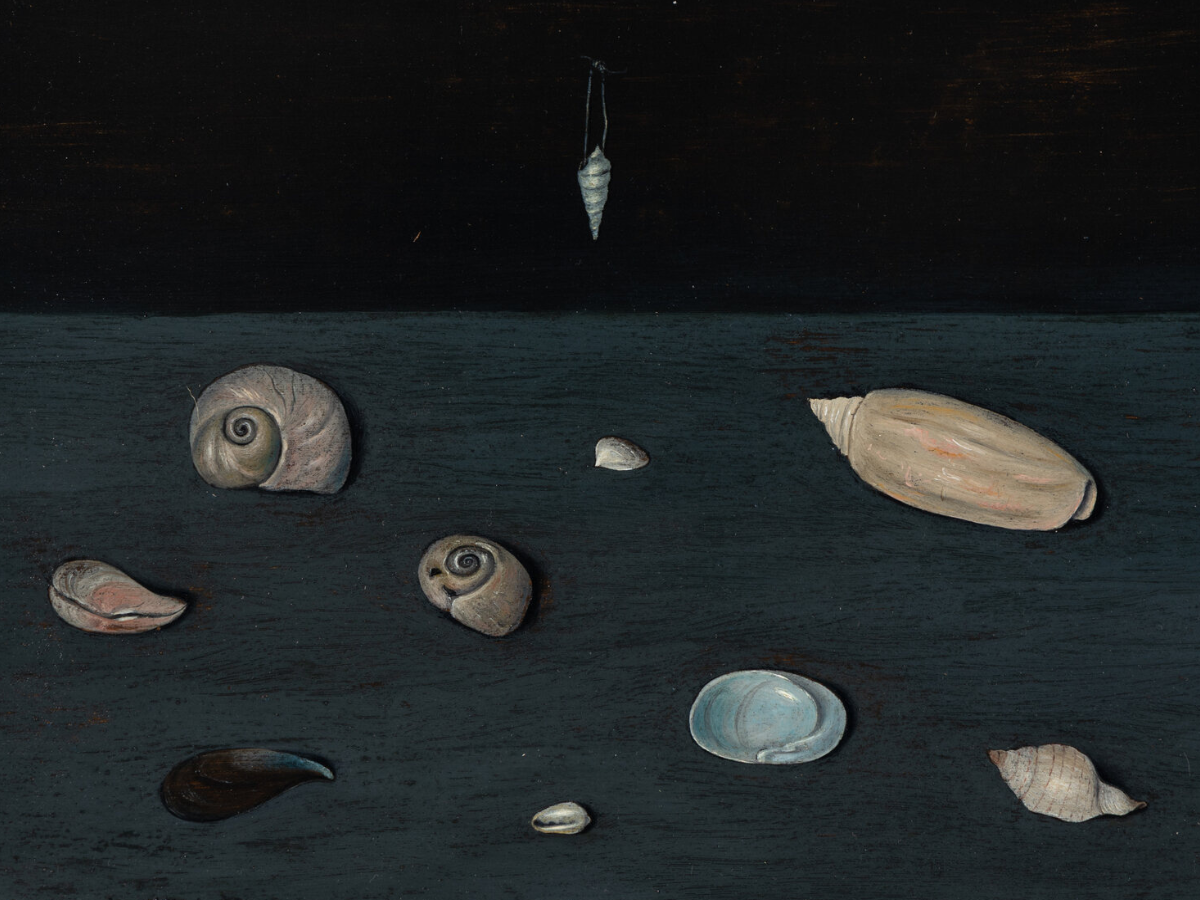
Painted in 1951, during one of the most prolific and formative periods of Abercrombie's career, Alderman Merriam’s Shells depicts an arrangement of nine sensitively rendered seashells resting on a stark, slate-gray surface, with a single conical shell suspended by a thread against a black wall — appearing to levitate above the rest. The shells belonged to Robert Merriam, Alderman of Chicago's Hyde Park neighborhood, where Abercrombie lived and worked. The painting is a rare instance of Abercrombie working directly from life, and offers new insight into her celebrated recurring shell motif: the smaller central nautilus shell bears a hole and crack echoed in her later solitary shell paintings, long presumed to be an invented motif but now confirmed as drawn from direct observation and memory.
For Abercrombie, the shell carried deep symbolic weight — a vessel of both protection and confinement, and a relic of a life once lived, transformed into an object of fascination. With its hypnotic spiral form, the shell often served as a talisman of friendship, typically gifted to those closest to her.
Alderman Merriam’s Shells was exhibited extensively during Abercrombie's lifetime, appearing in six of her solo exhibitions in 1952 and 1953, including shows at the Newman Brown Gallery and Steven Gross Studios in Chicago, the Edwin Hewitt Gallery in New York, the Bresler Gallery in Milwaukee, the Contemporary Arts Gallery in Evanston, and the Illinois Design Center in Chicago. In early 1952, Abercrombie gave the painting to Dr. John Reynolds of Kalamazoo, Michigan, in exchange for medical services. The work remained in Dr. Reynolds's collection for the rest of his life and was passed down through his estate — remaining unseen publicly for 75 years until its rediscovery this year, selling for a small fraction of its original $150 price tag.

Zack Wirsum
SVP, Head of Department, Post War and Contemporary Art
Mr. Wirsum joined the firm in 2007 as a Fine Art registrar and became a department specialist in 2013, with a focus on Post War and Contemporary art. Through his vision, the department has achieved record breaking prices. Mr. Wirsum evaluates and appraises well over 5,000 works of art each year, collaborating with leading international committees and experts on authentication. Prior to joining Freeman's, Mr. Wirsum served as an assistant director and conservator at the Chicago Conservation Center. He received a BFA from the School of the Art Institute of Chicago and is a practicing painter with gallery representation.