Condition Report
Contact Information
Lot 94
Sale 945 - Fine Printed Books & Manuscripts, Including Americana
Lots 1-307
Nov 9, 2021
4:00AM CT
Lots 308-687
Nov 10, 2021
4:00AM CT
Live / Chicago
Own a similar item?
Estimate
$5,000 -
7,000
Price Realized
$4,688
Sold prices are inclusive of Buyer’s Premium
Lot Description
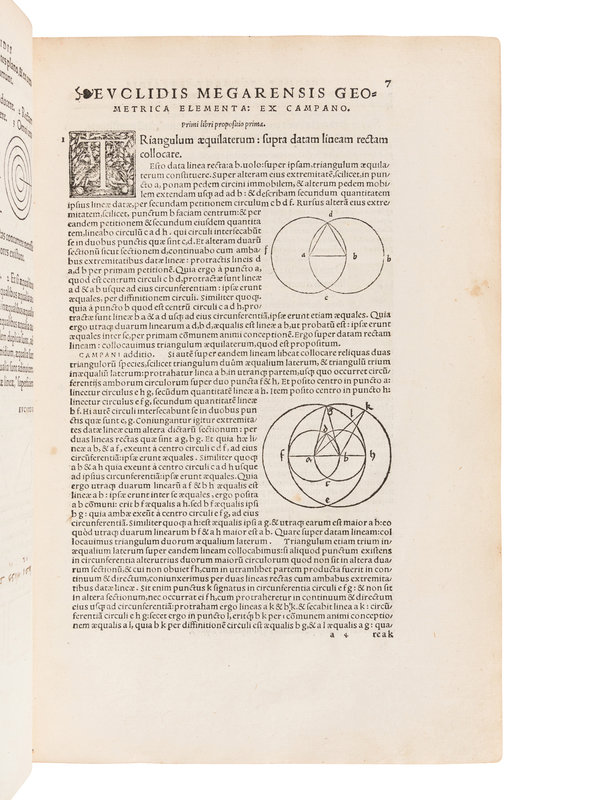
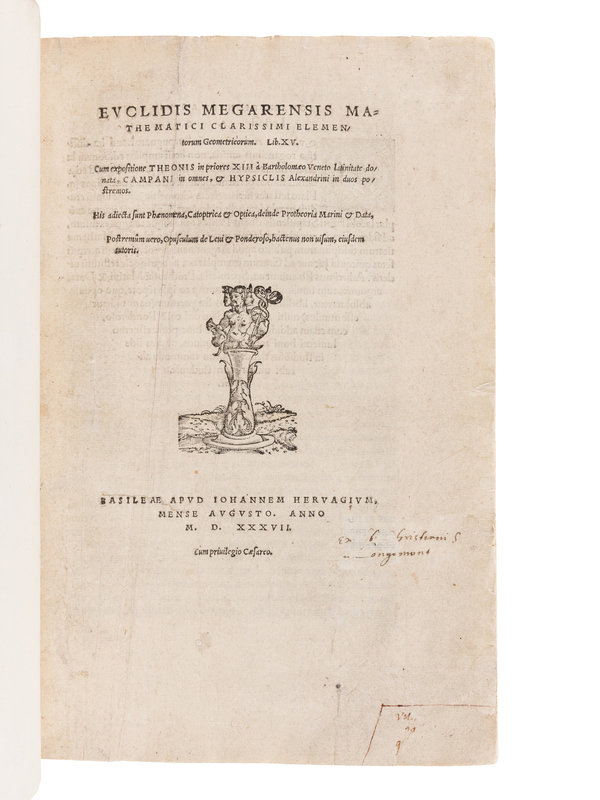
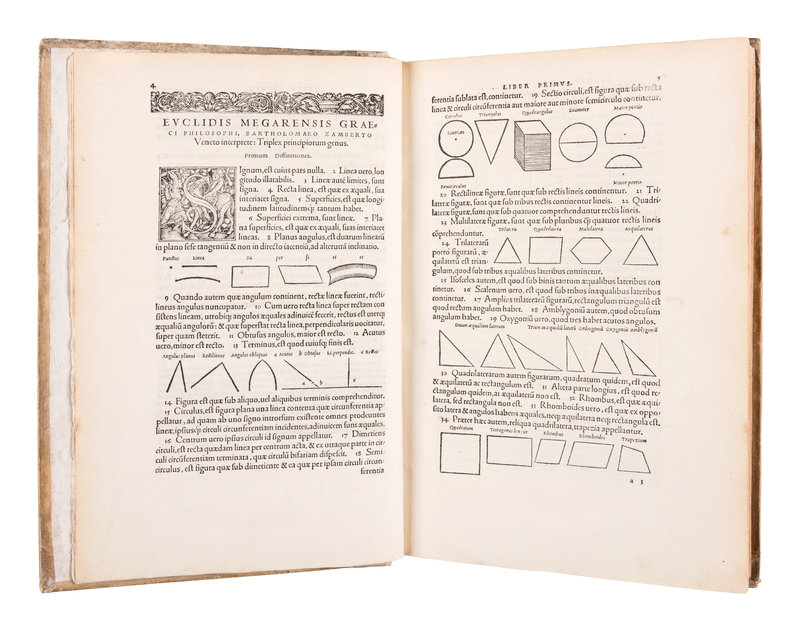
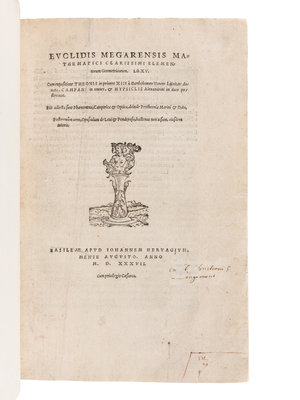
EUCLID (fl. ca 300 B.C.). Euclidis Megarensis Mathematici Clarissimi Elementorum Geometricorum Libri XV… Basel: Johann Herwagen, 1537.
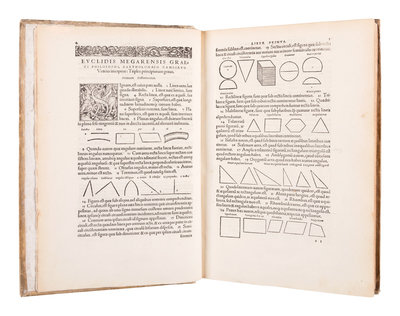
Folio (298 x 202 mm). Woodcut device on title-page, woodcut initials, woodcut illustrations. (Title torn crossing letters with old repair verso and lower corner renewed, closed tear on p.181 repaired, title slightly soiled). Contemporary vellum (endpapers renewed, slightly soiled). Provenance: Christen Sorensen Longomontanus (1562-1647), Danish astronomer (signature on title); Alexander Campbell (armorial bookplate).
FIRST HERVAGIUS EDITION OF EUCLID IN LATIN, containing the complete works derived from Zanetti's 1505 translation, and including comments by Campanus, Hypiciles, and the rare preface by Philip Melanchthon, removed by censors in many copies.
DANISH ASTRONOMER CHRISTEN SORENSEN LONGOMONTANUS'S COPY WITH HIS SIGNATURE.
Longomontanus was Tycho Brahe's assistant at the astronomical observatory of Uraniborg in 1589. There, Brahe, Longomontanus and Kepler worked to try to develop a theory to predict longitude at oppositions with complete accuracy. He had good "skill at manipulating observational data, and he may have played an important role in Tycho's remarkable research on the lunar theory" (DSB). He visited Frauenburg, where Copernicus had made his observations, and took a master's degree at Rostock. He was elected in 1605 to a professorship in the University of Copenhagen, where we became chair of mathematics in 1607, a position he held until his death.
Longomontanus developed Tycho's geoheliocentric model of the universe to public acceptance. When Tycho died in 1601, he had not yet completed his program for the restoration of astronomy. Though the observational aspects were complete, Longomontanus selected and integrated the data into accounts of the motion of the planets and presented the results, which he published in his Astronomia Danica of 1622. Though Kepler's Rudolphine Tables of 1627, based on Tycho's observations, are often believed to be more accurate than any previous tables, Longomontanus's tables, published in 1622, also based on Tycho's observations, were demonstrably more accurate. With several marginal annotations, presumably in Longomontanus’s hand. Adams H-974; Houzeau Lancaster 832.
Selections from the Property of Dr. Eugene Vigil, Antiquariat Botanicum