Condition Report
Contact Information
Lot 264
Sale 759 - Selections from the Library of Gerald and Barbara Weiner
Oct 8, 2020
10:00AM CT
Live / Chicago
Own a similar item?
Estimate
$400 -
600
Price Realized
$3,750
Sold prices are inclusive of Buyer’s Premium
Lot Description
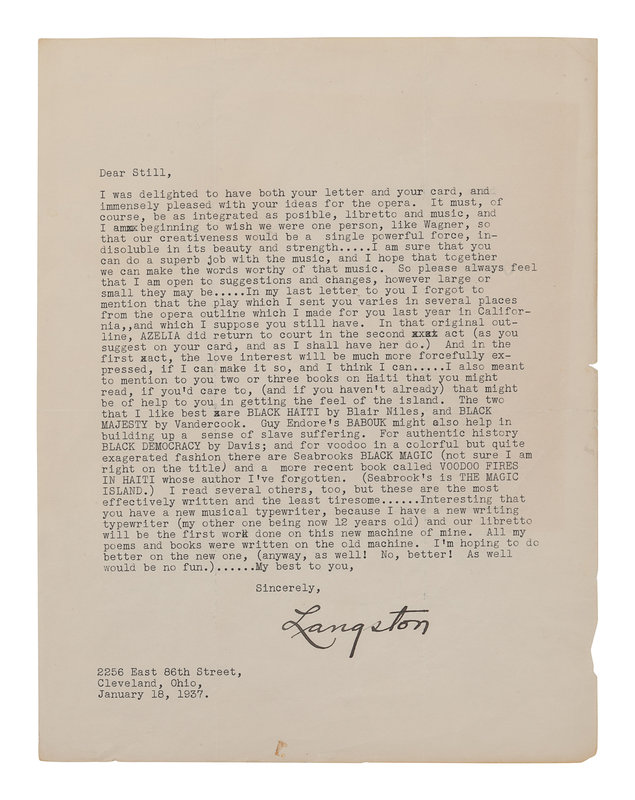
HUGHES, Langston (1901-1967). Typed letter signed (“Langston”), to William Grant Still. Cleveland, OH, 18 January 1937. 1 page, 8vo, small chips to left edge.
“I was delighted to have both your letter and your card, and immensely pleased with your ideas for the opera.”
Hughes writes to African American composer William Grant Still (1895-1978) regarding their collaboration on the opera Troubled Island about the life of Jean-Jacques Dessalines (1758-1806) and the Haitian Revolution. He muses on their creative partnership: “It must, of course, be as integrated as posible [sic], libretto and music, and I am beginning to wish we were one person, like Wagner, so that our creativeness would be a single powerful force, indissoluble in its beauty and strength…..I am sure that you can do a superb job with the music, and I hope that together we can make the words worthy of that music. So please always feel that I am open to suggestions and changes, however large or small they may be.”
Hughes shares several titles on Haiti with Still that he has read in preparation. He also notes, “Interesting that you have a new musical typewriter, because I have a new writing typewriter (my other one being now 12 years old) and our libretto will be the first work done on this new machine of mine. All my poems and books were written on the old machine. I’m hoping to do better on the new one, (anyway, as well! No, better! As well would be no fun.)”
Though Hughes began the libretto in 1936 and showed enthusiasm for the project, he left the project to report on the Spanish-American War for the Baltimore Afro-American. The libretto was finished by Verna Arvey (1910-1987), but the opera would not be performed until 1949, when it premiered on March 31 at the New York City Opera. Notably, it was the first grand opera composed by an African American composer to be produced by a major company.