Condition Report
Contact Information
Lot 66
Sale 6560 - The Fathers and Saviors of Our Country: A Presidential Sale
Mar 26, 2026
10:00AM CT
Live / Chicago
Own a similar item?
Estimate
$40,000 -
60,000
Price Realized
$38,400
Sold prices are inclusive of Buyer’s Premium
Lot Description
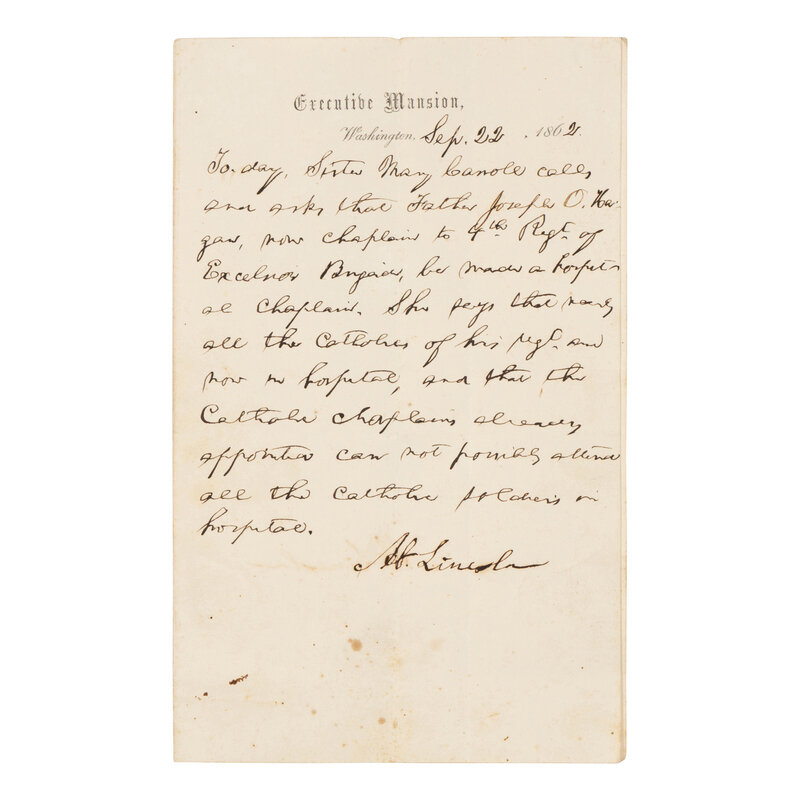
LINCOLN, Abraham (1809-1865). A hitherto unpublished autograph memorandum, Washington, D.C., 22 September 1862.
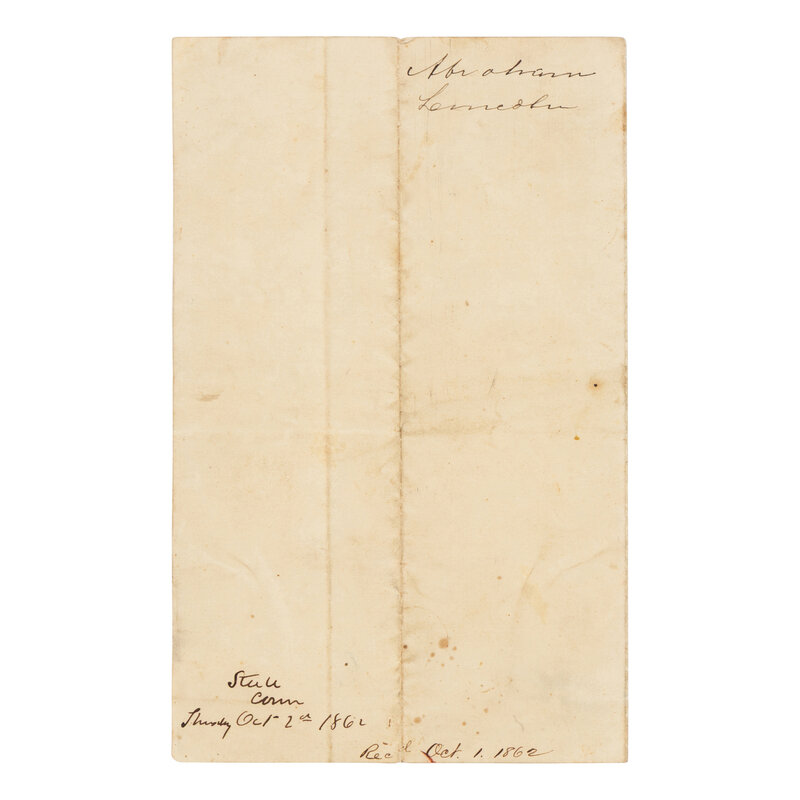
One page on bifolium, 8vo (203 x 127 mm), on Executive Mansion stationery, old vertical folds, light spotting, minor offsetting from a contemporary signature ("Ab. Lincoln") in unknown hand. Docketed on verso twice, “State comm. / Thursday Oct 2nd 1862 / Rec’d Oct. 1 1862.”
LINCOLN APPOINTS A HOSPITAL CHAPLAIN ON THE SAME DAY HE ISSUES THE PRELIMINARY EMANCIPATION PROCLAMATION—ONE OF ONLY FOUR EXTANT DOCUMENTS IN LINCOLN’S HAND FROM THIS HISTORIC DAY.
In full: “Today, Sister Mary Carroll calls and asks that Father Joseph O’Hagan, now chaplain to 4th Regt of Excelsior Brigade, be made a hospital Chaplain. She says that nearly all the Catholics of his regt. are now in hospital, and that the Catholic Chaplains already appointed cannot possibly attend all the Catholic soldiers in hospital.”
In the summer of 1862, New York-Tribune editor Horace Greeley published a scathing editorial entitled “The Prayer of Twenty Millions,” which harshly criticized President Abraham Lincoln for what Greeley viewed as his not being aggressive enough in defeating the Confederacy and freeing the slaves within its borders. At one point, the fiercely abolitionist editor wrote, “We complain that you…elected as a Republican, knowing full well what an abomination Slavery is…seem never to interfere with its atrocities, and never give a direction to your military subordinates…”
Lincoln, who had spent the last few months secretly drafting a preliminary proclamation formally emancipating all slaves in Confederate-held territories, was nonetheless incensed by Greeley’s editorial. Wanting to keep his cards close to his vest, Lincoln’s response as published in the Tribune on 22 August 1862 forcefully asserted, “If I could save the Union without freeing any slave I would do it, and if I could save it by freeing all the slaves I would do it; and if I could save it by freeing some and leaving others alone, I would also do that.”
The preliminary draft was first read to the cabinet on 13 July, and many expressed horror at the idea, believing that emancipating at such a fragile moment in the conflict would either signal weakness or attract additional foreign support for the Confederacy. It was agreed that such a proclamation could be issued only following a major Union victory, which finally came on 17 September with the Confederate defeat at Antietam.
Five days later, Lincoln convened his cabinet and announced that he would be issuing the Preliminary Emancipation Proclamation, saying that "I made a solemn vow before God, that if General Lee was driven back from Pennsylvania, I would crown the result by the declaration of freedom to the slaves."
On this day, Sister Mary Carroll paid a visit to the Executive Mansion to request that Father Joseph O’Hagan, then serving as chaplain to the 73rd New York Fire Zouaves under General Daniel Sickles’s Excelsior Brigade, be appointed a hospital chaplain in order to accommodate the lack of Catholic chaplains available at the time. O’Hagan had been elected chaplain by 73rd in September 1861, despite his not yet having finished his formal Jesuit training. The young priest was initially horrified by the men who had chosen him as their chaplain, writing that “Most of them were the scum of New York society… Fighting was their normal condition, and when they could not meet a common enemy, their kept ‘their hand in it’ by daily skirmishes among themselves…”
Despite this rough first impression, O’Hagan came to love and respect the men of the 73rd, with O’Hagan and another priest even being captured by Confederate troops on 30 June 1862 while looking after wounded Union soldiers. It may have been this event, having taken place so recently, that inspired Sister Mary Carroll to petition President Lincoln to transfer him to what may have been considered a safer position for a man of the cloth. Ultimately, Father O’Hagan remained where he was and was present with General Sickles at Gettysburg when, on 2 July 1863, Sickles was severely wounded by a cannonball that blasted through his right leg. O’Hagan accompanied Sickles off the field and later went with him to Washington to oversee his recovery before returning to Gettysburg to attend to the wounded who remained. A month later, O’Hagan was ordered to return to Maryland to finish his Jesuit vows. Upon completion, he immediately reenlisted with the 73rd and would accompany them into Richmond on 3 April 1865, effectively signaling the end of the Civil War. (cf. Miller, Faith of the Fathers, pp.115-117).
Sister Mary Carroll was a member of the Sisters of Charity, a Catholic society that, during the Civil War, provided nursing services to wounded soldiers. Born in Ireland in 1836, she emigrated to the United States in the 1850s. In 1862, she was tapped by Dr. John Shaw Billings to head a corps of nurses operating out of Cliffburne General Hospital in Washington. Years later, Dr. Billings would write that “These were the first Catholic sisters employed in the military hospitals in this vicinity…and I made special request that Sister Mary Carroll should be sent in charge, being assured of her knowledge, zeal, and loyalty. The result more than confirmed my expectations.” Over the course of the war, her health became increasingly fragile, necessitating a transfer to New Orleans in 1865, though with her reputation and value so well established that she continued to collect a salary from Cliffburne, which she donated to the patients in her care. In 1888, her sister applied to Congress on her behalf for a pension owing to her ill health, accompanied by letters of recommendation from Billings, General P.H. Sheridan, General Sickles, and Surgeon General William Hammond. In considering her case, it was written that “She was one of the good sisterhood who, in war or peace alike, are the aids of suffering humanity… She did all that she could to help her country, and at last surrendered her health.” The pension was ultimately granted in gratitude for her good works.
The issuing of the Emancipation Proclamation is widely credited as having played a key role in the Union victory, as it instilled in Union soldiers a sense of a heavenly duty to oversee the decisive end of slavery in the United States. The present memorandum, one of only four surviving documents in Lincoln’s hand dated September 22, 1862, is the only one to relate in any way to religion or divinity as well as his only surviving interaction with a member of the Sisters of Charity.
The “Ab. Lincoln” signature: In 2011, analysis was conducted comparing the ink of the signature to that of the body of the document. The results revealed differences between the two; however, both inks exhibited similar Raman spectral peaks and were identified as iron gall ink. The body of the text is unquestionably in Lincoln’s hand and is not in dispute. The signature, however, cannot be conclusively attributed to Lincoln at this time and warrants further study. It is possible that the "Ab. Lincoln" was added by a clerk upon receipt at the War Department in order to mark it as high priority, as it was common practice at the time to abbreviate the first name of public figures in official correspondence (see: letter from Allen Francis to Abraham Lincoln, 12 June 1849; Report of Speech at Vandalia, Illinois, 23 September 1856 as published in the Daily Democratic Press [Chicago, 27 September 1856]; letter from Leander Mussell to Abraham Lincoln, 16 August 1858.)
REFERENCES:
Not in Basler
This lot is located in Chicago.