Condition Report
Contact Information
Lot 177
Sale 6560 - The Fathers and Saviors of Our Country: A Presidential Sale
Mar 26, 2026
10:00AM CT
Live / Chicago
Own a similar item?
Estimate
$20,000 -
30,000
Price Realized
$25,600
Sold prices are inclusive of Buyer’s Premium
Lot Description
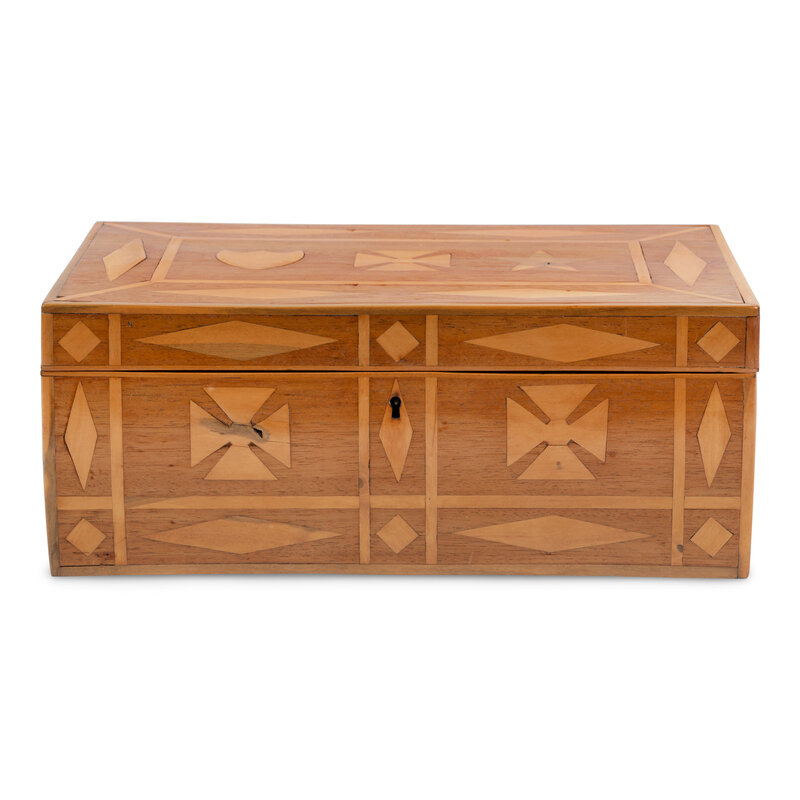
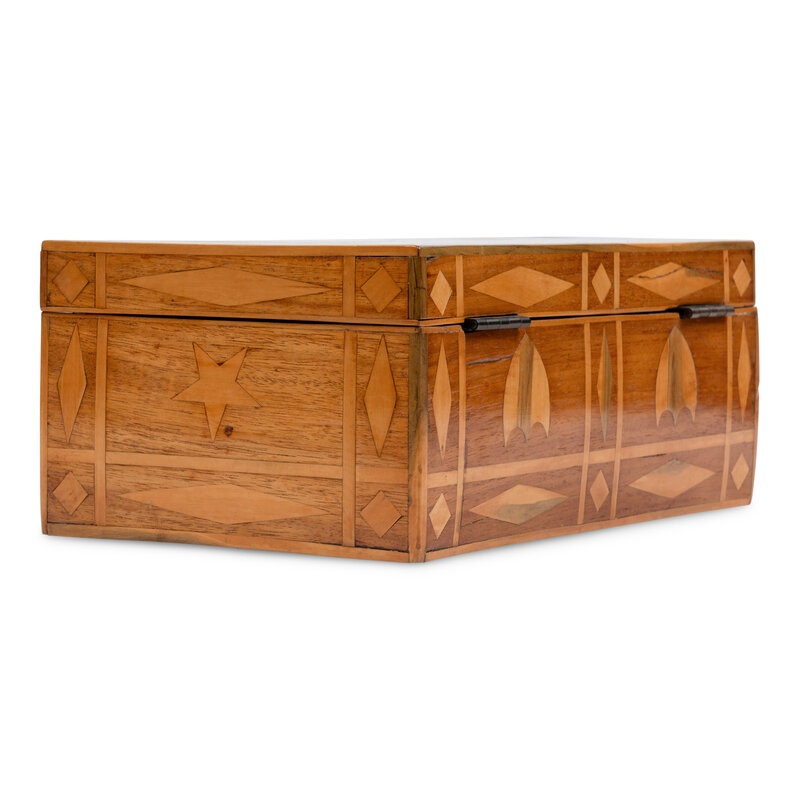
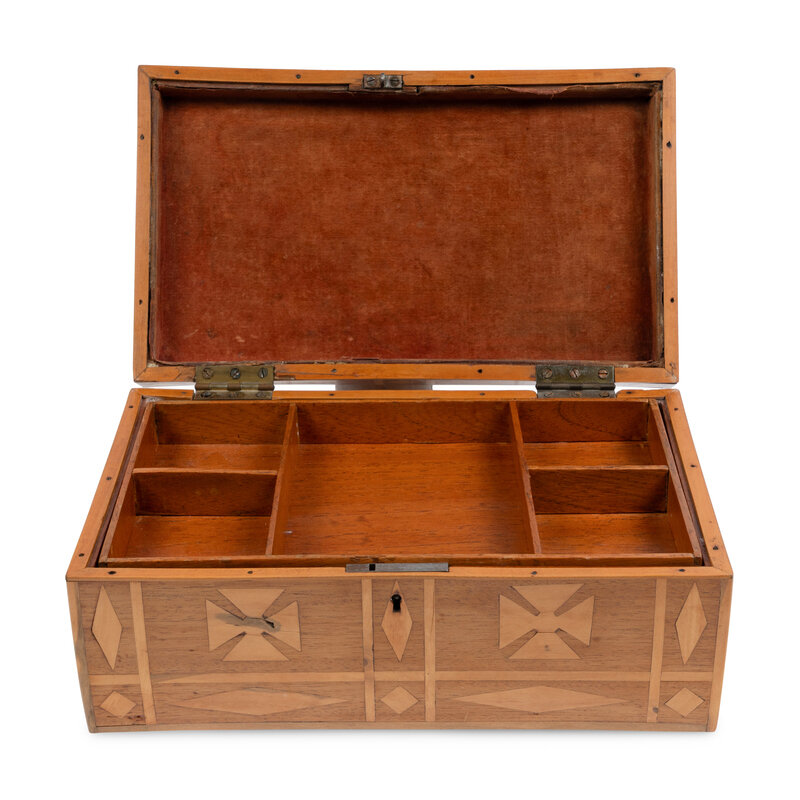
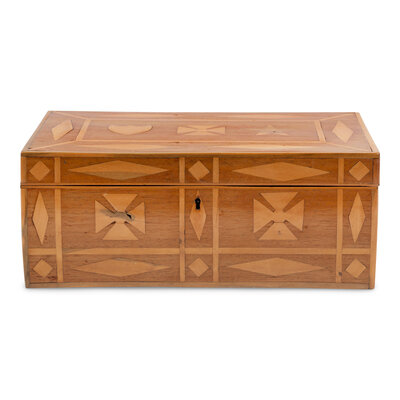
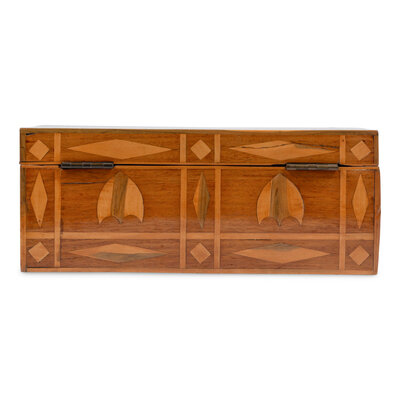
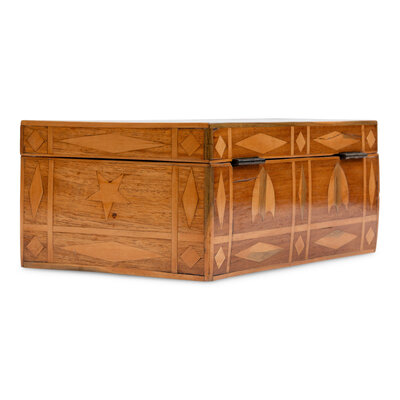
[LINCOLN CONSPIRATORS]. A marquetry box constructed by Lincoln conspirator Dr. Samuel Mudd while imprisoned at Fort Jefferson, ca 1867.
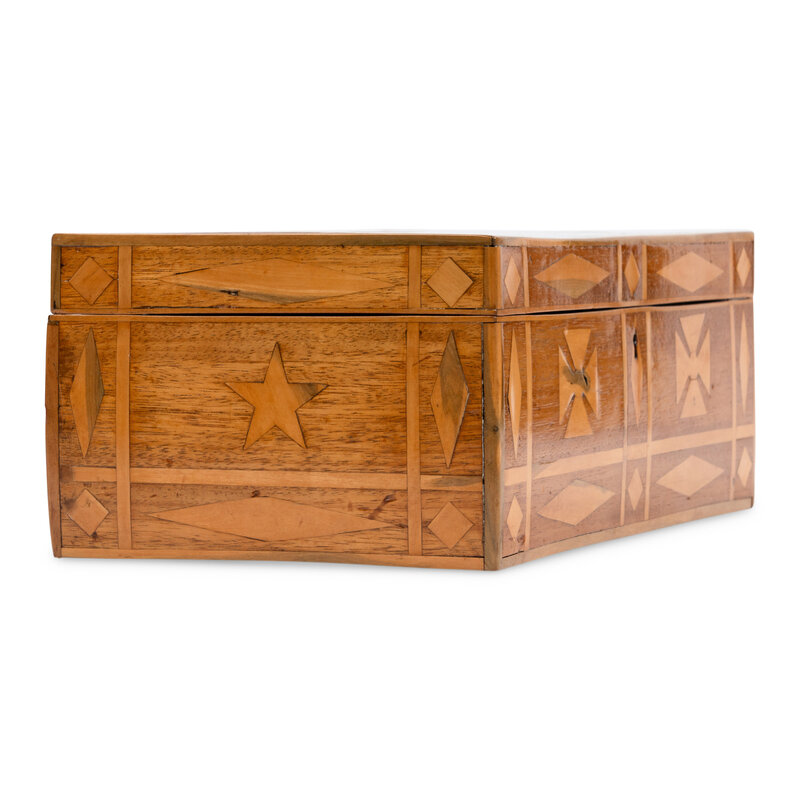
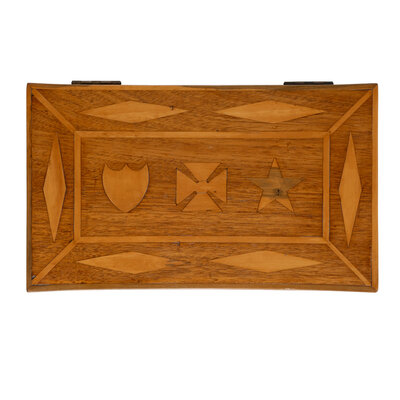
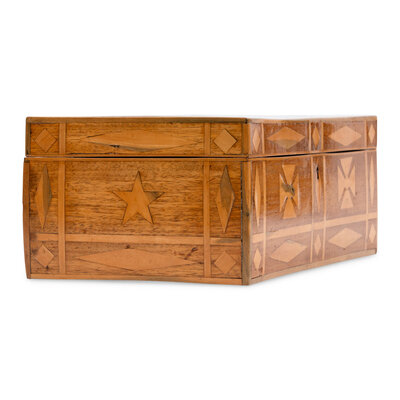
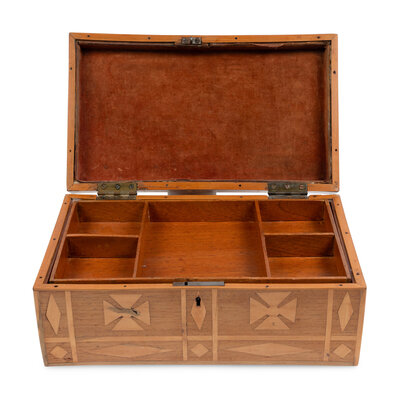
Marquetry box constructed of olive wood with inlay decorations, felt-lined lid, with lift-out tray, lock (lacking key). 12 1/4 x 5 x 7 3/4 in. Minor light scratches and dents, minor restoration to lid.
ONE OF FEW EXTANT MARQUETRY BOXES CONSTRUCTED BY LINCOLN CONSPIRATOR DR. SAMUEL MUDD, WHILE IMPRISONED AT FORT JEFFERSON.
On 29 June 1865, a sentence was handed down to Dr. Samuel Mudd and seven others for their various roles in the assassination of President Abraham Lincoln. While four were sentenced to hang, Dr. Mudd, Edmund Spangler, Michael O'Laughlen, and Samuel Arnold were ordered imprisoned at Fort Jefferson, an island fortress off the coast of Florida, which had primarily housed military prisoners throughout the American Civil War.
By war's end, Fort Jefferson had become notorious for its horrific living conditions. Overcrowded and subject to frequent hurricanes and brutal heatwaves, prisoners also had to contend with cholera and yellow fever epidemics, bed bugs, mosquitoes, and rationed fresh water, as well as being forced to wear balls and chains whenever they were out of their cells. Upon catching his first glimpse of the island that was to be his prison, Mudd began to nervously pace the deck, wringing his hands and exclaiming over and over again, "There is no hope for me!"
Despite assuring his captors that escape from the island prison was impossible, Mudd attempted to do just that by stowing away on the transport Thomas A. Scott on 25 September 1865. According to Mudd, "thirty or forty" prisoners had managed to get off the island by hiding aboard supply ships in previous months. Mudd, however, was so well-known that his absence was immediately noticed, and he was quickly recaptured. Mudd lost his work privileges in the prison hospital and was put to work in the carpentry shop along with Edmund Spangler and Samuel Arnold, both of whom had previously worked in the trade before their arrest. By summer 1866, Mudd had become quite adept at constructing small items from driftwood, writing to his wife on 23 August, "With the exception of bread and coffee, we subsist ourselves entirely making little work boxes, picture frames, which we shell and inlay with different colors of wood." (See The Life of Dr. Samuel Mudd, edited by Nettie Mudd, pp.204-206).
In the fall of 1867, the long-feared yellow fever epidemic finally hit Fort Jefferson, with Michael O'Laughlen and 5th Artillery surgeon Joseph Sim Smith among its first victims. As the only prisoner on the island with medical training, Dr. Mudd took over and is credited with stemming the tide of the disease. In gratitude, a petition was circulated among the soldiers on the island which read in part, "He inspired the hopeless with courage and by his constant presence in the midst of danger and infection.... [Many] doubtless owe their lives to the care and treatment they received at his hands." Mudd was transferred out of the carpentry shop shortly afterwards.
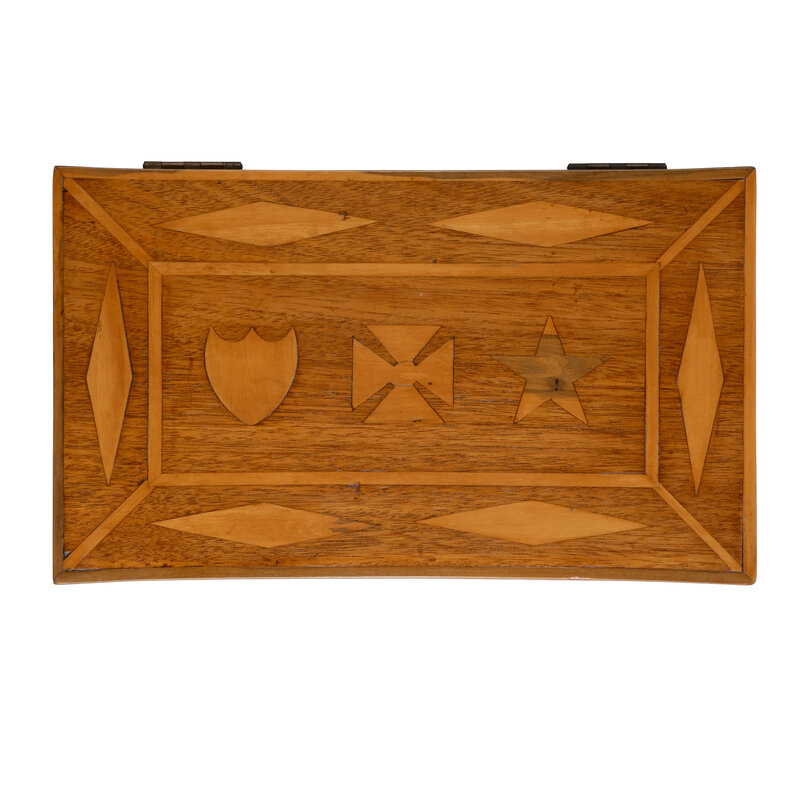
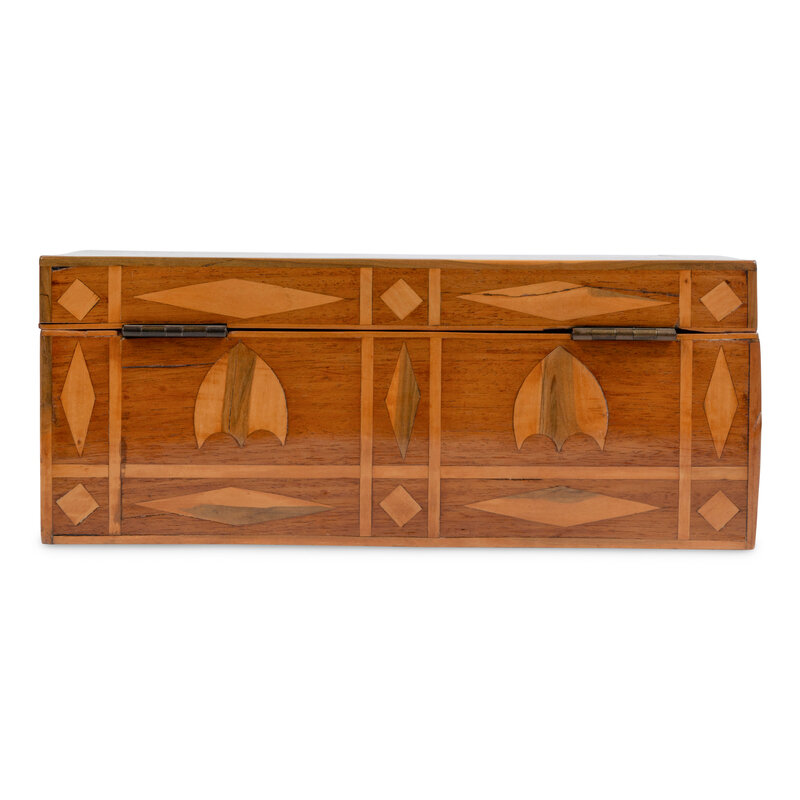
Among the signatories to Mudd's petition was Private William Henry Ward (1834-1879), who worked at Fort Jefferson as a butcher. The present box is unique among others constructed by Mudd in that its lid is adorned not with the name of its intended recipient but with a United States patriotic shield, a Union Army V Corps cross, and a Union Army 1st Division badge. Interestingly, two shields on the rear of the box are rendered upside down, an international sign of distress.
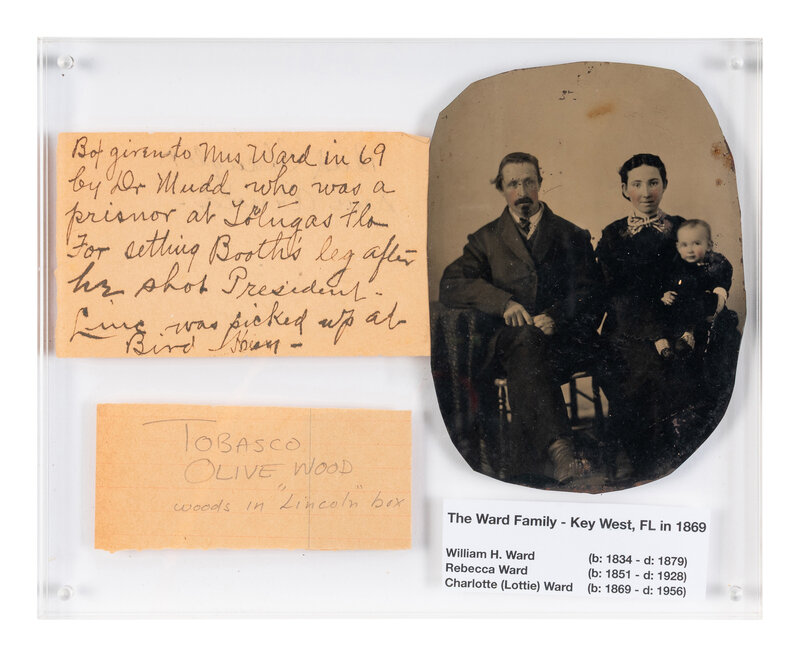
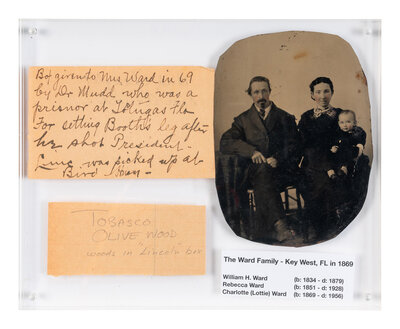
A note accompanying the box, with a half plate tintype of Ward and his family, reads, "Box given to Mrs. Ward in '69 by Dr. Mudd, who was a prisoner at Tortugas Fla for setting Booth's leg after he shot President Linc. was picked up at Bird Key." On the verso are the names "Bud Spangler" and "Sam Arnold," suggesting that all three prisoners worked on this box together. (A box of similar design and construction was previously sold through Cowan's Auctions in 2005 with a note inside identifying it as being the work of all three men.) The box descended through Ward's family, first to his daughter Charlotte (1869-1941) and then to Charlotte's daughter, Venice Kemp Hayes Christensen Kennison (1892-1964). Charlotte Ward married silent film actor Frank R. Hayes (1872-1923) in 1899, and the family moved to Los Angeles, California, in 1916.
With the number of living Civil War veterans dwindling by the day during this period, the United States began utilizing the new medium of motion pictures to reconsider and revise its historical interpretations of the war and its causes, the most notorious example being D.W. Griffith's The Birth of a Nation (1915). Among those reconsidered historical figures was Dr. Mudd, whose daughter Nettie had published a biography of her father in 1906. On 2 May 1938, Nettie appeared on Cecil B. DeMille's Lux Radio Theatre to help present a radio adaptation, prompting Venice's half-brother W.A. Christensen (founder of the National Eye Dog Association to Aid the Blind), to write DeMille two days later, requesting Nettie Mudd's address so his mother could write to her. In this letter, Christensen discusses in detail the circumstances under which the box was gifted, as well as an attempt by Florida Governor Albert W. Gilchrist to purchase it from his family two decades prior.
During one of Venice's visits back to Florida from New York City where she worked as an actress, she met and befriended a little girl singing in a Sunday school class named Gloria Swanson. According to Swanson, "Afterward a pretty lady who was visiting the class told me I had a very nice voice... Her name was Venice Hayes... A week later she called Mother up and invited us over. Her father [Frank Hayes] wanted to hear me sing... [He] was helping the local people to put on a show, after he heard me sing he asked Mother if I could be in it." (Swanson on Swanson, p.18). Upon Swanson's arrival in California, she renewed her acquaintance with the Hayes family. Following Venice's death in 1964, the box was passed on as part of her estate to Mr. Robert Clark and Mr. David Darley, who later gifted it to the present consignor.
PROVENANCE:
Dr. Samuel Mudd (1833-1883);
By gift to William H. Ward (1834-1879), butcher at Fort Jefferson and signer of the petition to pardon Dr. Samuel Mudd;
By gift (1869) from Mudd to Rebecca Ward (1851-1928), wife of the above;
By descent to Charlotte Ward Christensen Kemp Hayes (1869-1956), daughter of the above;
By descent to Venice Kemp (Hayes) Christensen Kennison (1892-1964), American actress and daughter of the above;
Inherited by Mr. Robert Clark and Mr. David Darley from the above Estate;
By gift (2024) from the above to the present owners, The Lane/Ortiz Trust
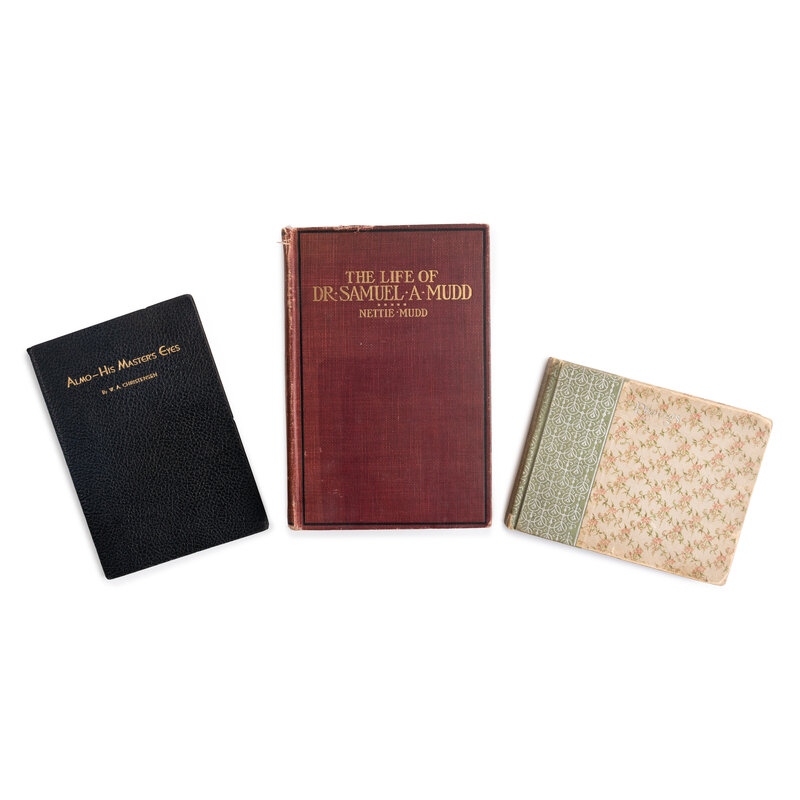
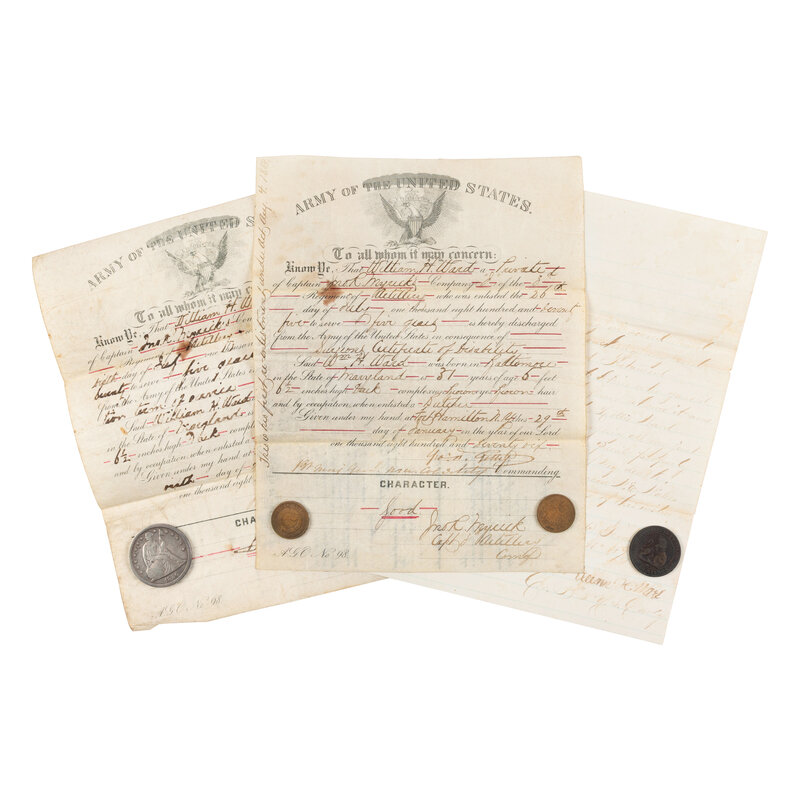
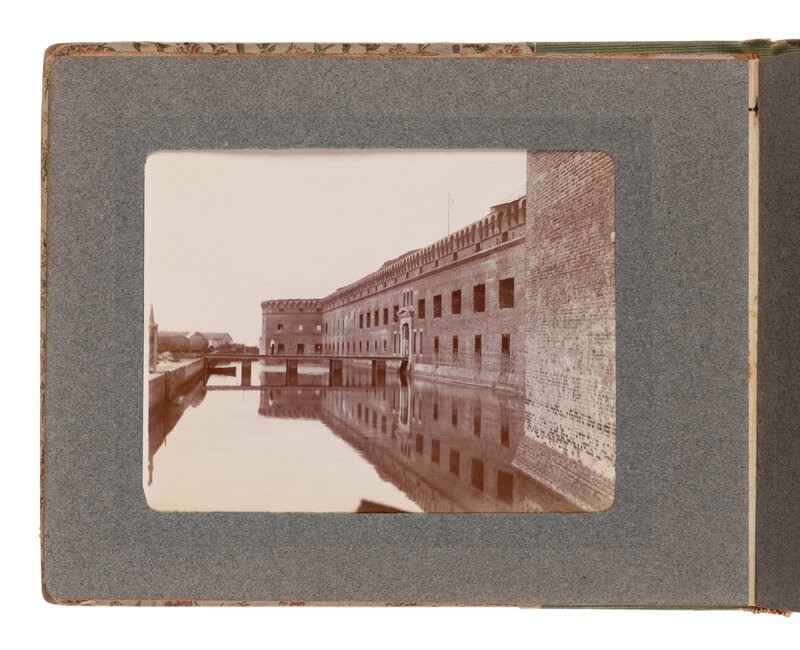
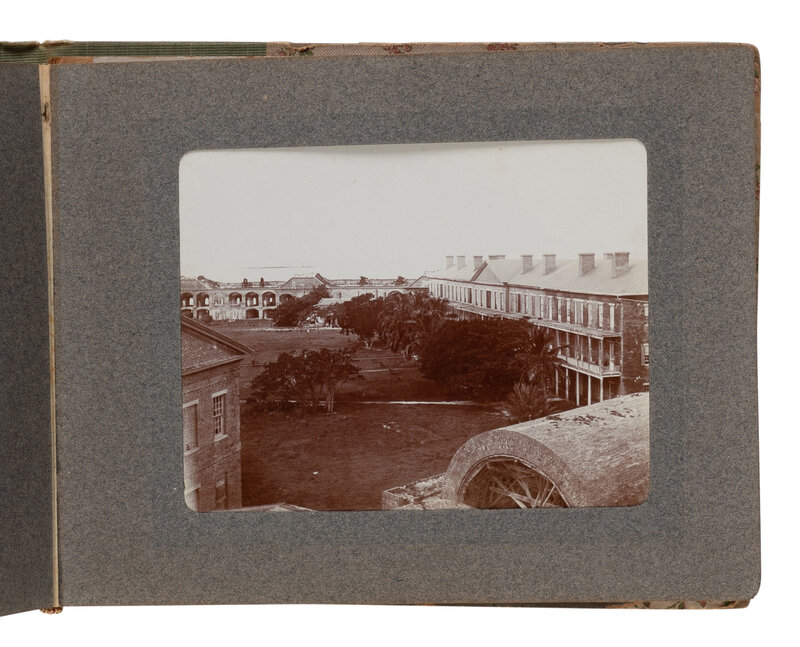
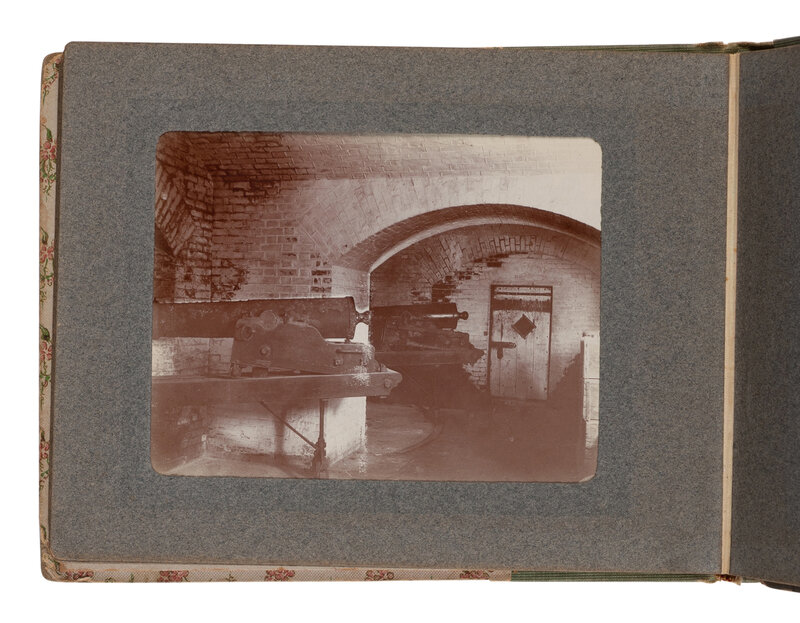
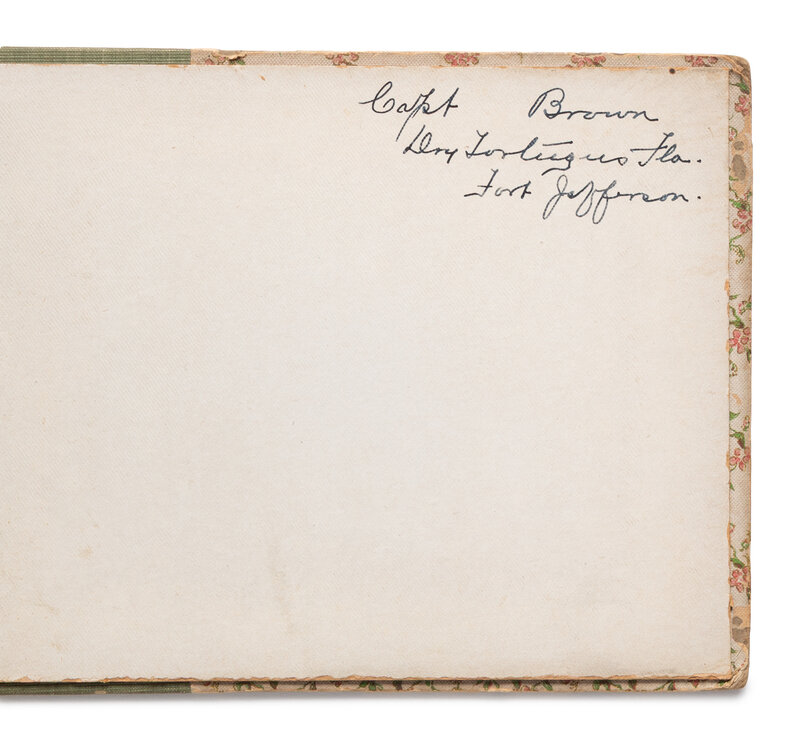
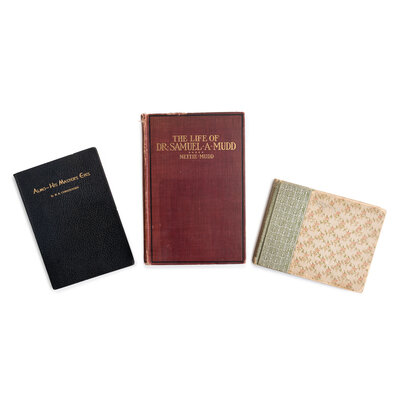
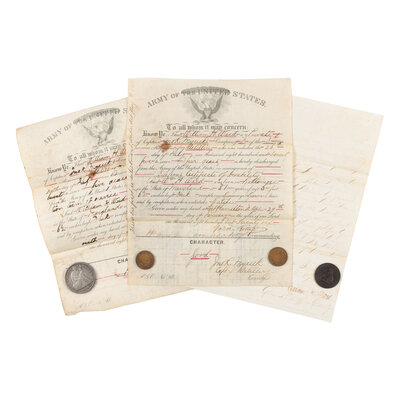
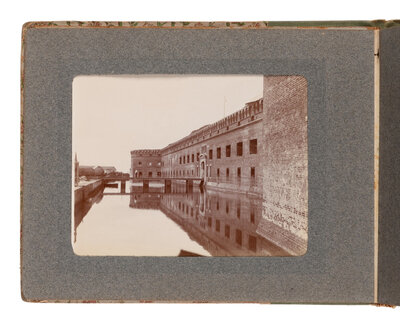
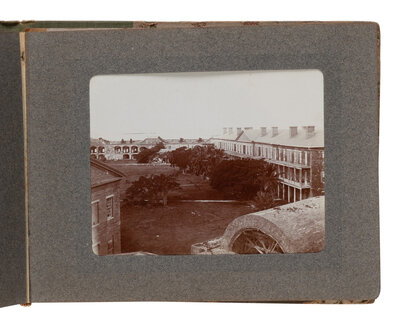
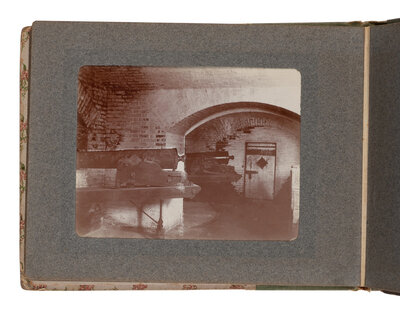
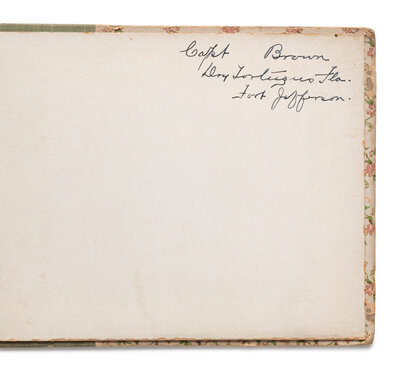
[With]: An extensive archive of materials related to the marquetry box constructed by Dr. Samuel Mudd during his imprisonment at Fort Jefferson, and the related provenance above, including: 1) A group of 3 vellum discharge documents related to William H. Ward's service in the United States Army, 1867-1875. -- 2) A manuscript document signed ("William H. Ward"), Fort Clark, Texas, 16 May 1879. Ward's last will and testament bequeathing all of his personal property to his daughter, Lottie Ward. -- 3) A group of 10 boudoir cards depicting various scenes of Fort Jefferson, ca late 19th century. -- 4) A small photo album with 13 snapshot photographs of various scenes at Fort Jefferson, including a view of Dr. Samuel Mudd's cell, ca early 20th century. Ownership inscription on rear pastedown of "Capt. Brown, Dry Tortugas, Fla. Fort Jefferson." -- 5) MONROE, Nettie Mudd (1878-1943). The Life of Dr. Samuel A. Mudd. New York and Washington: The Neale Publishing Co., 1906. Original red cloth gilt. -- 6) CHRISTENSEN, William A. (1885-1940). Typed letter to Cecil B. DeMille dated 4 May 1938, inquiring about the current address of Nettie Mudd Monroe. -- 7) [DEMILLE, Cecil B. (1881-1959)]. Typed letter on Cecil B. deMille Productions letterhead dated 11 May 1938, with current address of Nettie Mudd Monroe and signed by deMille's longtime secretary Gladys Rossen. -- 8) A group of newspaper clippings, books, etc. related to the above, neatly housed in a large binder.
The Lane/Ortiz Trust
This lot is located in Chicago.