Condition Report
Contact Information
Lot 166
Sale 6560 - The Fathers and Saviors of Our Country: A Presidential Sale
Mar 26, 2026
10:00AM CT
Live / Chicago
Own a similar item?
Estimate
$800 -
1,200
Price Realized
$1,024
Sold prices are inclusive of Buyer’s Premium
Lot Description
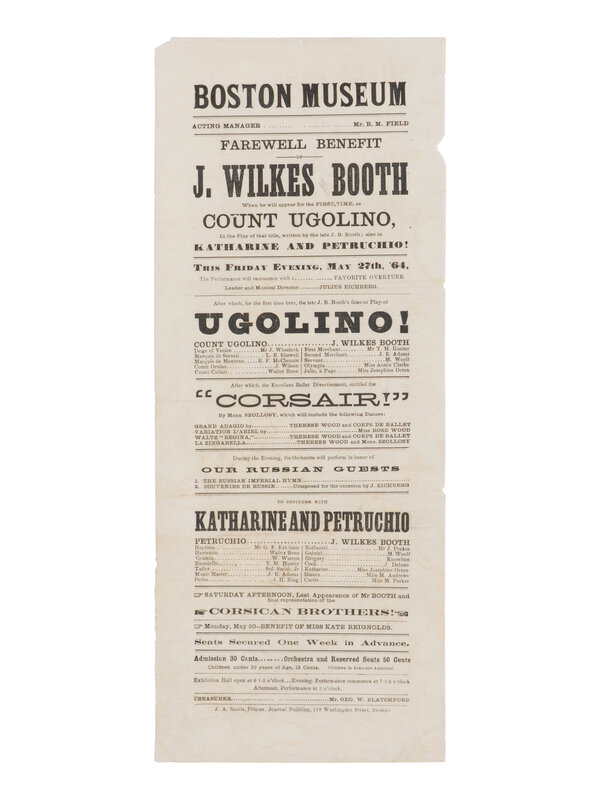
[BOOTH, John Wilkes (1838-1865)]. A broadside playbill for Booth's performance as Count Ugolino in the play of the same title at the Boston Museum, 27 May 1864.
14 x 5 1/2 in. printed broadside. (Old folds, some minor marginal losses, minor dampstaining.)
BOOTH'S FINAL PERFORMANCE OF HIS 1864 BOSTON ENGAGEMENT, THE LAST MAJOR RUN OF HIS CAREER.
On 25 April 1864, John Wilkes Booth began a monthlong engagement at the Boston Museum in which he performed in numerous plays, including Romeo and Juliet, The Marble Heart, and The Corsican Brothers. This engagement is also notable for being the one during which Booth met Isabel Sumner, a sixteen-year-old girl with whom he would exchange numerous letters and gifts for over two months following its end.
Count Ugolino, as noted in the text of the playbill, was written by Booth's father, the tragedian Junius Brutus Booth, Sr., and is believed to be his only original work. Its first performance was at Philadelphia's Arch Street Theatre on 20 April 1825 as a benefit for the actor Henry Wallack. Though well-reviewed at the time, the play failed to find an audience and was performed only sparingly over the ensuing decades. A notice in the Boston Daily Evening printed shortly before the performance read, "We have not the slightest idea what the character is...[though] it is said to possess many passages of rare poetic beauty."
This engagement was the longest of Booth's theatrical career, and the young star chose to end it with his father's play as a birthday tribute. Booth would appear onstage as a performer only three more times, in November 1864 and in January and March 1865. His final performance took place at Ford's Theatre on 18 March 1865 in a benefit for his friend John McCullough. Less than a month later, Booth would assassinate Abraham Lincoln in the very same theatre.
This lot is located in Chicago.