




Condition Report
Contact Information
Lot 7
Sale 6479 - Asian Works of Art
Mar 27, 2026
10:00AM ET
Live / New York
Own a similar item?
Estimate
$2,000 -
3,000
Price Realized
$5,760
Sold prices are inclusive of Buyer’s Premium
Lot Description
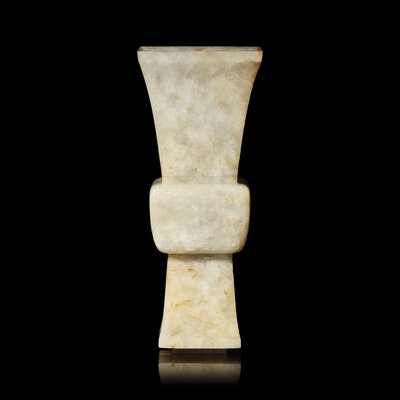
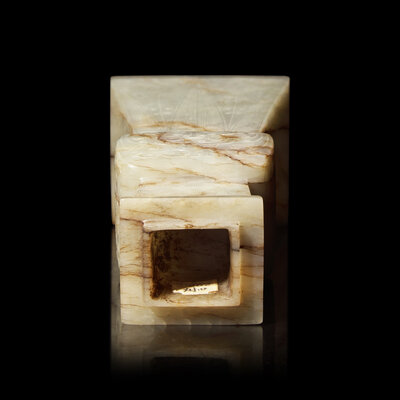
A Chinese Jade Gu Vase, 18th Century
清中期 玉花觚
清中期 玉花觚
18th Century
Carved from verigated beige jade, this piece features a finely-carved stylized beast motif on each side of its central section, while the upper and lower registers are adorned with continuous plantain leaf motifs as a deliberate evocation of its bronze age predecessors.
Note:
The gu form, originating from Neolithic earthenware wine vessels, ranks among the earliest ritual vessel types. Its bronze counterpart first emerged in the late Erlitou period, though it did not become prevalent until the late Shang dynasty (13th century BC). Most examples were cast in a circular section, while rectangular examples remain exceptionally rare. The typical gu is characterized by a slender stem, flared mouth, and splayed foot, creating an elegant silhouette.
The three registers of a gu were typically fully decorated. The upper and lower sections commonly feature plantain leaf motifs, while the middle register is centered by a beast mask (taotie).
During the Song dynasty and later periods, literati and antiquarians revived the gu form, often recreating it with increasingly ornate patterns. The Qianlong Emperor also paid tribute to this archaic ritual vessel; for a closely comparable example, bearing a similar decoration and an imperial poem inscribed to the interior, see the piece in the collection of the Taipei Palace Museum (accession no. 故玉002484N000000000).
註:
觚形器源自新石器時代的陶製酒器,是最早的禮器類型之一。其青銅形式始見於二里頭文化晚期,但直至晚商時期(西元前13世紀)方趨盛行。多數觚為圓形截面,方形者則極為罕見。典型的觚以細長頸、喇叭口和外撇圈足為特徵,形成優美流暢的輪廓線條。
觚的三段器身通常滿飾花紋:上段與下段多飾蕉葉紋,中段則以獸面紋(饕餮紋)為主題紋飾。
至宋代及以後,文人與金石學家復興了觚的形制,並常以愈加繁麗的紋樣加以重鑄。乾隆皇帝亦曾向此一古禮器致敬;可比對本品之例,可見一件飾有類似紋樣且器身內壁刻有御製詩的作品,現藏於國立故宮博物院(藏品編號:故玉002484N000000000)。
Height 6 5/8 in., 16.9 cm.
This lot is located in New York.