Condition Report
Contact Information
Lot 86
Sale 6465 - Printed and Manuscript Americana
Jan 29, 2026
10:00AM ET
Live / Philadelphia
Own a similar item?
Estimate
$5,000 -
8,000
Price Realized
$28,800
Sold prices are inclusive of Buyer’s Premium
Lot Description
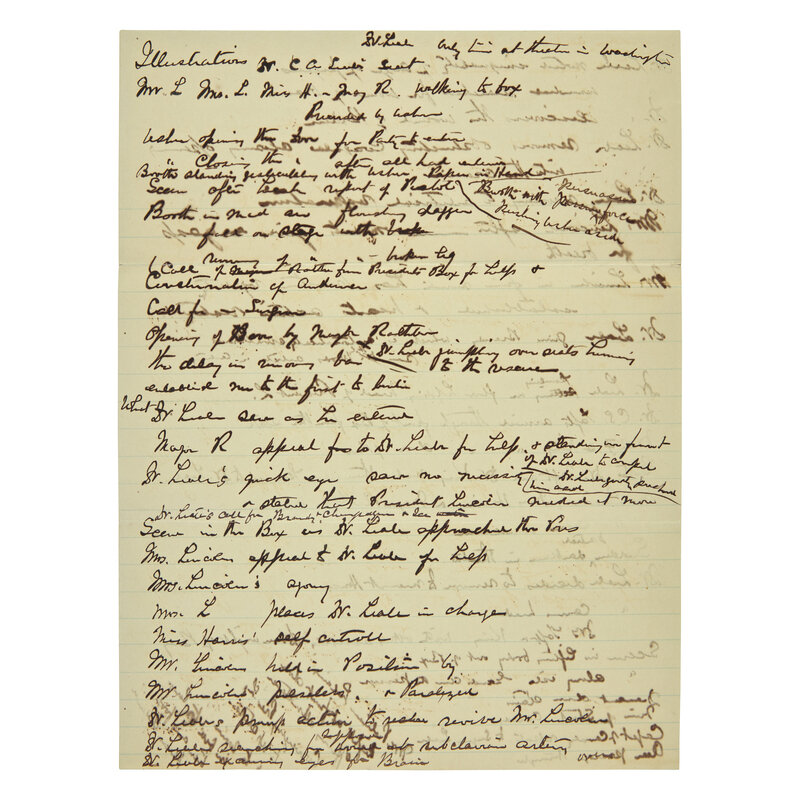
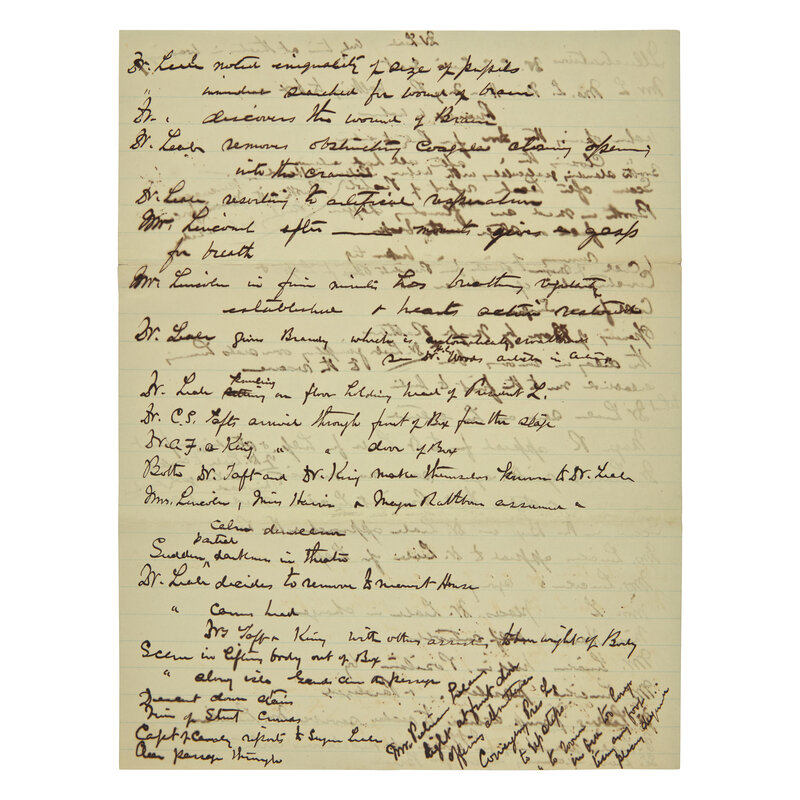
[Lincoln, Abraham] Leale, Charles A. Autograph Notes Recounting Lincoln's Assassination
Years After Lincoln's Assassination, Dr. Charles Leale Vividly Pieces Together His Memories of That Tragic Night
No place, no date, ca. 1880s-1890s. Single ruled sheet, 10 1/2 x 8 in. (267 x 203 mm). Two-page autograph notes in the hand of Charles A. Leale, recounting the night of President Abraham Lincoln's assassination. Creasing from old folds.
Rare autograph notes recounting President Abraham Lincoln’s assassination, written by Charles A. Leale, the first doctor to aid the mortally wounded President at Ford's Theatre the night of April 14, 1865.
Reads in part: "...Mr. L. Mrs. L. Miss H. Maj. R. walking to box...Usher opening the door for Party...Booth with persuasive force pushing usher aside.
Booth in mid air flourishing dagger fell on stage with broken leg. Call of Major Rathbone from Presidents Box for help...Call for a Surgeon...Dr. Leale jumping over seats hurrying to the rescue...Dr. Leale's call for Brandy & Champagne & Ice...Scene in the Box as Dr. Leale approached the Pres. Mrs. Lincoln appeal to Dr. Leale for help...Mrs. Lincoln's agony...Mrs. L. places Dr. Leale in charge...Dr. Leale's prompt action to revive Mr. Lincoln...Dr. Leale searching for supposed wound at subclavian artery...Dr. Leale noted irregularity of size of pupils...Dr. discovers the wound of Brain...removes obstructing coagula...resorting to artificial respiration...Mr. Lincoln...gives a gasp for breath...Dr. Leale kneeling on floor holding head of President L. ...Both Dr. Taft and Dr. King make themselves known...Dr. Leale decides to remove to nearest House..."
Charles A. Leale (1842-1932) was 23-years-old the night of Lincoln's assassination. An Assistant Surgeon in the U.S. Army Volunteers, he had received his medical degree only six weeks earlier from Bellevue Hospital Medical College in New York City, and was then assigned to duty as the surgeon in charge of the Wounded Commissioned Officers’ Ward at the General Hospital at Armory Square in Washington, D.C. Having read that the President was likely to attend, Leale bought tickets for the April 14 production of Our American Cousin at Fords' Theatre. According to testimony given by Leale after the shooting, at the theater he had been seated less than 40 feet from the Presidential box, and had witnessed President Lincoln's arrival, accompanied by his wife Mary Todd and Major Henry Rathbone and his guest. At about half past ten Leale heard a gunshot and screaming and then saw assassin John Wilkes Booth, with dagger in hand, leap from the Presidential box onto the stage, where he then quickly made an exit. Answering calls for a doctor, Leale rushed to the Presidential box where he was the first person to aid the mortally wounded president. He found the President unresponsive in his chair with labored breathing. Placing him in a recumbent position, Leale searched Lincoln's body for what he at first thought was a knife wound. He soon discovered a bullet hole in the back of Lincoln's head, and upon dislodging a blood clot, noticed that the President's breathing improved. Despite this, he understood the president's wound to mortal.
Leale was soon joined in the box by Dr. Charles S. Taft and Dr. Albert F.A. King. They determined that the president could not survive a carriage ride back to the White House, and agreed that he should be removed immediately to the nearest house. With the aid of others, the three men carried the president out of the theater and across the crowded street to the home of William A. Peterson. Placing him diagonally on a bed in a back room, the men stripped the president of his clothes and retrieved water and blankets to keep him comfortable. Shortly after, the President's family physician, Dr. R. K. Stone, and Surgeon General Henry H. Crane arrived. Taking charge of the situation, Stone, along with Leale and company, monitored the president's pulse and breathing throughout the night, while probing the wound for the bullet, and removing coagula to help sustain the President's breathing. Throughout the night and into the morning Leale remained at the President's beside and held the his right wrist to note his pulse, until 7:20 when President succumbed to his wound. Due to Leale's quick action and medical care, the President survived for another 10 hours into the morning of April 15.
Only hours after the passing of the president, Leale sat down and penned an account of his actions that night for the Surgeon General. Two years later, in 1867, he wrote another account for a congressional committee, largely copied from his original report, but containing some minor changes. In the years that followed, Leale rarely spoke about that night's events, and only publicly discussed it for the first time 44 years later in 1909 during the centennial of Abraham Lincoln’s birth, after a request from the Military Order of the Loyal Legion of the United States.
According to Helena Iles Papaioannou and Daniel W. Stowell there are seven extant accounts by Leale of his experience. Five date to 1865, four being copies of his first report (two at the National Archives and two at the New York Public Library), each in a clerical hand (the original report in Leale's hand has not been located), and one letter by Leale, dated May of 1865, to physician Dwight Dudley (in the Shapell Collection). One is from 1867, addressed to Representative Benjamin F. Butler, chair of a committee in the United States House of Representatives investigating Lincoln’s assassination (in the Library of Congress). The last is from 1909, the aforementioned speech given to the Military Order of the Loyal Legion of the United States (published in Harper's Weekly and separately as Lincoln's Last Hours).
As the above notes attest, decades after the assassination Leale was still recording the events of that night to keep them fresh in his mind, such was the magnitude of it that would loom over the remainder of his life, and to keep for posterity the details of his actions in aiding the mortally wounded president.