Condition Report
Contact Information
Lot 42
Sale 6465 - Printed and Manuscript Americana
Jan 29, 2026
10:00AM ET
Live / Philadelphia
Own a similar item?
Estimate
$1,500 -
2,500
Price Realized
$1,792
Sold prices are inclusive of Buyer’s Premium
Lot Description
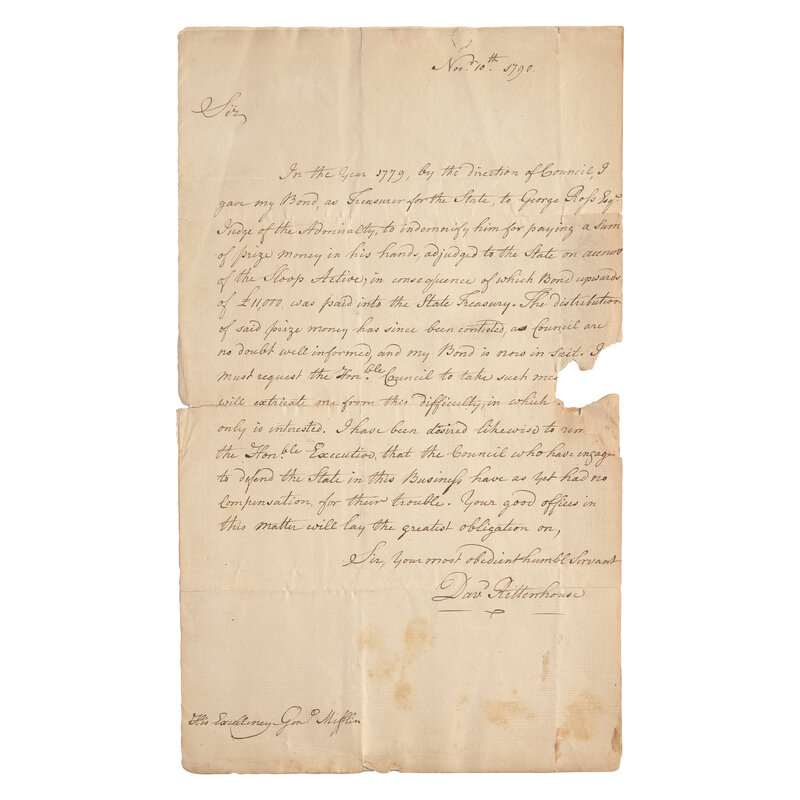
[American Revolution] Rittenhouse, David. Autograph Letter, signed
An Early Test of Federal Authority
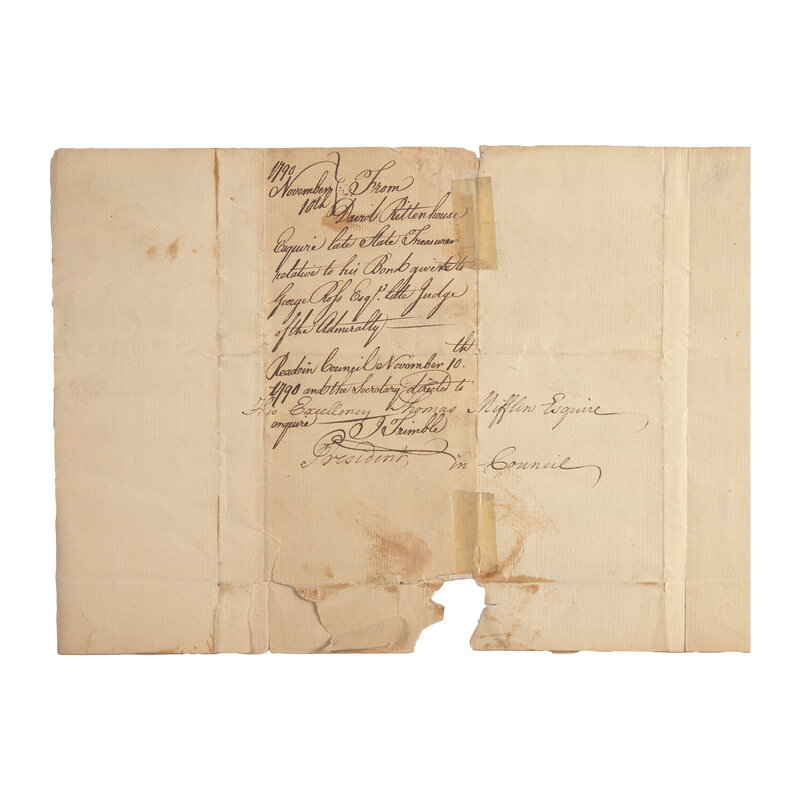
(Philadelphia), November 10, 1790. Bifolium, with integral address leaf, 12 3/4 x 7 3/4 in. (324 x 197 mm). One-page autograph letter, signed by David Rittenhouse to Pennsylvania Governor Thomas Mifflin: "In the year 1779, by the direction of Council, I gave my bond, as Treasurer for the State, to George Ross Esq. Judge of the Admiralty, to indemnify him for paying a Sum of prize money in his hands, adjudged to the State on account of the Sloop Active, in consequence of which Bond upwards of £11,000 was paid into the State Treasury. The distribution of said prize money has since been contested, as Council are no doubt well informed, and my Bond is now in Suit. I must request the Honble. Council to take such me(asures) will extricate me from this difficulty, in which (loss of text) only is interested. I have been desired likewise to rem(ind) the Honble. Execution, that the Council who have engaged to defend the State in this Business have as yet had no Compensation for their trouble. Your good offices in this matter will lay the greatest obligation on, Sir, your most obedient humble Servant Davd. Rittenhouse". Addressed on integral leaf by Rittenhouse, docketing to same. Creasing from old folds, separations along same. Loss in right side from when seal opened, affecting a few words; two sello tape repairs on verso folds; scattered soiling and edgewear.
In an early test of state will over federal authority, David Rittenhouse (1732-96) writes to the first governor of Pennsylvania, Thomas Mifflin (1744-1800), requesting to be extricated from liabilities incurred from giving a bond while Treasurer of Pennsylvania, in the disputed prize claim growing out of the capture of the British sloop Active in 1778.
In early fall of 1778, Connecticut fisherman Gideon Olmstead and three associates were captured and impressed into the British Navy onboard the Sloop Active. While en route to New York hauling supplies for the British Army, the four men managed to take control of the vessel and redirect her toward a friendly port. Before they could land, however, they were sighted and then forcibly taken, against their protest, by two American vessels, a brig and a privateer, each of whom claimed her as their prize. By the end of the year the Pennsylvania state court of admiralty, acting on a jury's findings that Olmstead and crew were not in control of the vessel when it was captured, divided the prize money into four parts that went to the commander of the Pennsylvania brig, the Pennsylvania government as owner of the brig, the captain of the privateer, and Olmstead and his colleagues. Olmstead appealed the decision to the Continental Congress, who ruled that he was entitled to the entirety of the prize money, but the Pennsylvania government resisted, since state law permitted admiralty appeals only on matters of law, and not of fact. What resulted was a 30-year legal battle pitting state against federal authority.
Judge George Ross, Signer of the Declaration of Independence and judge of the original state admiralty court, had ordered David Rittenhouse, then state treasurer, to make a bond for the amount of the state share of the prize money. When in 1788 Rittenhouse left office he kept the amount because he remained subject to the bond, and when he died in 1796, his two daughters fell heir to the sum, and its accrued interest. In 1803, following the Supreme Court case of Penhallow v. Doane, Olmstead obtained a decree against the daughters, who were ordered to hand over the original funds and dividends. Pennsylvania Governor Thomas McKean, who had ruled against Olmstead in 1792, directed the state legislature to resist the ruling, and both Houses passed bills, calling for the daughters to return the money to the state (not the federal government) and promising them protection from indemnity “from any process whatever issued out of any federal court in consequence of their obedience to the requisition.”
By 1809, the case had reached the Supreme Court of the United States, where Chief Justice John Marshall ordered that the 1803 ruling be enforced, and directed a federal marshal to collect the money (now totaling $15,000) from the Rittenhouse heirs. If the money was not produced, he ordered to have them arrested. Pennsylvania Governor Simon Snyder announced his intention to obey the 1803 ruling, but summoned a militia in order to protect the daughters from the federal marshal. In three ensuing confrontations, the state militia, with crossed bayonets, prevented the federal marshal from enforcing his orders, leading to the latter's threat of sending in federal troops to enforce the court order. Governor Snyder appealed directly to President James Madison to intervene, but the president declined to get involved. In the meantime, while the threat of violence had subsided, the federal marshal had managed to arrest one of the daughters, and the Chief Justice of the Supreme Court of Pennsylvania then ruled that the federal courts had jurisdiction, and that Olmstead was entitled to the money. Governor Snyder, wishing to end the years-long controversy, subsequently paid the federal marshal, and Rittenhouse's daughter was released.
This lot is located in Philadelphia.