Condition Report
Contact Information
Lot 31
Sale 6465 - Printed and Manuscript Americana
Jan 29, 2026
10:00AM ET
Live / Philadelphia
Own a similar item?
Estimate
$4,000 -
6,000
Price Realized
$10,880
Sold prices are inclusive of Buyer’s Premium
Lot Description
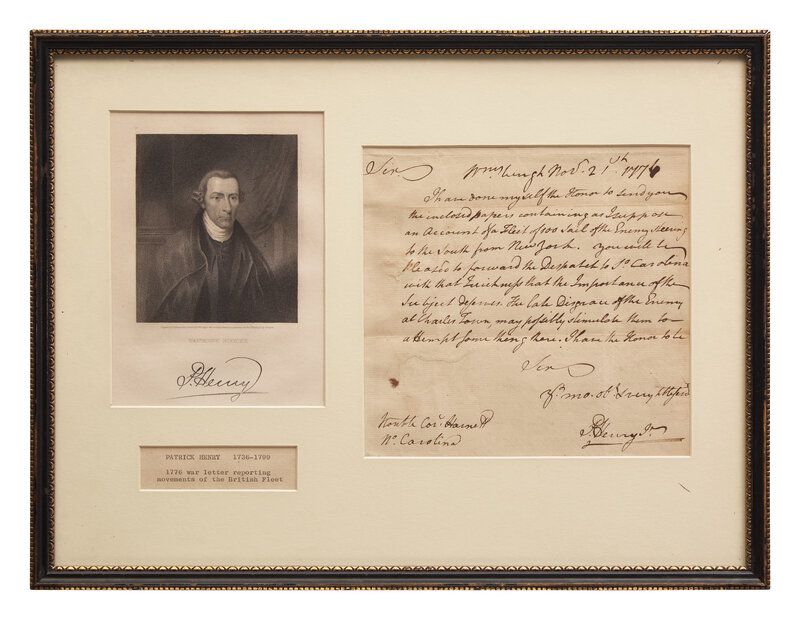
[American Revolution] Henry, Patrick. Autograph Letter, signed
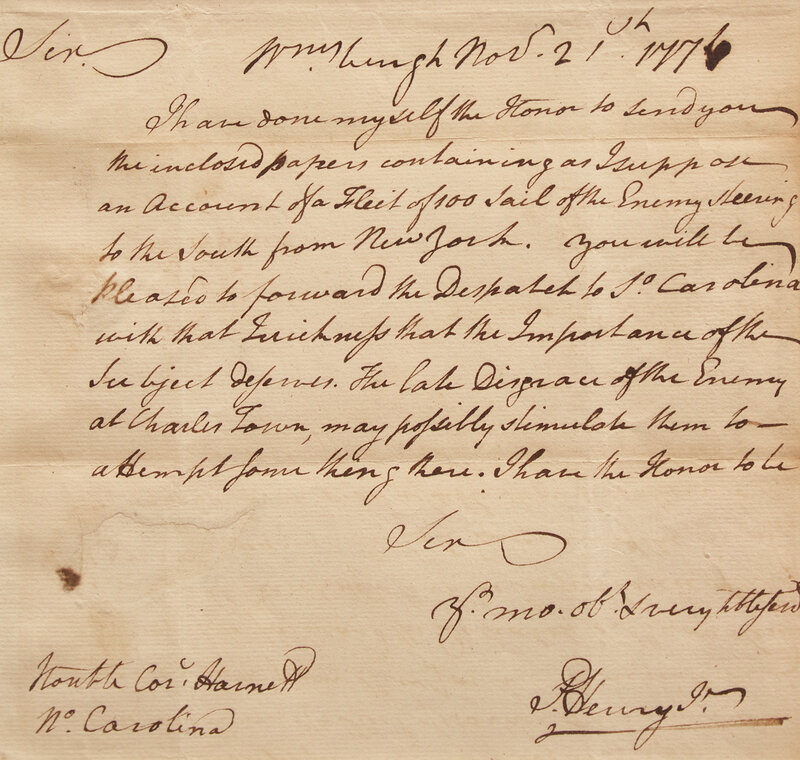
Williamsburg, Virginia, November 21, 1776. Single sheet, 9 1/8 x 8 in. (232 x 203 mm). One-page autograph letter, signed by Patrick Henry as the Governor of Virginia to Cornelius Harnett, warning of a British fleet heading toward South Carolina. In full: "I have done myself the Honor to send you the inclosed papers containing as I suppose an Account of a Fleet of 100 sail of the Enemy steering to the South from New York. You will be Pleased to forward the Despatch to So. Carolina with that Quickness that the Importance of the Subject deserves. The late Disgrace of the Enemy at Charles Town, may possibly stimulate them to attempt some thing there...P. Henry". Docketed on verso; remnants of original red wax seal. Inlaid; creased from old folds; open tear from seal now restored in lower portion; other small repairs. In mat with an engraved portrait of Henry, and in frame, 13 1/4 x 17 1/2 in. (336 x 444 mm).
A fine and rare war-dated autograph letter signed by Virginia patriot and orator Patrick Henry (1736-99) as the war-time governor of Virginia. Written immediately following the fall of New York, Henry warns Cornelius Harnett (1723-81), president of the North Carolina Committee of Safety, of a reported British fleet sailing south from New York. Invoking the "late Disgrace" of the British Army and their failed siege of Charleston, South Carolina the previous June of 1776, Henry presses Harnett to quickly forward his dispatch of the fleet's movements, as they "may possibly...attempt some thing there." Despite this warning, the British would not attack Charleston again until 1780, where they would successfully take the city and hold it until the end of 1782.
Cornelius Harnett was a prominent North Carolina patriot and statesman. Born in Chowan County, he became a leading Wilmington merchant. Entering public life in 1750, he held successive positions, including justice of the peace and member of the colonial assembly. With the Stamp Act controversy he became one of the colony's earliest and most vocal leaders resisting British rule, chairing the Wilmington chapter of the Sons of Liberty, and in 1770, chairman of the group to enforce non-importation of British goods. As resistance to British rule increased in the 1770s, Harnett was at the vanguard, where he was called by Massachusetts revolutionary Josiah Quincy, the "Samuel Adams of North Carolina". In 1775 he was elected president of the provincial Council of Safety, effectively placing him as chief executive of North Carolina. In this role, and as a member of the provincial assembly, he was deeply involved in the state's military planning, including the raising, training, and arming of troops. In the spring of 1776 he was elected chairman of the committee that drafted the Halifax Resolves, the first official provincial action calling for independence from Great Britain. Harnett conducted the first public reading of the Declaration of Independence in North Carolina, and also helped draft its first constitution, while in 1777 he was elected to the Continental Congress, where he supported the ratification of the Articles of Confederation. With the British capture of Wilmington in 1781, he was taken prisoner by the British, and died in captivity shortly afterwards.