Condition Report
Contact Information
Lot 18
Sale 6465 - Printed and Manuscript Americana
Jan 29, 2026
10:00AM ET
Live / Philadelphia
Own a similar item?
Estimate
$3,000 -
5,000
Price Realized
$4,160
Sold prices are inclusive of Buyer’s Premium
Lot Description
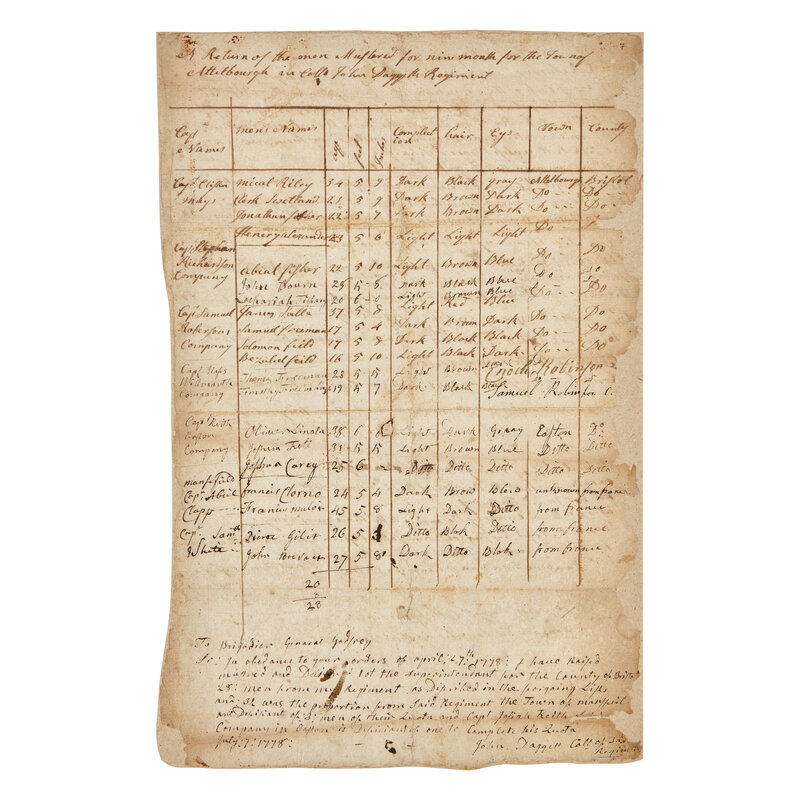
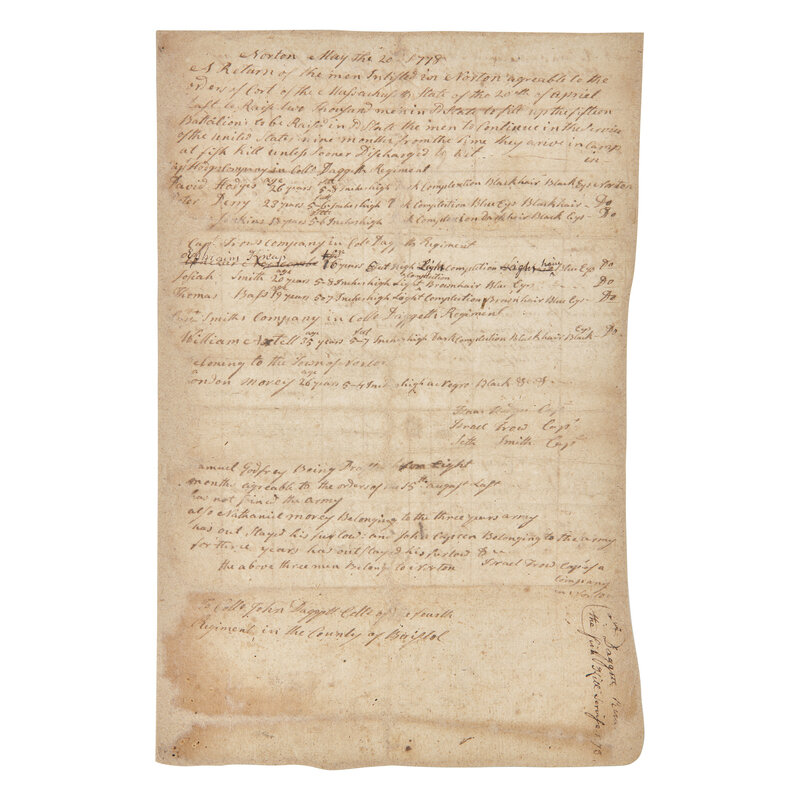
[African-Americana] 1778 Manuscript Continental Army Muster List
Norton, Attleboro, etc., Massachusetts, 1778. Single sheet, 13 1/4 x 8 5/8 in. (336 x 219 mm). Two-page manuscript document, being a muster list for service in the Continental Army: the recto listing eight men belonging to three companies in Colonel John Daggett's regiment, including the mention of one African-American solider, a "London Morey", and listing the men's age, height, color of complexion, hair, eyes, and town; verso with manuscript tabular list of 20 men recruited from Daggett's militia, listing their company, name, age, height, complexion, eye color, town and county or country (the last four being from France). Creasing from old folds; scattered soiling; repairs along edges; some text slightly faded.
A rare Revolutionary War muster list from Massachusetts, for men enlisted for service in the Continental Army, and including mention of one African-American soldier, a man named London Morey. While Morey served in the militia of Colonel John Daggett's regiment, he was ultimately rejected for service in the Continental Army.
On February 26, 1778, the Continental Congress resolved for each state to contribute specific numbers of troops to the Continental Army, by drafting men from their state militias. On April 20, the General Court of Massachusetts-Bay passed a resolution for completing 15 battalions of Continental troops, as required by the Congress's resolution. Because one-seventh of the male inhabitants of the state was insufficient to complete the fifteen battalions, the Court resolved that each county and town should furnish additional troops. The county of Bristol was to provide 149 additional men, of which eight were to come from Norton, 12 from Attleboro, seven from Mansfield, and eight from Easton. The remaining 113 were to come from the eight other towns in Bristol County.
While the British promised enslaved runaway men their freedom in return for enlisting in their army, American military leaders did not offer emancipation. Despite this, African Americans did join the American army, and fought in the war's first battles at Lexington and Concord, and at Bunker Hill. Of the estimated 100,000 men who served in the Continental Army during the war, at least 5,000 were Black. Both enslaved and free Blacks served in the army as soldiers, laborers, and servants. In some cases, they were offered freedom when they enlisted, while others remained enslaved, fighting in place of their masters. The large majority of Black soldiers fought in integrated units, while occasionally, all-Black units were formed, like the 1st Rhode Island Regiment and the Bucks of America, a Massachusetts militia company.