Condition Report
Contact Information
Lot 131
Sale 6465 - Printed and Manuscript Americana
Jan 29, 2026
10:00AM ET
Live / Philadelphia
Own a similar item?
Estimate
$1,000 -
1,500
Price Realized
$3,200
Sold prices are inclusive of Buyer’s Premium
Lot Description
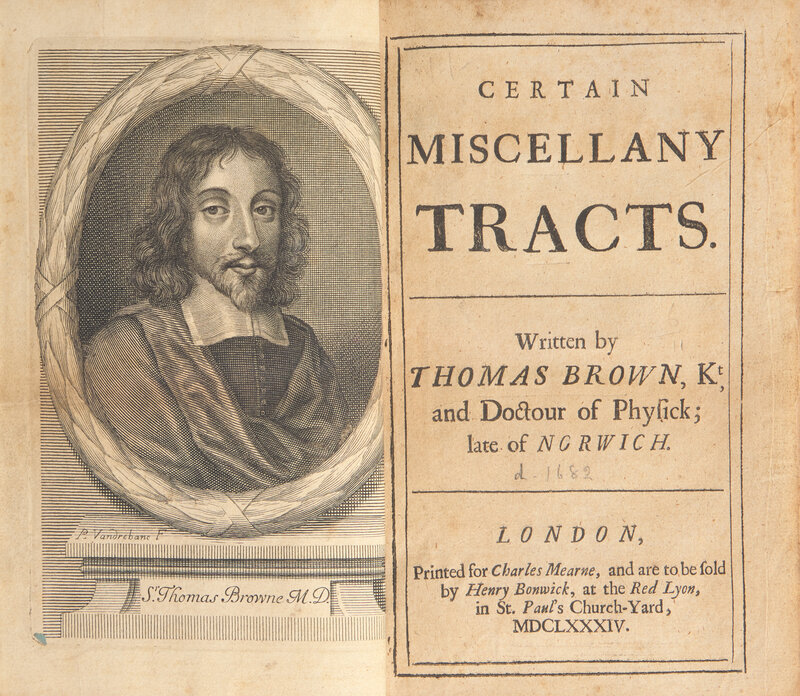
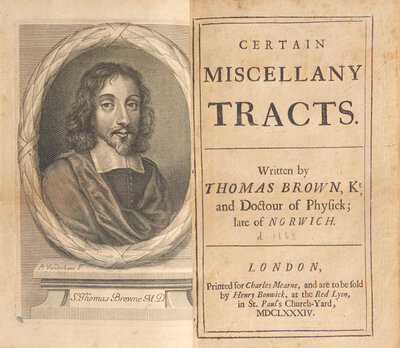
[Presidential] [Roosevelt, Franklin D.] Brown, Thomas. Certain Miscellany Tracts
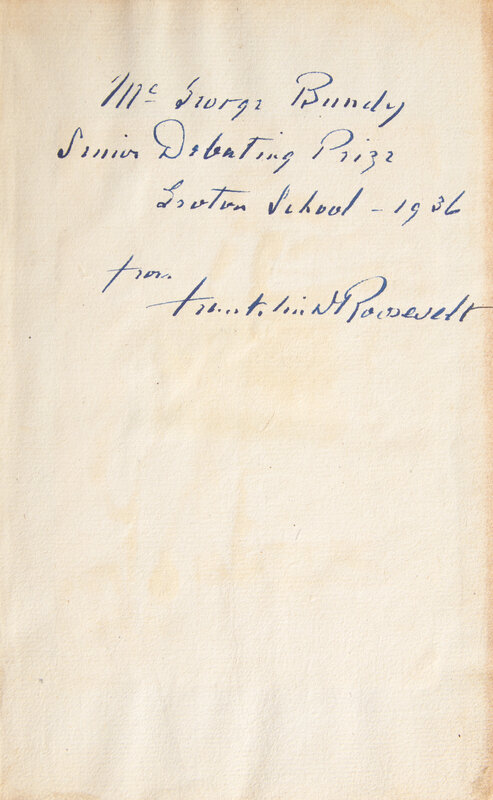
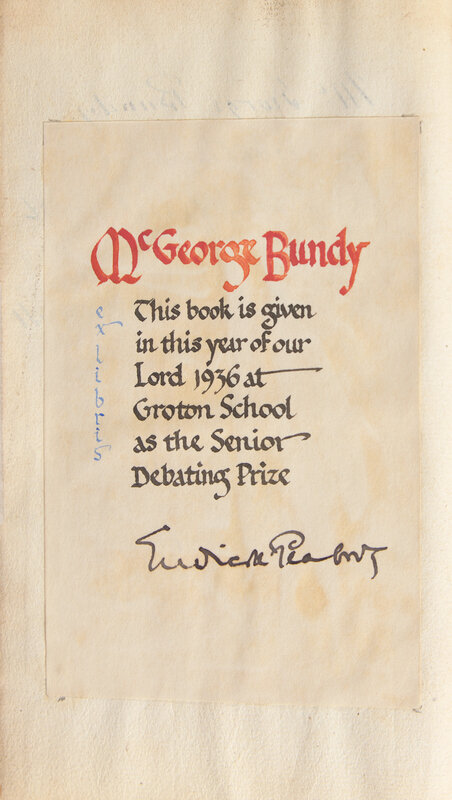
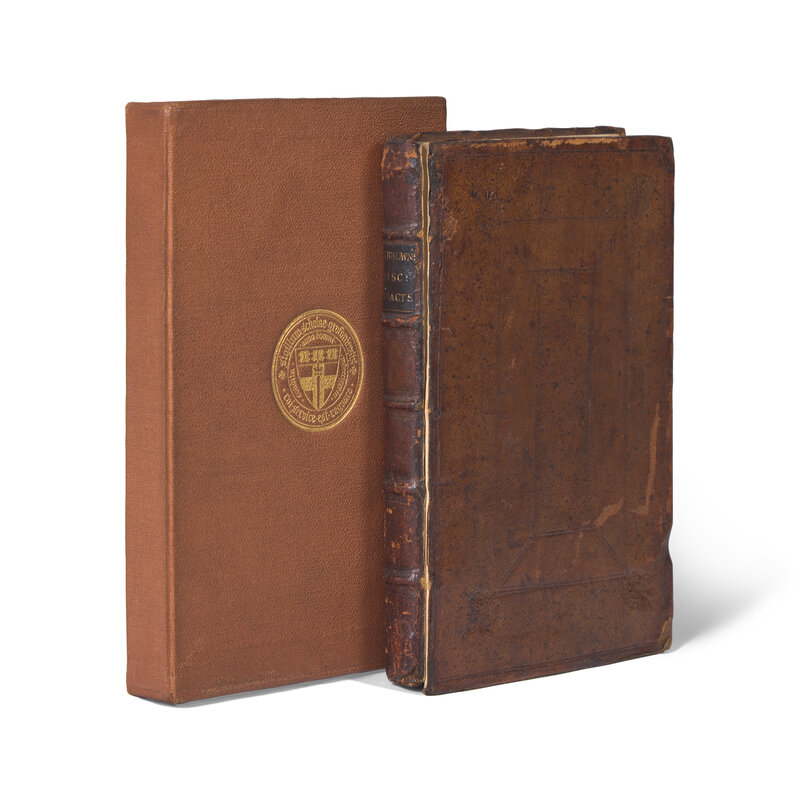
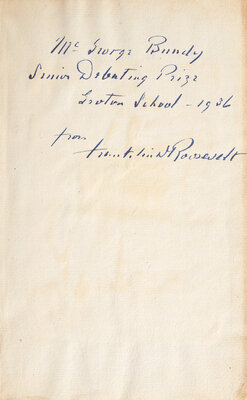
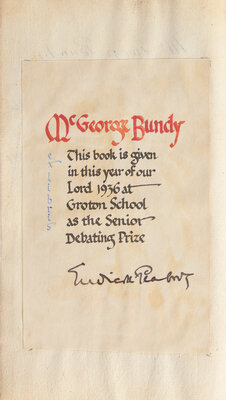
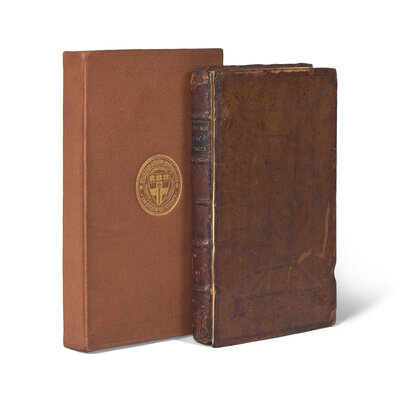
London: Printed for Charles Mearne, and are to be sold by Henry Bonwick, 1684. First edition, second issue. Presentation copy, inscribed by President Franklin D. Roosevelt to McGeorge Bundy on front free endpaper: "McGeorge Bundy / Senior Debating Prize / Groton School-1936 / from Franklin D. Roosevelt". 12mo. (iv), 215, (7) pp. Illustrated with an engraved frontispiece portrait of Brown by P. Vandreban. Full contemporary speckled brown sheep, ruled in blind, black morocco spine label, stamped in gilt, front board detached, boards and extremities scuffed and moderately worn, wear at spine ends; red speckled edges; book-plate of American Orientalist and philologist Fitzedward Hall on front paste-down; prize book-plate on verso of front free endpaper, signed by Groton School headmaster Endicott Peabody; scattered spotting to text; scattered wear along fore-edge; in cloth slip case. ESTC R9918; Pforzheimer 109
A fine presentation copy, inscribed by President and Groton alum Franklin D. Roosevelt (1882-1945) to McGeorge Bundy (1919-96), United States National Security Advisor to Presidents John F. Kennedy and Lyndon B. Johnson. Gifted to Bundy as a debating prize while a student at the Groton School, in Groton, Massachusetts. Roosevelt attended Groton from 1896-1900, and was a close personal friend with founder and headmaster Endicott Peabody (1857-1944), who has also signed. Roosevelt would later famously recall, "as long as I live, the influence of Dr. and Mrs. Peabody means and will mean more to me than that of any other people next to my father and mother."
Part of a family with roots in education and public service, McGeorge Bundy served as a young intelligence officer in World War II. After graduate work, he became a professor of Government at Harvard, and later served as the Dean of the Faculty of Arts and Sciences there. From 1961-66 he was the National Security Advisor to Presidents Kennedy and Johnson. He was involved in many of that era’s major foreign policy decisions and controversies, including the Bay of Pigs invasion, the Cuban Missile Crisis, and the sharply increasing U.S. involvement in the war in Vietnam. From 1966 to 1979 he served as president of the Ford Foundation, where his team led work supporting civil rights, the national expansion of public television, environmental action, ethical investing, and international development and cooperation. As professor of history at New York University from 1979 until his death in 1996, he studied and wrote about the history of nuclear weapons, becoming a forceful advocate for global arms control.