Condition Report
Contact Information
Lot 112
Sale 6465 - Printed and Manuscript Americana
Jan 29, 2026
10:00AM ET
Live / Philadelphia
Own a similar item?
Estimate
$2,000 -
3,000
Price Realized
$5,440
Sold prices are inclusive of Buyer’s Premium
Lot Description
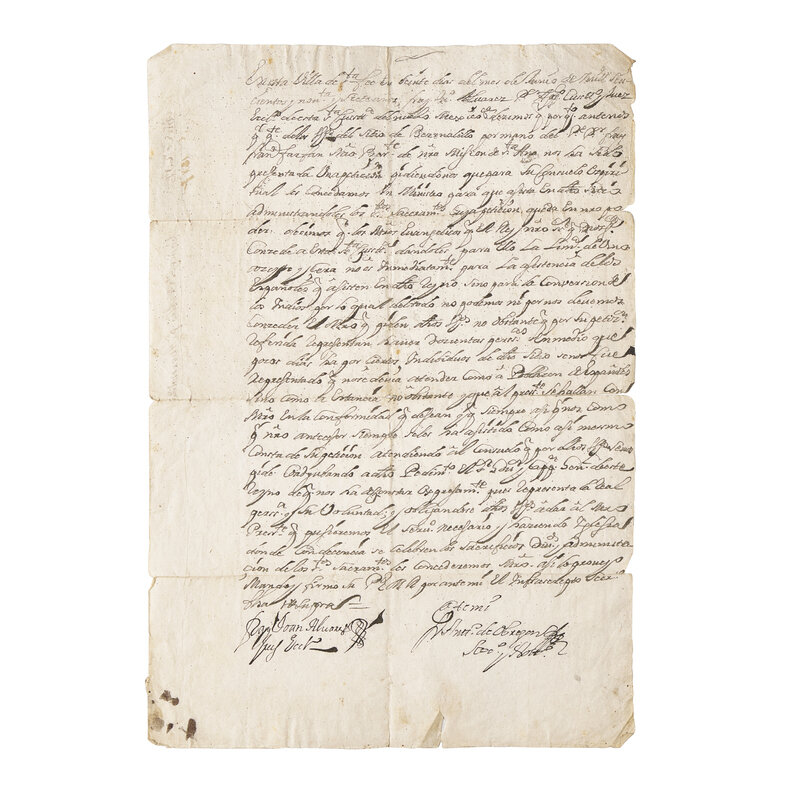
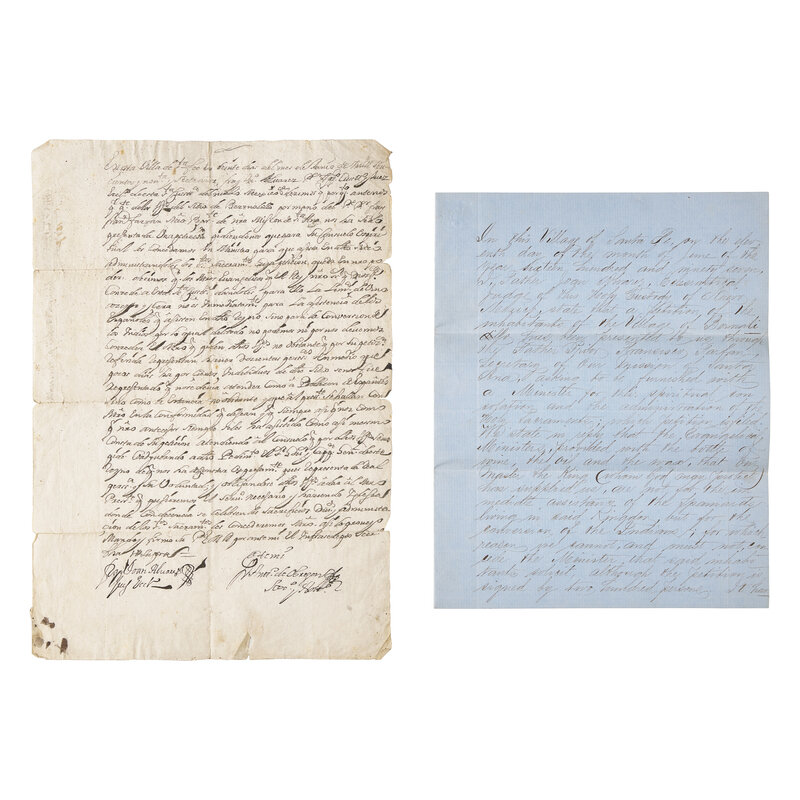
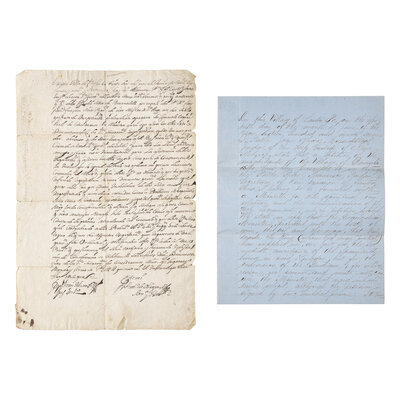
[Native-Americana] [New Mexico] Obregon, Antonio de. Autograph Document, signed
"Evangelical Ministers...are not for, the immediate assistance of the Spaniards...but for the conversion of the Indians..."
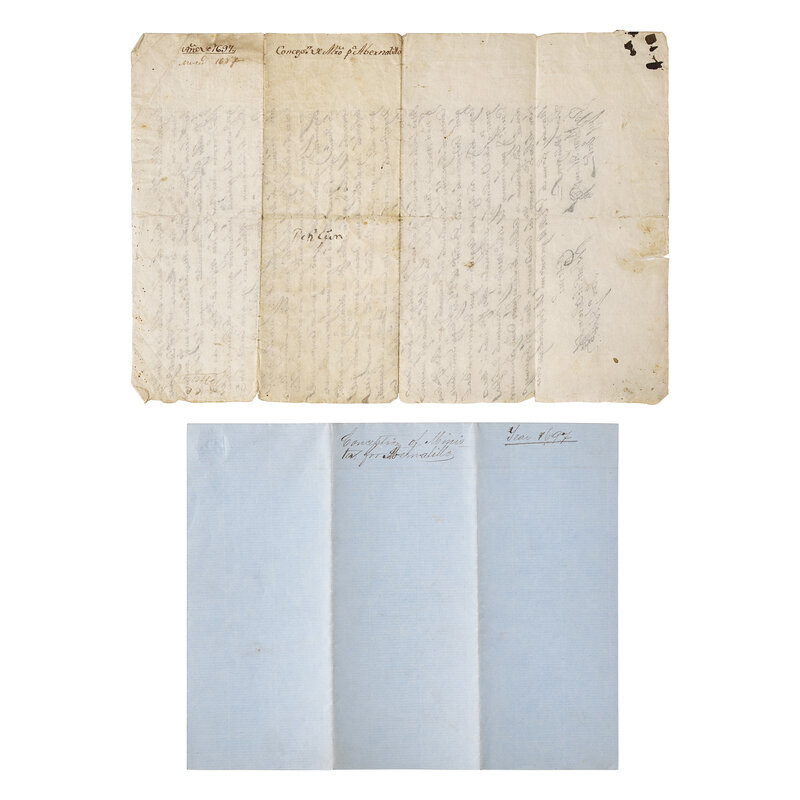
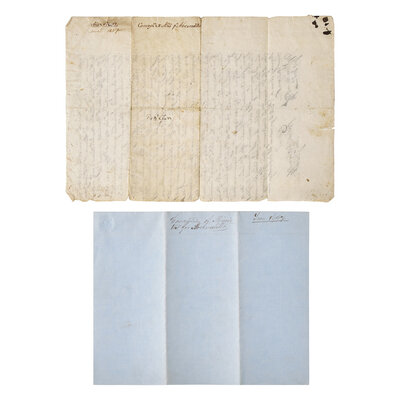
(Santa Fe, New Mexico), June 11, 1697. Single sheet, 12 1/4 x 8 1/2 in. (311 x 215 mm). Autograph document in Spanish, signed by Franciscan Father Antonio de Obregon y Alcocer, being a proclamation by Father Juan Alvarez of the Holy Custody of New Mexico, regarding the request for a Christian Minister in the village of Bernalillo. Reads in full (translated): "In this Village of Santa Fe, on the eleventh day of the month of June of the year sixteen hundred and ninety seven, I, Father Joan Alvarez, Ecclesiastical Judge of this Holy Custody of Nuevo Mexico, state that a petition of the inhabitants of the Village of Bernalillo has been presented to us through the Father Prior Francisco Farfan, Secretary of Our Mission of Santa Ana, asking to be furnished with a Minister for the their spiritual consolation and the administration of the Holy Sacraments; which petition is filed. We state in reply that the Evangelical Ministers, provided with the bottle of wine, the oil and the wax, that our Master the King (whom God may protect) has supplied us, are not for, the immediate assistance of the Spaniards living in said Kingdom, but for the conversion of the Indians; for which reason we cannot, and must not, concede the Minister that said inhabitants solicit, although the petition is signed by two hundred persons. It having, however, a few days ago been represented to us by certain individuals of the said Village that the latter ought not to be considered as a Spanish settlement, but as an "Estancia", and that they have at present a Minister in conformity with their desire, and that they have always been assisted by us, as well as by our predecessor, as it has been stated in their petition; and taking in consideration that we are asked for consolation by the said inhabitants, joining them in their petition the Governor and Captain General whose disire (sic) we hold in much consideration, as he represents the Royal person and his will; and as said inhabitants pledge themselves to provide with the necessary food the President Minister that we should concede to them, as with as to build a Church where the Devine (sic) Services and the Administration of the Holy Sacraments could be performed with decency; we concede a Minister to them. So it was provided, commanded and signed, by this Most Reverend Paternity, before me the undersigned Secretary, date as above. 'Fray Joan Alvarez' Ecclesiastical Judge Before Me 'Fray Anto de Obregon' Secretary." Contemporary docketing on verso; creasing from old folds; scattered soiling; some paper loss to margins. With a 19th-century manuscript English translation.
Rare and interesting ecclesiastical manuscript from Spanish colonial New Mexico. One year after the Pueblo Indian Revolt of 1696, inhabitants of the village of Bernalillo are granted a Minister from Santa Fe for their spiritual needs, and for the "conversion of the Indians. "
Fathers Juan Alvarez and Antonio de Obregon were high ranking Franciscan priests operating in Santa Fe. In 1698, both men were appointed as Inquisition Commissaries by the Tribunal of the Holy Order in Mexico City. In this role they enacted the policies of the infamous Spanish Inquisition, by promoting indigenous conversion to Christianity, and punishing accused heretics in the colony.
The province of Santa Fe de Nuevo Mexico was established by Spanish Conquistador Juan Onate de Salazar in 1598. His brutal subjugation of the land that is now Arizona and New Mexico instilled fear and resentment against Spanish rule in the Pueblo Indians for years to come. As colonial villages and plantation-like ecomiendias were established, Franciscan missions soon followed. Their approach initially showed tolerance for Native American practices, so long as the Pueblos attended mass and maintained a facade of Christian beliefs. However, traditional culture began to be outlawed by the Spanish throughout the 17th-century, including the performance of special dances and other rites, as well as the use of prayer masks and psychoactive substances.
Tensions first came to a head on a grand scale in 1680, when a coordinated revolt of multiple Pueblo villages was orchestrated by a Tewa religious leader named Pope. The Indians rose up against the colonists and pillaged Spanish properties, killed settlers, destroyed Churches, and besieged the colonial headquarters until governor Antonio de Otermin ordered a retreat south at the end of August. For the next ten years the Spanish attempted to retake the territory, but none were fully successful until Diego de Vargas retook the capital of Santa Fe in 1692. The reconquest was not complete as some Pueblos villages held out, with 14 of them coordinating another revolt in 1696, which was mercilessly crushed. By the end of the century, the last resisting towns had surrendered or been evacuated, and Spanish control was essentially complete.
Some settlements in New Mexico were better assimilated to Spanish culture than others due to their location, trading practices, and intermarriage between inhabitants and colonists. The village of Bernalillo was a mixed Indian/Spanish population, and was therefore labeled an "Estancia" (Indian village).
A unique survival. Documents from the Spanish Mission period in the American Southwest are rare to auction.
This lot is located in Philadelphia.