Condition Report
Contact Information
Auction Specialist
Lot 308
Sale 6431 - American Historical Ephemera & Early Photography Online
Lots Open
Nov 11, 2025
Lots Close
Nov 24, 2025
Timed Online / Cincinnati
Own a similar item?
Estimate
$2,000 -
3,000
Lot Description
TAFT, William Howard (1857-1930). Archive of correspondence between Taft & “Gus” Karger, ca 1908-24.
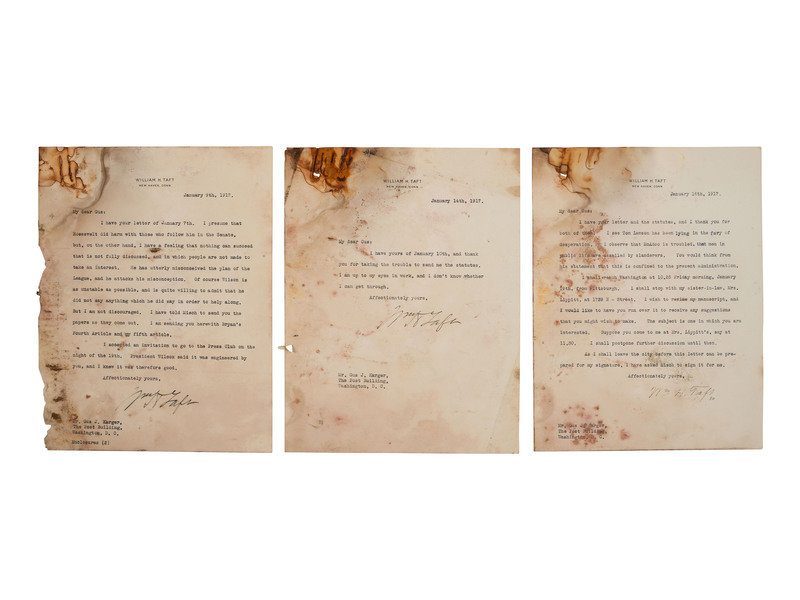
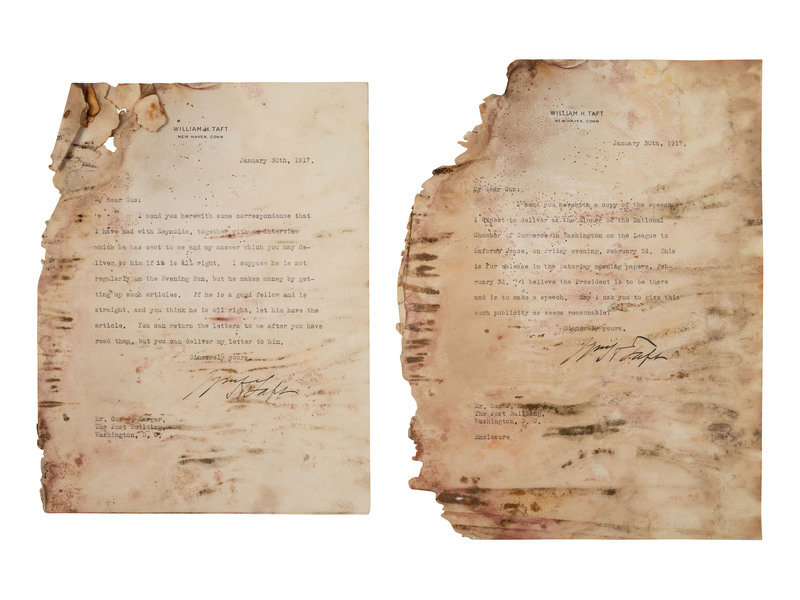
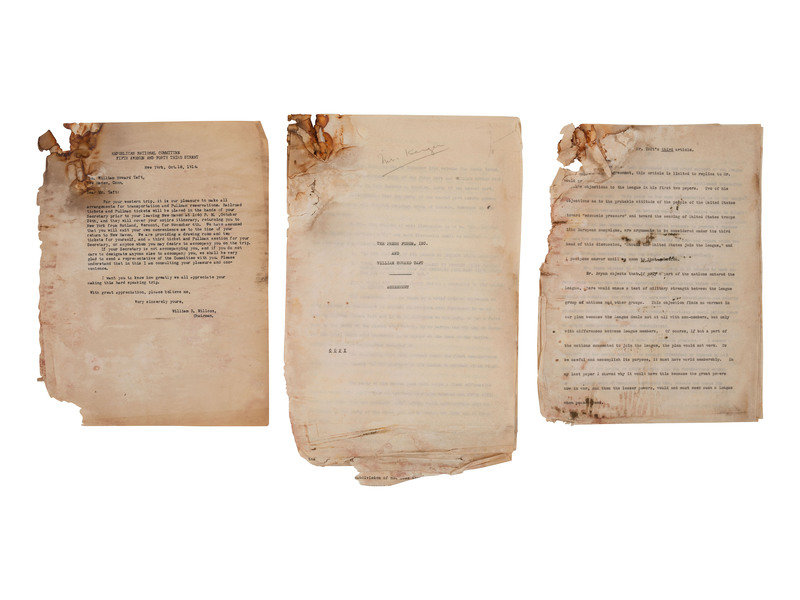
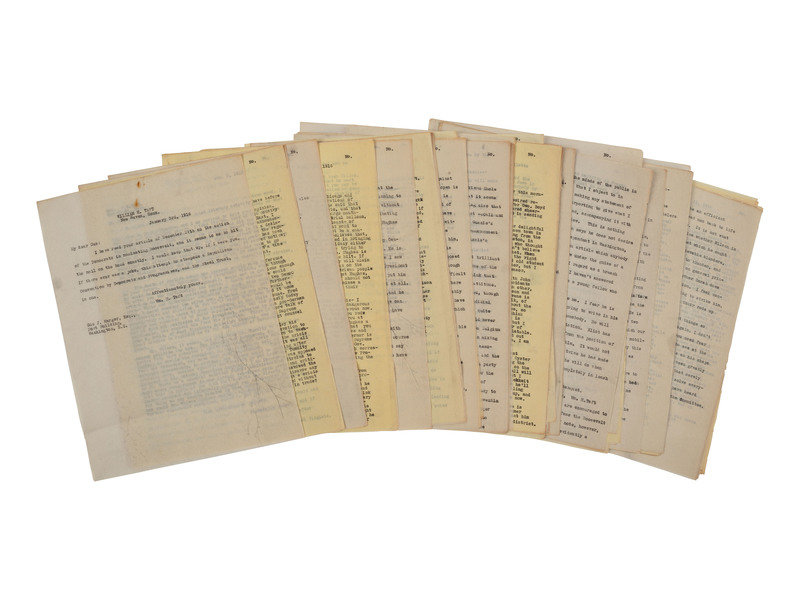
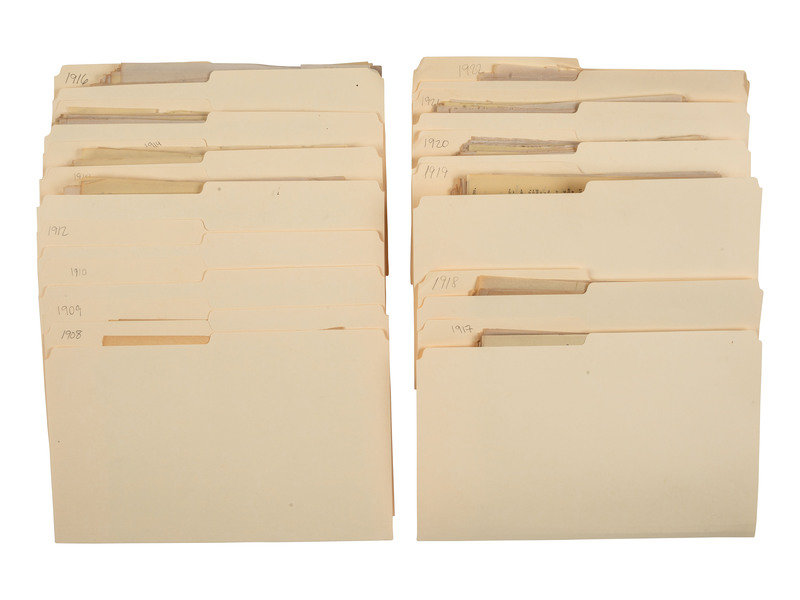
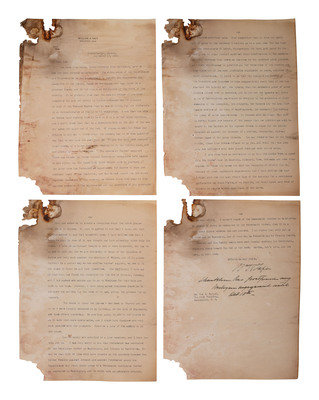
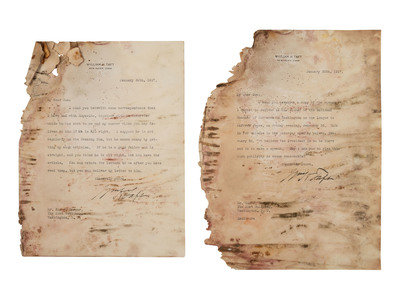
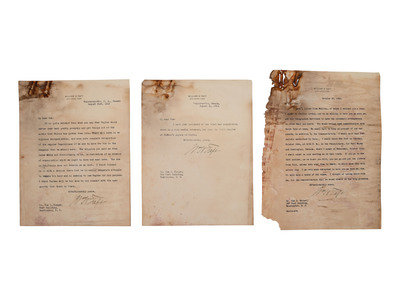
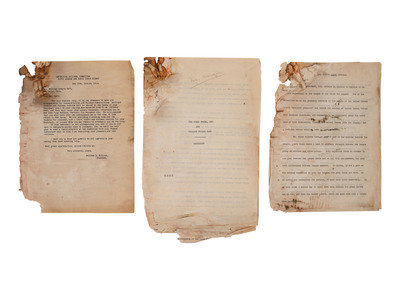
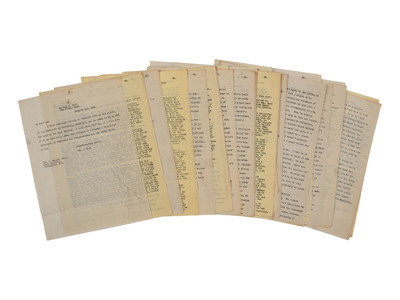
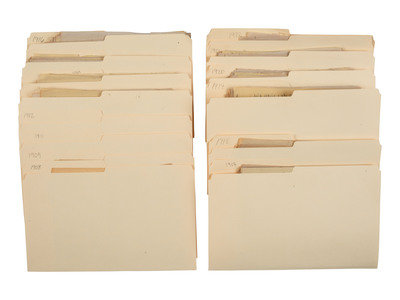
Approximately 900 documents, the majority of which are letters exchanged between William H. Taft and Gus J. Karger (1826-1924) during the years 1908-1924 (bulk 1913-1921). Archive consists of the following: 12 typed letters signed by Taft (“Wm. H. Taft”), spanning 1916-1917, while Taft was serving as Kent Professor of Law and Legal History at Yale Law School; 2 letters secretarially signed (“Wm. H. Taft”) by Taft’s private secretary Wendell W. Mischler (1870-ca 1950s); more than 30 copies of telegrams exchanged primarily between Taft and Karger; a small number of typed copies of speeches and articles authored by Taft, including several relating to his written debates with William J. Bryan over the League to Enforce Peace; and over 800 copy typescripts, primarily of correspondence between Taft and Karger, but with a small number of copies of letters from other figures as well. Provenance: Consignor relates that the archive was acquired from an estate sale near Washington, D.C., ca early 2000s.
William Howard Taft served as the 27th President of the United States (1909-1913) before becoming the tenth Chief Justice of the United States (1921-1930), the only person to have served in both offices. The correspondence offered here primarily reflects Taft’s post-Presidential legal and political career. From 1913-1921 Taft served as a professor at Yale University, while supplementing his income with paid speeches and by writing articles for various publications. During this time period, Taft also served as president of the League to Enforce Peace, as a chairman of the American Red Cross’s executive committee, and as a co-chairman of the National War Labor Board. Post-presidency, Taft maintained his close personal friendship with German-Jewish newspaperman Gus Karger. Having arrived in Washington, D.C. in 1906 as a correspondent for the Cincinnati Times-Star, a prominent Midwest newspaper owned by Taft’s oldest brother, Karger quickly attained a prominent role in D.C. political circles. He served as the press chief of William Howard Taft’s 1908 presidential campaign, director of the Republican Party’s press bureau in the 1912 presidential election, and as President of the National Press Club in 1918. Karger and Taft were regular correspondents who shared extremely candid commentary with one another on political issues of the day. Their letters are both political and personal in nature, providing a behind-the-scenes window into the inner workings of Washington during the Progressive Era.
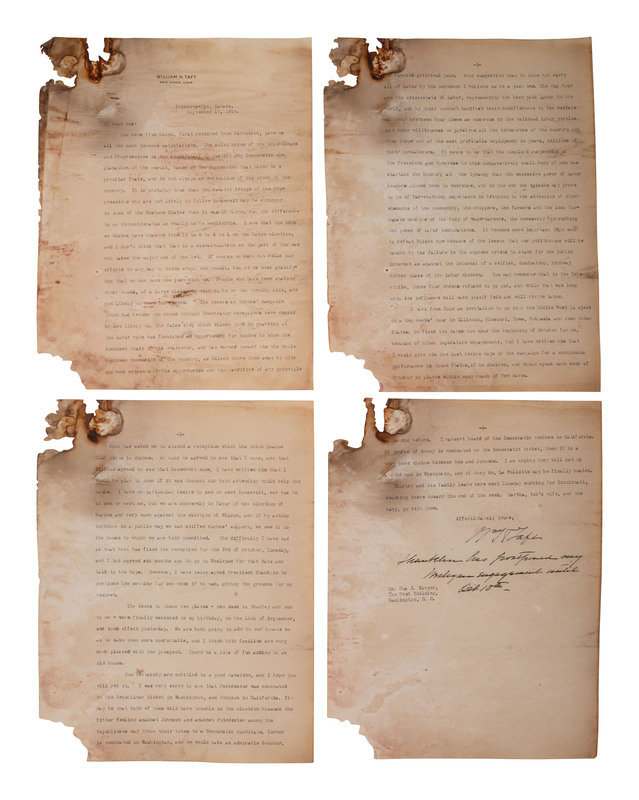
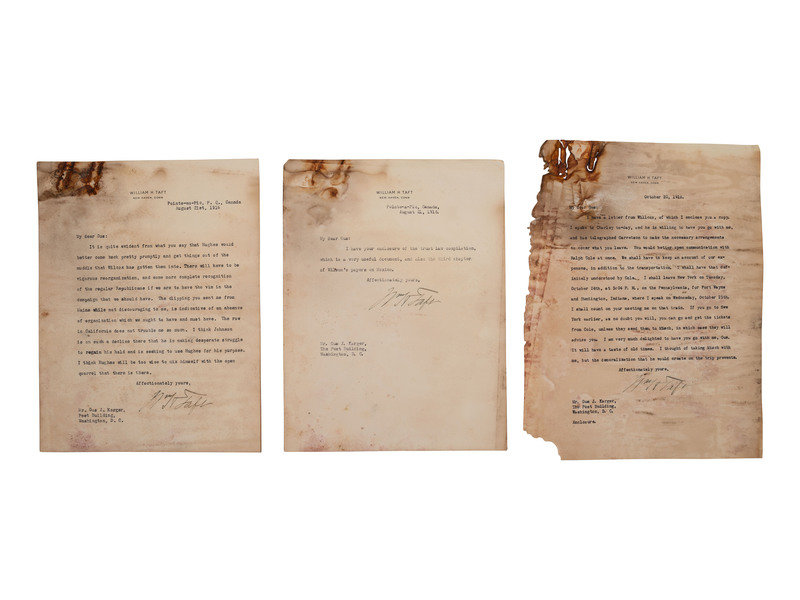
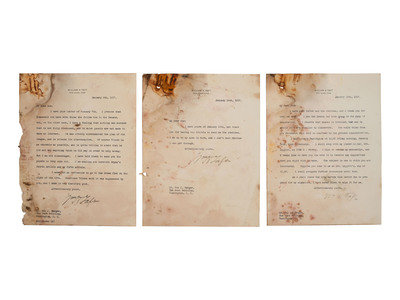
The twelve original letters in the archive are all on Taft’s personal letterhead “William H. Taft / New Haven, Conn” and are addressed to Karger. The letters span a five-month period from August 1916 through January 1917 (two letters, each 1p, 21 Aug 1916; 2pp, 8 Sept; 4pp, 17 Sept; 2pp, 26 Sept; 1p, 20 Oct; 2pp, 24 Dec; 2pp, 30 Dec; 1p, 9 Jan 2017; 1p, 14 Jan; and two letters, each 1p, from 30 Jan). These letters are highlighted by Taft’s letter of 30 December 1916. Taft comments first on his series of written debates with William Jennings Bryan via the Press Forum discussing proposals on the League to Enforce Peace, then turns towards Woodrow Wilson.
The original letters of fall 1916 focus to a large extent on the 1916 United States presidential election featuring Republican Charles Evans Hughes and incumbent Democratic President Woodrow Wilson. Taft discusses the candidates, internal Republican divisions, his own speaking engagements, and the outsize influence exerted over the President and Congress by the “selfish, dominating, highway robber class of the labor element.” In the letter of 17 September, Taft also comments on a Republican engagement organized as a means to demonstrate a reconciliation between Taft and Roosevelt.
Topics discussed within the copy typescripts include the following: the 8-hour work day and debates with Samuel Gompers; the League to Enforce Peace; foreign policy with regard to Mexico; ambassador appointments during the Harding administration; Dollar diplomacy in South America (specifically Colombia); the Philippines; the War Labor Board; Taft serving as a replacement on the U.S. Supreme Court and his Supreme Court appointment; World War I; and internal issues within the Republican party during the Progressive Era. Amongst the typescripts are copies of some of Taft's most noteworthy missives, such as his 11 November 1919 letter to Karger in which he endorses the Suffrage Movement.
While Taft-Karger letters signed do appear at auction, we locate no records of lots with this volume of correspondence. More noteworthy is the fact that the Cincinnati Historical Society which houses the Gus Karger Papers does not have original Taft-Karger letters in their collection with the dates of the original signed letters offered here, nor does it house copies of these original letters. Further research may indicate that some correspondence is new to the historical record.
The typescripts, which contain Taft’s correspondence on thin white paper and Karger’s correspondence on thin yellow paper, appear to be a nearly complete set of correspondence between Taft and Karger from 1913-1921. Typed notes accompanying the copies of correspondence would seem to indicate that these papers are not Taft or Karger’s retained copies of correspondence, but rather may be connected to the handling of the Taft-Karger correspondence following Karger’s death. Historian Jonathan Lurie’s article “Chief Justice Taft and Henry Pringle: How Pringle Came to Write the Life and Times of William Howard Taft (1939)” (Journal of Supreme Court History, vol. 43, no.2, July 2018, pp.141-159) indicates that following Karger’s death in 1924, the reporter’s widow and his son engaged in efforts to sell Karger’s correspondence with Taft. This plan was vehemently opposed by Taft due to the extremely candid nature of his remarks regarding living politicians and other individuals. Lurie later notes that “Mrs. Karger had also contacted an employee in the Washington office of the Chicago Daily News, Leroy Vernon, who proposed that he undertake to have the entire correspondence copied.” Lurie indicates that the Taft family acquiesced to the copying which was completed in 1930, at which point Vernon provided Robert Taft (William H. Taft’s son) with a set of the letters. Leroy T. Vernon (1879-1938), political editor of The Chicago Daily News, served for twenty-five years as chief of the newspaper’s Washington bureau and lived in Washington D.C. at least through 1933. Given that this archive was acquired in a D.C. suburb, there may be a connection between Vernon, the copied correspondence, and the archive offered here. It is unclear exactly how many copies of the Taft-Karger correspondence were made, but in addition to this set there is another set with the alternating white and yellow typescripts housed at the Cincinnati Historical Society, a gift from Karger's daughter-in-law in the 1960s.
This lot is located in Cincinnati.