Condition Report
Contact Information
Auction Specialist
Lot 70
Sale 6425 - American Historical Ephemera and Early Photography, including The Larry Ness Collection of Native American Photography
Part I - Lots 1-222
Oct 23, 2025
10:00AM ET
Part II - Lots 223-376
Oct 24, 2025
10:00AM ET
Live / Cincinnati
Own a similar item?
Estimate
$600 -
800
Price Realized
$900
Sold prices are inclusive of Buyer’s Premium
Lot Description
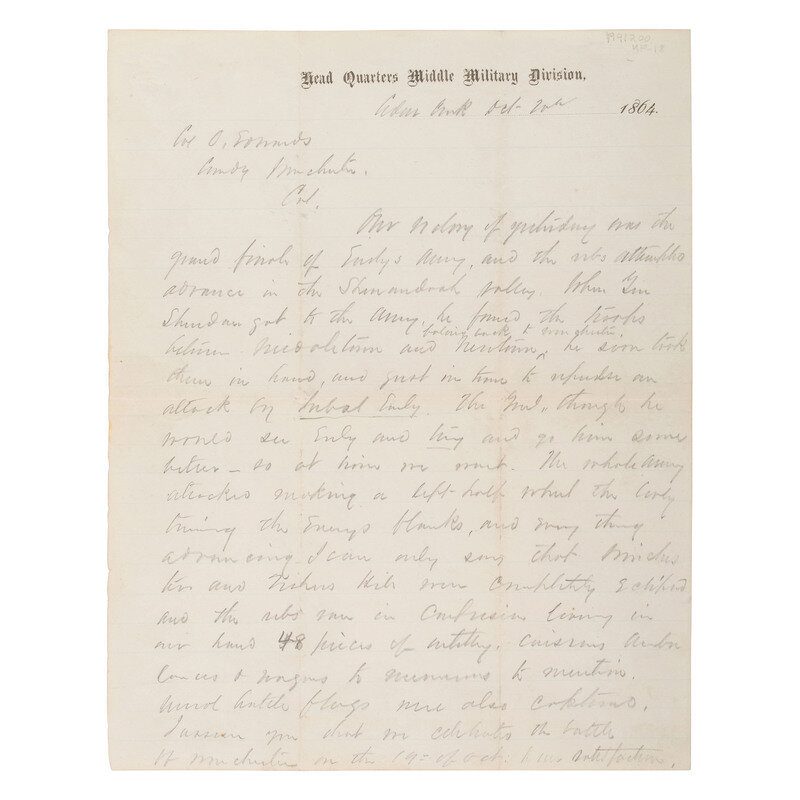
[CIVIL WAR]. FORSYTH, James W. (1834-1906). ALS to Col. Edwards describing Gen. Sheridan's victory at the Battle of Cedar Creek. 20 Oct 1864.
WHEN GEN SHERIDAN GOT TO THE ARMY, HE FOUND THE TROOPS...FALLING BACK TO WINCHESTER. HE SOON TOOK THEM IN HAND, AND JUST IN TIME TO REPULSE AN ATTACK BY JUBAL EARLY...
2 pages, 7 5/8 x 9 3/4 in., creased along old folds, with some soiling and wear. On Head Quarters Military Division letterhead, with year printed. Addressed to "Col. O. Edwards, Comdg Winchester."
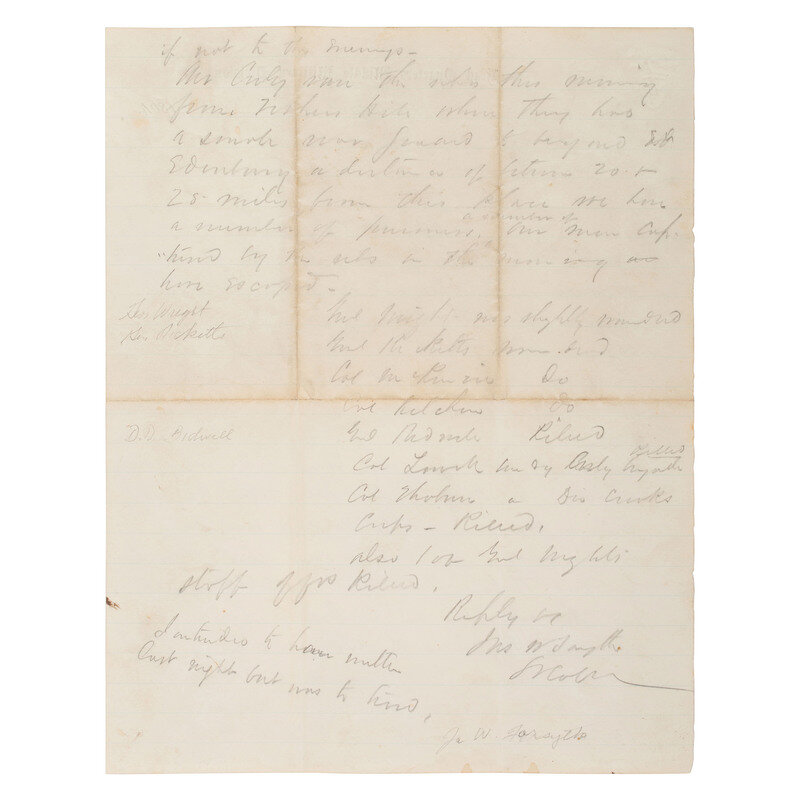
In part: "Our victory of yesterday was the grand finale of Early's Army, and the rebs attempted advance in the Shenandoah Valley. When Gen Sheridan got to the Army, he found the troops between Middletown and Newton falling back to Winchester. He soon took them in hand, and just in time to repulse an attack by Jubal Early. The Genl. thought he would see Early and try and go him some better, so at him we went. The whole Army attacked making a left half wheel the cavly turning the Enemy's flanks, and every thing advancing. I can only say that Winchester and Fishers Hills were completely eclipsed and the rebs ran in confusion leaving in our hand 48 pieces of artillery, caissons, ambulances & wagons to [sic] numerous to mention. Several battle flags were also captured. I assure you that we [indecipherable] the battle of Winchester in the 19th of oct. to our satisfaction if not the Enemy's. Our Cvly ran the rebs this morning from Fisher's Hill where they had a sm[?] rear guard to beyond Edenberg a distance of between 20 & 25 miles from this place we have a number of prisoners, a number of our men captured by the rebs in the morning have escaped."
Forsyth then begins a list of casualties including General Wright, who is described as being "slightly wounded," General Ricketts, described as "wounded," several colonels wounded and killed, and one of General Wright's staff officers killed.
In a final note scrawled at the bottom of the page and signed by Forsyth, he writes, "I intended to have written last night but was to [sic] tired."
The poem, Sheridan's Ride by Thomas Buchanan Read, celebrates the victory at Cedar Creek, specifically Sheridan's actions from his timely arrival to his leadership of Union troops to repulse Early's attack and send the Confederate troops fleeing, much of which is also described in the letter offered here. One poignant stanza from that poem reads, "The first that the General saw were the groups / Of stragglers, and then the retreating troops... He dashed down the line mid a storm of huzzas, / And the wave of retreat checked its course there, because / The sight of the master compelled it to pause. / With foam and with dust the black charger was gray; / By the flash of his eye, and his nostril's play, / He seemed to the whole great army to say, / 'I have brought you Sheridan all teh way / From Winchester down, to save the day!'"
James William Forsyth (1834-1906), a native of Maumee, OH, graduated West Point in 1856, receiving a commission as 2nd lieutenant in the 9th US Infantry, a position he filled with distinction at San Juan Island, until being promoted to first lieutenant in the first year of the Civil War. He then joined the Union Army to serve as colonel of the 64th Ohio Infantry Regiment for a short time, then transferring to the Army of the Potomac in January of 1862 to serve as the assistant US Inspector General, and later aide-de-camp to General Joseph Mansfield during the Maryland Campaign. After that, he served as provost marshal of the Army during the Battle of Fredericksburg. By 1863, Forsyth was transferred to become General Philip Sheridan's adjutant, serving in that capacity at Chickamauga and being brevetted to major for his actions there. Forsyth followed Sheridan to the AoP's Cavalry Corps, becoming his chief of staff during the Overland Campaign, and later becoming chief of staff of the Army of the Shenandoah and the Union Cavalries during the Shenandoah Valley Campaign and the Appomattox Campaign, respectively. He was brevetted thrice, up to the rank of brigadier general of volunteers for his actions at Cedar Creek, Five Forks, and the Shenandoah Valley Campaign.
After the war, Forsyth would go on to command a cavalry brigade and then took various staff positions within the Department of the Missouri, as Philip Sheridan became that department's commander. Forsyth is best known for his post-war service as colonel of the 7th US Cavalry at the Wounded Knee Massacre in 1890.