
Condition Report
Contact Information
Auction Specialist
Lot 64
Sale 6425 - American Historical Ephemera and Early Photography, including The Larry Ness Collection of Native American Photography
Part I - Lots 1-222
Oct 23, 2025
10:00AM ET
Part II - Lots 223-376
Oct 24, 2025
10:00AM ET
Live / Cincinnati
Own a similar item?
Estimate
$600 -
800
Price Realized
$480
Sold prices are inclusive of Buyer’s Premium
Lot Description
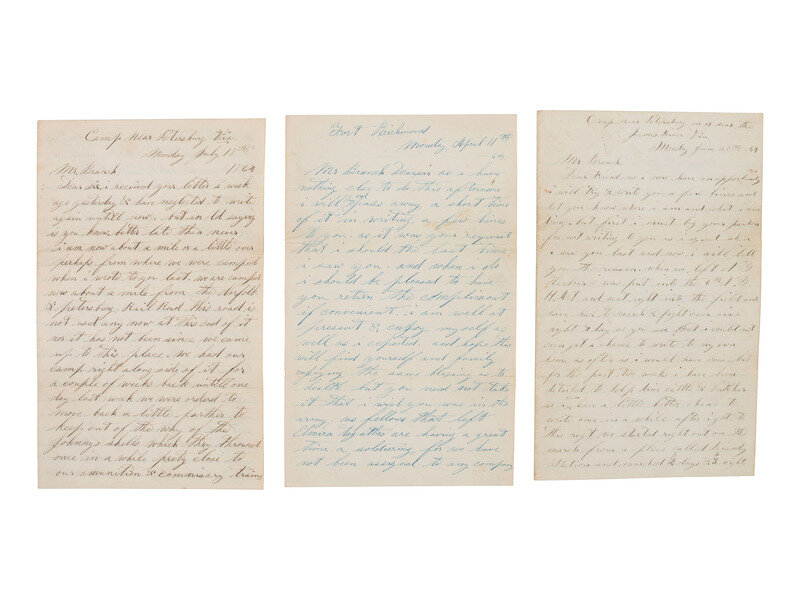
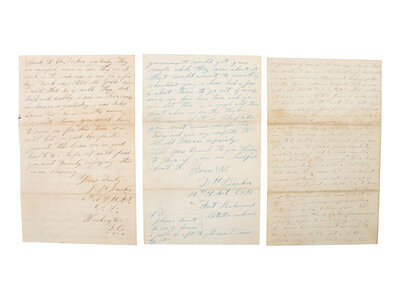
[CIVIL WAR]. 3 letters from D. H. Barber, 6th NY Heavy Artillery, incl. battle content from Brandy Station, the Wilderness, and Bethesda Church.
3 war-date letters, each addressed to Barber's friend, "Mr. Branch." Includes:
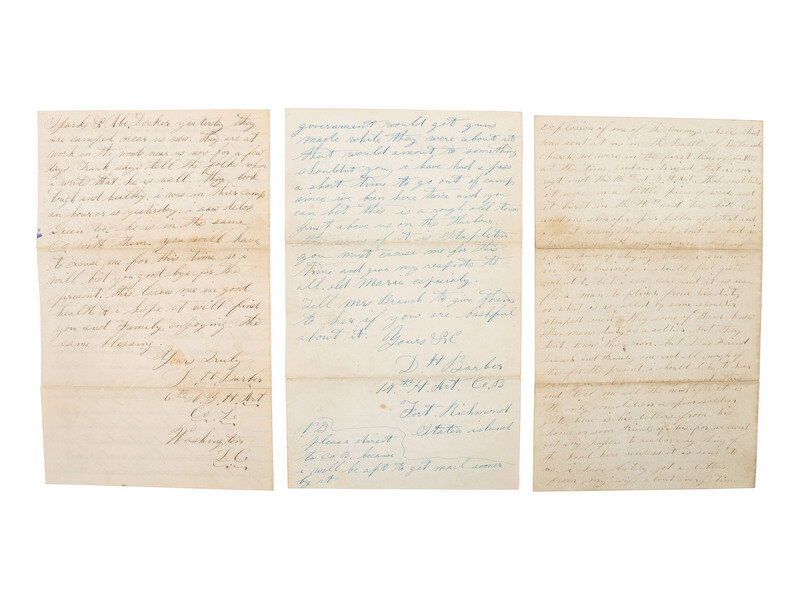
ALS, 4pp (creasing with some separations along creases, soiling), "Fort Richmond," [NY], 11 April 1864. discusses the pleasure of soldiering, saying that "us fellows that left Elmira together" are having quite an easy time of it as they haven't been assigned to a company yet. They are currently at a fort in Staten Island, near Fort Lafayette, which was used as a prison for civilians who were deemed disloyal to the Union/ Barber makes an interesting note of it, writing: "The old cage that holds so many copperheads stands between here and Fort Hamilton almost in the middle of the channel. That is Fort Layefayette [sic]..." He also mentions the one gun they have at his fort, yet unmounted, which weighs "only eighty thousand and eighty lbs" and with which Barber seems unimpressed. He signs his name with the regimental and company designation of "14th H. Art. Co. B," though we know he was as yet "unassigned."
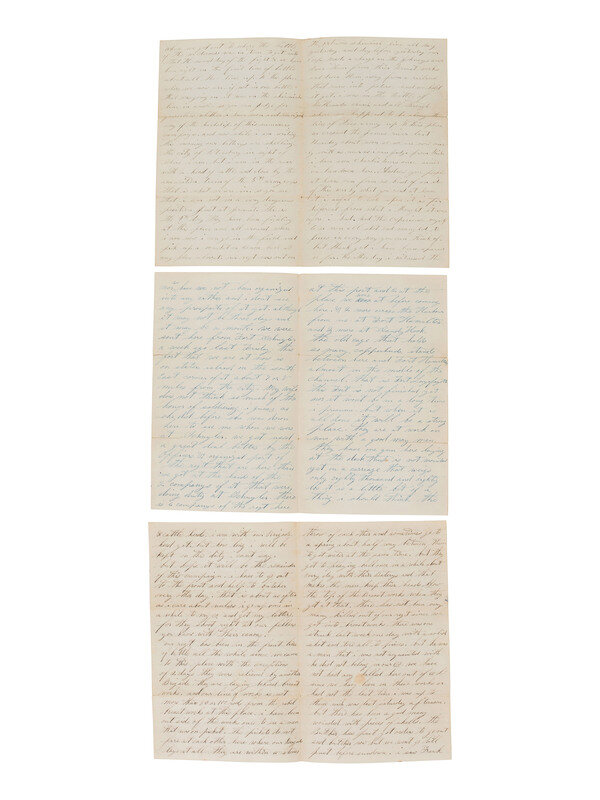
ALS, 4pp (creasing with some separations along creases, soiling), "Camp near Petersburg on or near the James River Via," 20 June 1864. Barber lets his friend know that he has been assigned to the 6th New York Heavy Artillery Regiment "and sent right into the field and have had to march & fight ever since night & day..." He tells how his unit began marching from Brandy Station to the location of the Battle of the Wilderness, arriving in time to join the fight on the second day of battle. He continues more broadly about the Overland Campaign: "...We have been right in the front line of battle about all the time up to this place where we now are if not in one battle that was going on it was on the skirmish line in another so you can judge for yourselves whether I have seen and realized any of the hardships of this summer's campaign." Though he is in a safe position at the time he's writing, he can see the Union batteries shelling Petersburg. He writes that his regiment was on the front lines the past two days, and pushed the Confederate forces away from a railroad that the Union now holds. He then reflects on the toll of these experiences, stating, "Andrew you people at home can form no kind of an idea of this war by what you read...it is awful to look upon, it is far different from what I thought it was before I had had the experience myself to se [sic] men all shot and mangled to pieces in every way you can think of...The other day I witnessed the explosion of one of the enemy's shells that was sent at us in the Battle of Bethesada [sic] Church...it burst in the 15th and tore both legs and one arm of a poor fellow off that and a great many others just about as bad I have seen with my own eyes..."
ALS, 4pp (creasing, light toning/staining), "Camp near Petersburg Via," 18 July 1864. Barber notes that he is continuing with his duty of assisting the butcher with the Brigade's herd, but that his regiment has been in the front line of battle since coming to this camp. They do have breastworks to protect them now and Barber reports that "there has not been very many killed out of our regt since we got into breastworks. There was one struck last week one day with a solid shot and tore all to pieces, but he was a man that I was not acquainted with he did not belong in our co."
David H. Barber was 22 years of age when he enlisted as a private on 28 December 1863. He was unassigned until mustering into Company L of the 6th New York Heavy Artillery in May of 1864. He mustered out with that regiment in August of the following year at Washington, DC.