Condition Report
Contact Information
Lot 29
Sale 6419 - Asian Works of Art
Dec 16, 2025
10:00AM ET
Live / Philadelphia
Own a similar item?
Estimate
$400 -
600
Price Realized
$2,880
Sold prices are inclusive of Buyer’s Premium
Lot Description
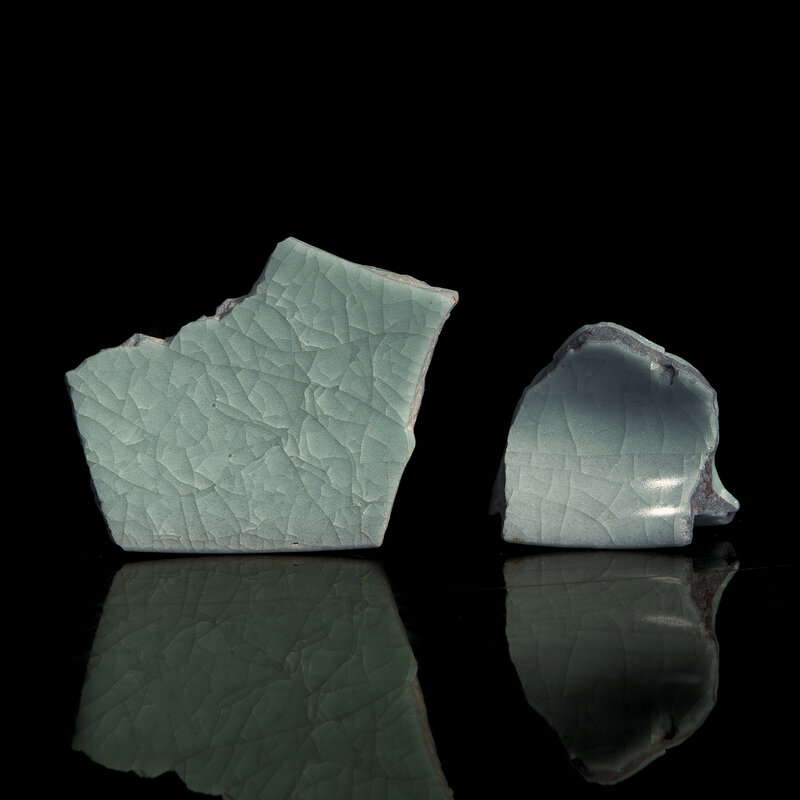
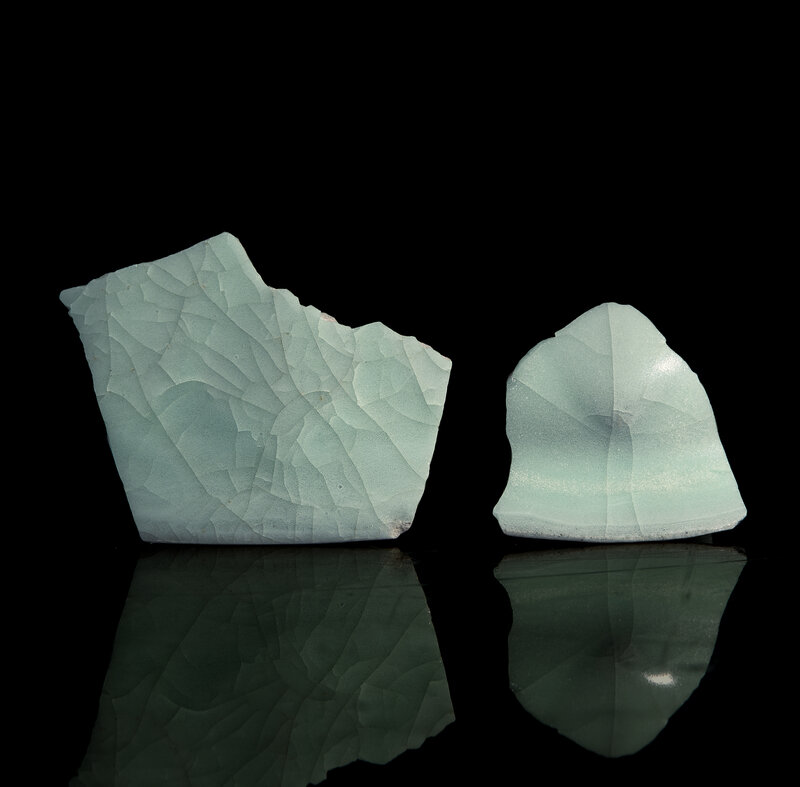
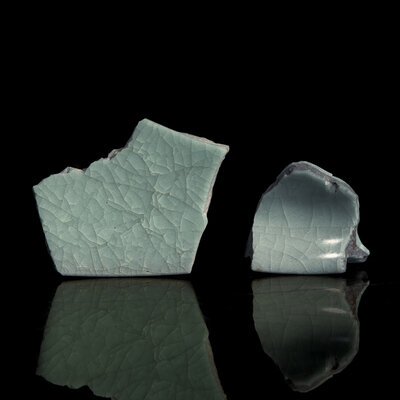
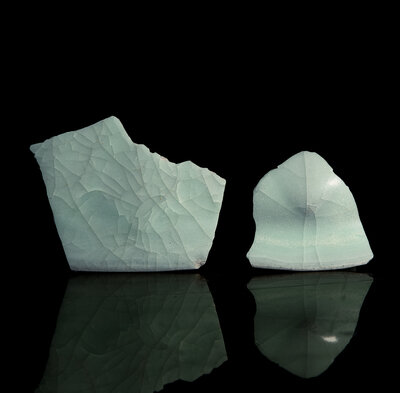
Two Rare Guanyao Celadon Fragments, Southern Song Dynasty
南宋 官窯粉青釉瓷片兩件
南宋 官窯粉青釉瓷片兩件
Southern Song Dynasty (1127-1279)
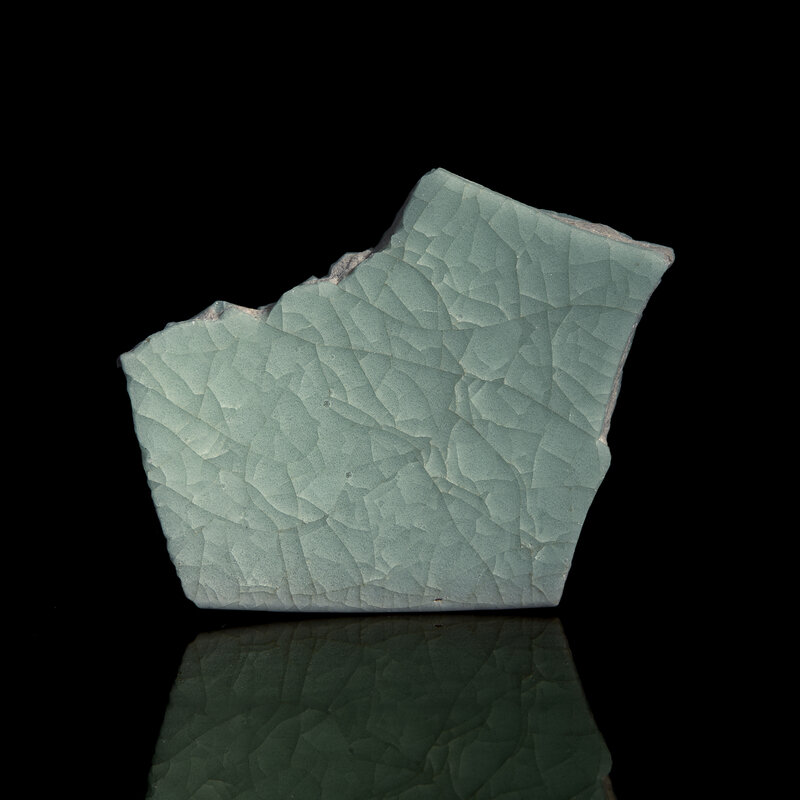
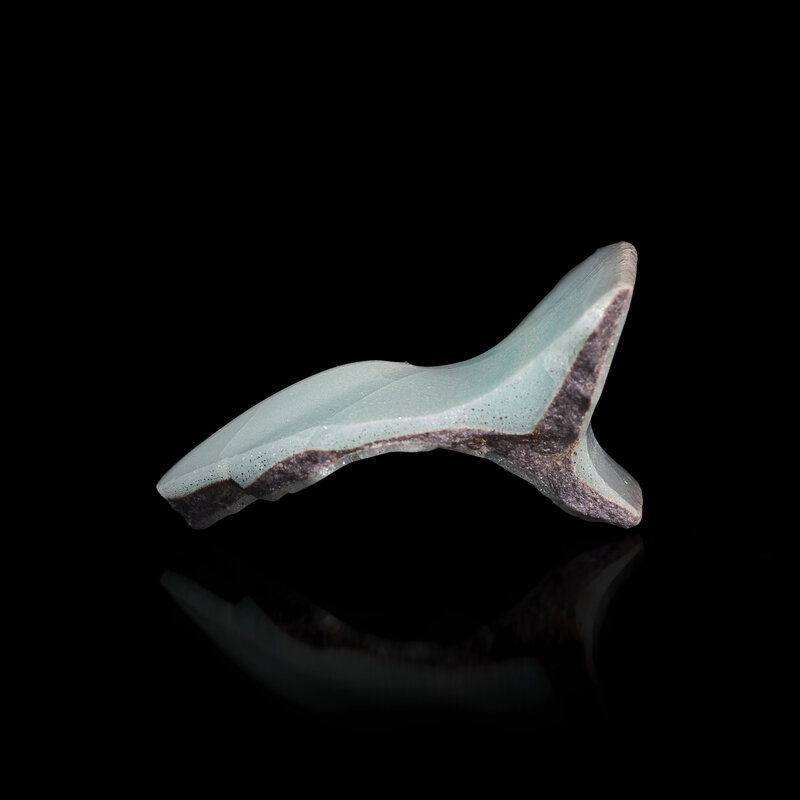
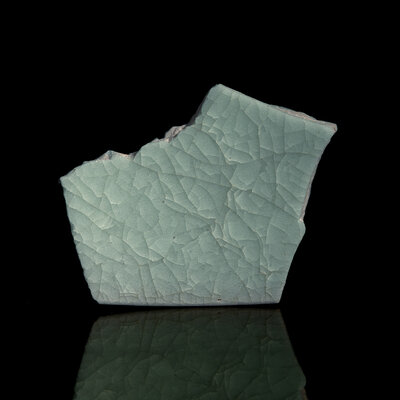
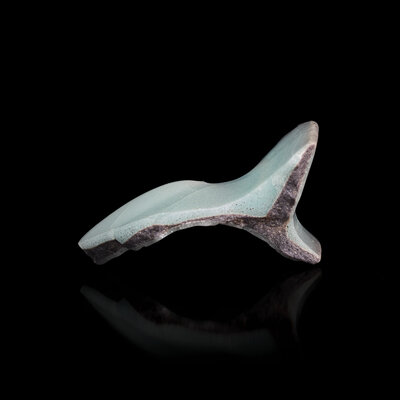
Comprising a fragment of a "lotus petal" bowl's rim, distinguished by its characteristic craquelure, and an exquisitely potted fragment from a lotus leaf-form cover. Both pieces display the quintessential finely potted greyish bodies and thick blueish-celadon glaze of the Imperial kilns of the Southern Song dynasty.
Note:
In 1086, the legendary finely-potted celadon-blue-glazed Ru ware was first commissioned by the Northern Song court, representing an unparalleled zenith in the history of Chinese ceramics. However, this golden age was tragically short-lived. Forty years later, the dynasty fell to the invading Jin armies, an event marked by the capture and humiliation of Emperors Huizong and Qinzong. Yet, the legacy of Ru ware endured. By 1149, its spirit was reborn in Lin’an (modern Hangzhou) in the form of Guan (Official) ware. As the Southern Song court's successor to Ru, Guan ware consciously emulated its revered predecessor in multiple aspects. As recorded in Ye Zhi's Southern Song text, Tanzhai Biheng: "After the imperial court moved south of the Yangtze River, Shao Chengzhang was put in charge of the rear garden establishment, known as the Shao Bureau. Following the old capital's traditions, a kiln was established within the Interior Department to produce celadons, named the 'Inner Kiln'." Serving exclusively as imperial ceramics, sacred objects such as altar stands were produced only by these official kilns. Guided by Daoist principles, both Ru and Guan ware pursued the ultimate celadon glaze, a color meant to embody the heavens. To compensate for the dark, iron-rich local clay, Guan artisans perfected a body of extraordinary fineness, often as thin as 0.3 cm. The delicate form was then enveloped in a thick, opulent glaze applied in multiple layers. Research from the Palace Museum in Beijing confirms that this glaze featured a high potassium and low calcium composition, which drastically reduced its fluidity during firing. This unique formula resulted in a glaze with a soft, dense texture and a warm, jade-like tactile quality—a triumph of artistry that came at the cost of an extremely low success rate. The Confucian dictum, "When sacrificial vessels become damaged, they are to be buried," was scrupulously followed. Excavations at the Guan kiln sites have revealed large caches of deliberately shattered and buried wares. This practice ensured that any piece failing to meet the exacting imperial standard would never enter the public domain, further cementing Guan ware's identity as the sole preserve of the court. Consequently, the finest Guan ware fragments are typically discovered in the vicinity of the old Southern Song palace grounds. The two fragments presented here are emblematic of this standard of palace quality. The larger fragment, originally part of a lotus-petal bowl, exhibits the most exquisite glaze texture. A network of long, dark crackles is interlaced with shorter, transparent fissures, creating a pattern reminiscent of multifold rose blossoms or crackled ice. For comparison, see a similarly glazed lobed bowl in the Tokyo National Museum (Ref. TG-1234) and a large round Guan washer in the collection of the Taipei Palace Museum (Ref. 故瓷016928).The smaller fragment is likely from a lotus-leaf-shaped cover. Its glaze is a lighter, clearer blue, yet the dark grey clay body beneath lends it a characteristic depth and serenity. The crackle pattern here is more understated, consisting of subtle, transparent lines. The glaze quality can be compared to a foliate rim dish in the British Museum from the Sir Percival David Collection (Museum No. PDF,A.46), and a Guan lobed dish formerly in the collections of Sir Harry M. Garner and the Ise collection, sold at Sotheby's Hong Kong in September 2025 (Lot 5022).For nearly a millennium, owning a piece of Southern Song Guan ware has been the dream of collectors. The Qianlong Emperor (r. 1735-1796) composed over seventy poems celebrating the Qing imperial collection, which numbered fewer than one hundred pieces.It is, therefore, more than an honor to present these precious fragments. It is a rare opportunity to glimpse the very peak of Song elegance—a beauty born from adversity and refined to perfection.
公元1086年,傳世瑰寶汝瓷首度受命於北宋宮廷燒造,標誌著中國陶瓷史上無與倫比的巔峰。然而這黃金時代轉瞬即逝,僅四十年後王朝傾覆,金軍鐵蹄踏破山河,徽欽二帝蒙塵北狩的恥辱成為歷史烙印。汝瓷的香火卻未斷絕。至1149年,其美學精神在臨安(今杭州)以官窯之名重獲新生。作為南宋宮廷承繼汝窯的正統,官窯在多個層面刻意追摹前朝典範。據南宋葉寘《坦齋筆衡》所載:「中興渡江,有邵成章提舉後苑,號邵局。襲故京遺制,置窯於修內司,造青器,名內窯。」這些專屬御用的陶瓷中,祭壇供器等禮制重器僅由官窯燒造。秉承道家哲學,汝官二窯皆追求象徵天象的玄青釉色。為克服南方胎土含鐵量高的特性,官窯匠人將胚體修薄至僅0.3公分,再以多重施釉工藝覆以豐厚釉層。北京故宮研究院證實,其釉料獨特的高鉀低鈣配方大幅降低燒製流動性,形成溫潤致密、類玉質感的釉面——這般藝術成就的代價,是極低的成品率。《禮記》「祭器敝則埋之」的訓誡被嚴格遵循。官窯遺址考古發現大量刻意擊碎掩埋的殘器,此舉確保未達御準的器物永不流散民間,進一步強化官窯的宮廷專屬屬性。故最精粹的官瓷殘片,多見於南宋皇城舊址周邊。本次呈現的兩件殘片,正是這宮苑標準的典型體現。較大殘片原屬蓮瓣式碗,釉面呈現精妙絕倫的紋理:深色長開片與透明冰裂短線縱橫交織,形成層疊薔薇或春冰乍裂的意象。可參照東京國立博物館藏瓣口碗(編號TG-1234)及台北故宮藏官窯圓洗(編號故瓷016928)之釉色開片。較小殘片疑為荷葉式蓋器,釉色清透微藍,然因深灰胎骨映照而別具幽邃之境。開片紋理較為內斂,僅見隱約透明冰裂。其釉質可與大維德基金會藏葵口盤(編號PDF,A.46)及香港蘇富比2025年秋拍第5022號官窯葵口盤(原屬Garner爵士、伊勢收藏)相互參照。近千年來,典藏一片南宋官瓷始終是鑒藏家的終極夢想。乾隆皇帝(1735-1796年在位)曾為清宮不足百件的官窯珍藏題寫七十餘首御制詩。是次得以呈現此吉光片羽,非但與有榮焉,亦是窺見宋韻極致的難得機緣——這種於憂患中孕育、在淬煉裡臻至完美的美學境界,至今依然動人心魄。
Length of the larger 2 1/8 in., 5.4 cm.
This lot is located in Philadelphia.