Condition Report
Contact Information
Auction Specialist
Lot 265
Sale 6417 - Fine Printed Books & Manuscripts, Including Americana
Sep 10, 2025
10:00AM ET
Live / Philadelphia
Own a similar item?
Estimate
$5,000 -
8,000
Price Realized
$10,240
Sold prices are inclusive of Buyer’s Premium
Lot Description
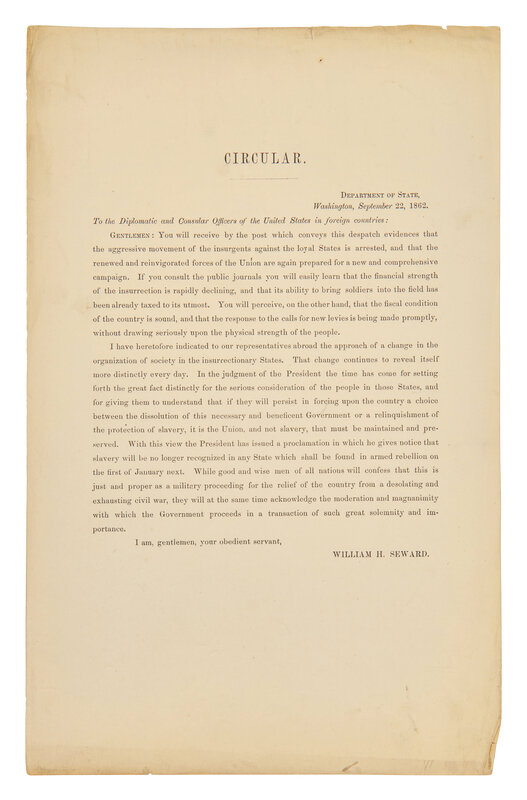
[Presidential] [Lincoln, Abraham] Seward, William H. Printed Circular Letter
(Washington, D.C.: Government Printing Office, ca. September 22-26, 1862). Printed diplomatic circular letter, signed and dated in type, William H. Seward, September 22, 1862. One sheet only (of two), excised from a bifolium (lacking the printed Emancipation found on pp. 3/4); wear along edges; residue on upper verso, from when likely mounted. 13 1/8 x 8 1/4 in. (333 x 209 mm). Eberstadt 3
"In the judgement of the President the time has come for setting forth the great fact distinctly for the serious consideration of the people in those States, and for giving them to understand that if they will persist in forcing upon the country a choice between the dissolution of this necessary and beneficent Government or a relinquishment of the protection of slavery, it is the Union, and not slavery, that must be maintained and preserved. With this view the President has issued a proclamation in which he gives notice that slavery will be no longer recognized in any State which shall be found in armed rebellion on the first of January next."
William H. Seward's circular letter transmitting the official State Department printing of the Preliminary Emancipation Proclamation, issued to United States diplomats and consular officers abroad to inform them of the issuance of the historic document that transformed the Civil War. Lincoln began drafting the Emancipation in July, 1862, and shortly after read it to his entire cabinet, who agreed to delay its release until a major Union military victory. That victory came at the Battle of Antietam, and Lincoln subsequently issued the Preliminary Emancipation on September 22, which stipulated that if the Confederate states did not end hostilities and rejoin the Union by January 1, 1863, all slaves in rebellious states would be freed.
The issuance of the Emancipation had important implications for the United States's foreign policy, as it signaled to the French and English governments to not recognize the Confederate government. As United States Minister in London, Charles Francis Adams, wrote to Seward on October 10, 1862, the effect of the Proclamation was “to draw the line with greater distinctness between those persons really friendly to the United States and the remainder of the community, and to test the extent of the genuine anti-slavery feeling left in this country.”
Rare, only six other copies of the transmittal letter (with the attached Proclamation) are known.