Condition Report
Contact Information
Auction Specialist
Lot 249
Sale 6417 - Fine Printed Books & Manuscripts, Including Americana
Sep 10, 2025
10:00AM ET
Live / Philadelphia
Own a similar item?
Estimate
$4,000 -
6,000
Price Realized
$2,560
Sold prices are inclusive of Buyer’s Premium
Lot Description
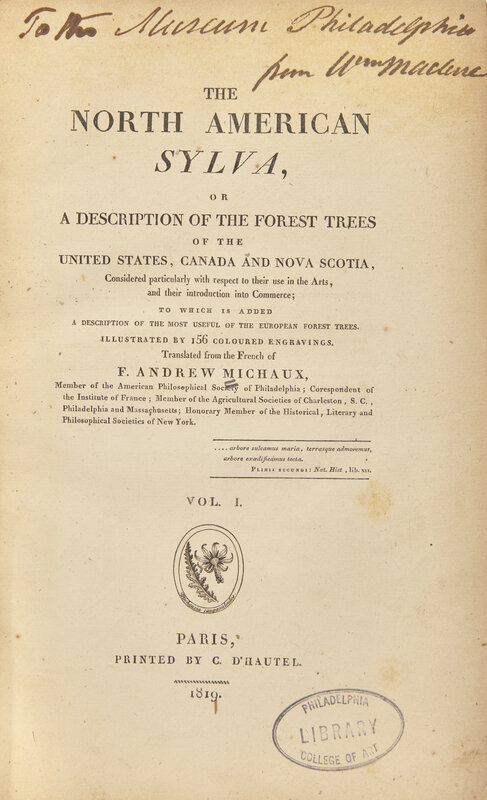
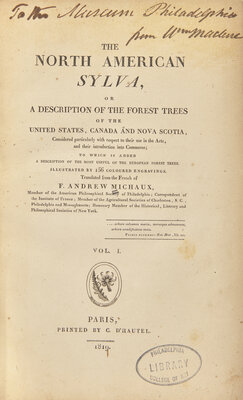
[Natural History] Michaux, F(rancois). Andrew. The North American Sylva, or A Description of the Forest Trees of the United States, Canada and Nova Scotia...
Presentation Copy from Scottish Naturalist William Maclure, the "Father of American Geology"
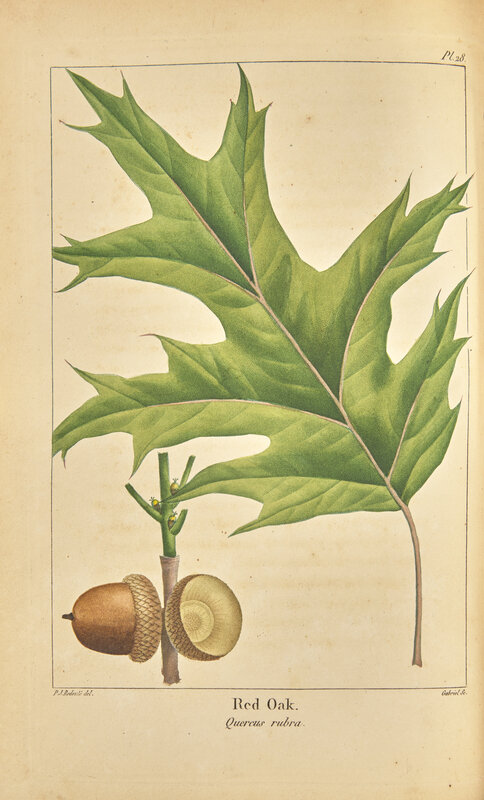
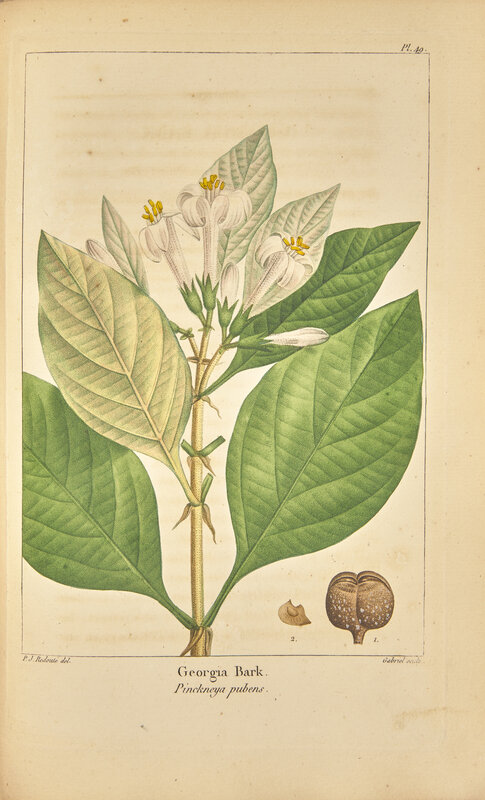
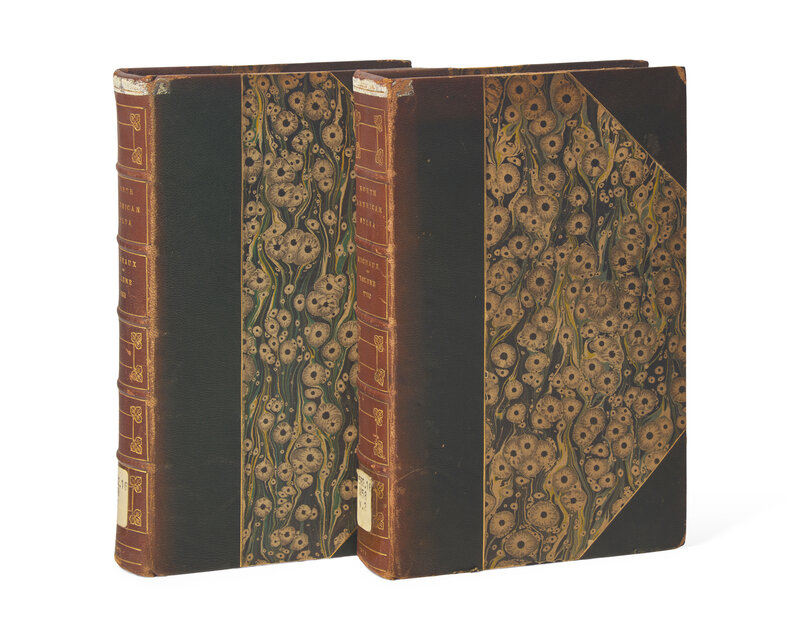
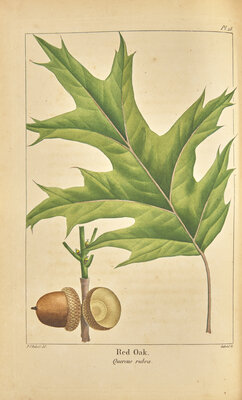
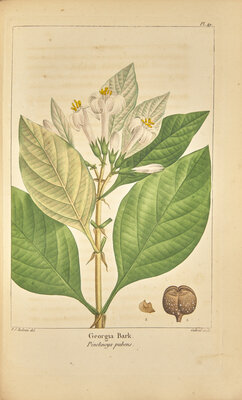
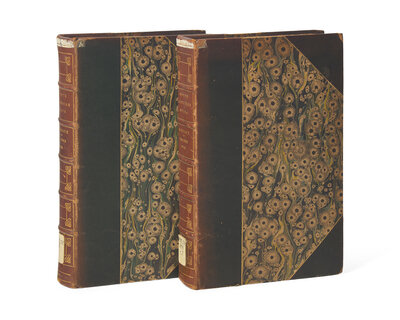
Paris: Printed by C. d'Hautel, 1819. In two volumes. First edition in English. Tall 8vo. (vi), v, (i), 383; (iv), 417, (1) pp., including half-titles. Presentation copy, inscribed by Scottish naturalist William Maclure on title-page of each volume: "To the Museum Philadelphia from Wm. Maclure". Illustrated with 156 stipple-engraved color plates after Pancrace Bessa, Pierre-Joseph Redouté, Henri-Joseph Redouté, and others. Three-quarter green morocco over marbled paper-covered boards, spines browned, library labels at foot of each spine, residue in upper spine and boards from removed labels, light wear along extremities, light rubbing to boards; all edges untrimmed; gift label on front paste-down of each volume; library ink stamp at bottom of each title-page, library pencil notations on verso of same and in gutter of facing page; library ink stamp at top of rear paste-downs; scattered foxing to text; light to moderate spotting and soiling to plates; plates free of library stamps; dampstaining in fore-edge of leaves at front of Vol. II. Sabin 48694 (three-volume issue, see note); Nissen BBI 1361; see Reese, Stamped With a National Character 21
A superb association copy of this famed work on North American trees, inscribed by Scottish geologist, educational reformer, and philanthropist, William Maclure (1763-1840), printer and publisher of the first American edition in 1841-42. First published in France between 1810-13 as Histoire des Arbres Forestiers de l’Amerique Septentrionale, this first edition in English was published between 1817-19--"Of the various editions with the text in English this, notwithstanding some typographical errors, is the best." (Sabin)
Born in Ayr, Scotland, as a young man William Maclure established himself as a wildly successful merchant, building incredible wealth which allowed him to travel extensively throughout Europe and the United States, where he developed a passion for geology. Retiring at the age of 34, Maclure emigrated to America in 1796 and devoted the rest of his life to scientific pursuits and educational reform, and single-handedly conducted and then published the first geological survey of the United States in 1809. A proponent of Swiss pedagogue Johann Heinrich Pestalozzi's (1746–1827) educational theories, Maclure established numerous Pestalozzian schools in the Philadelphia area and beyond, and used his vast wealth to support educational institutions such as the Academy of Natural Sciences (of which he was president for 23 years) as well as subsidizing the work of numerous scientists and teachers.
It was under this motivation that Maclure joined Robert Owen's struggling utopian community of New Harmony in Indiana in 1820, bringing with him his "Boatload of Knowledge” such a scientific equipment, a printing press, as well as scientists Thomas Say (1787-1834) and Charles Alexandre Lesueur (1778-1846). "Maclure supported their work in New Harmony and bought a small hand-press on which, between 1827 and 1843, were printed the monographic publications of Say and Lesueur as well as some of his own works and two by David Dale Owen, one of the sons of Robert Owen, who became a celebrated geologist. The most notable work to come off Maclure's press was the first American edition of François André Michaux's North American Sylva. Maclure had bought the remaining copies of the Paris edition himself, together with the original copper plates, while he was living in France in 1824." (MacPhail & Sutton, A Bibliography of the Natural History Works Printed at New Harmony, Indiana, 1827-1843, p. 300)
It is possible that the "Museum Philadelphia" that Maclure presented this work to was Charles Willson Peale's Philadelphia Museum. Peale painted Maclure's portrait in 1818, which now resides at the Academy of Natural Sciences, and Maclure is known to have donated many geological specimens to Peale's museum.
This lot is located in Philadelphia.