Condition Report
Contact Information
Auction Specialist
Lot 13
Sale 6417 - Fine Printed Books & Manuscripts, Including Americana
Sep 10, 2025
10:00AM ET
Live / Philadelphia
Own a similar item?
Estimate
$10,000 -
15,000
Price Realized
$17,920
Sold prices are inclusive of Buyer’s Premium
Lot Description
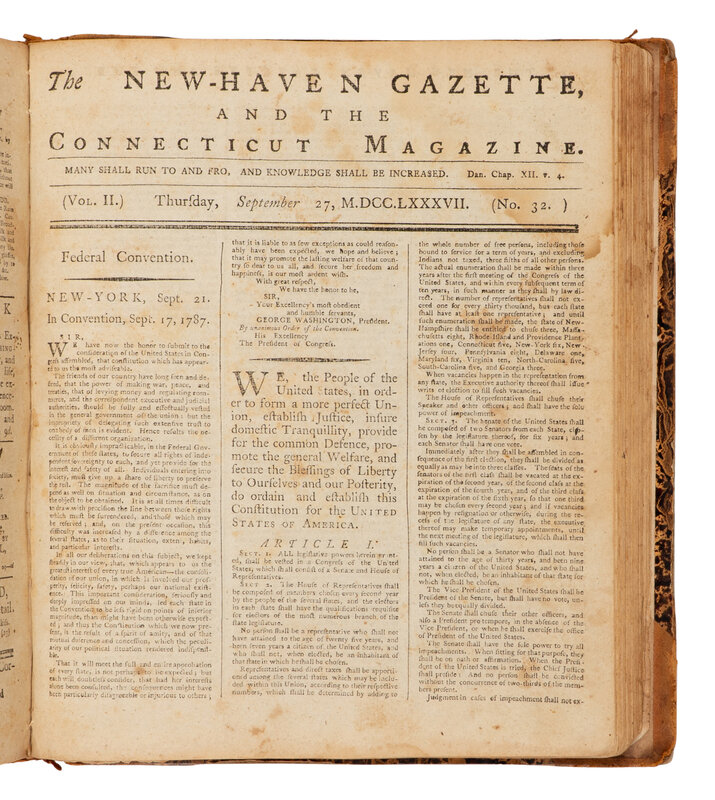
[Americana] [United States Constitution] The New-Haven Gazette, and the Connecticut Magazine
The Earliest Available Connecticut Printing of the United States Constitution
"We, the People of the United States, in order to form a more perfect Union, establish Justice, insure domestic Tranquility, provide for the common Defence, promote the general Welfare, and secure the Blessings of Liberty to Ourselves and our Posterity, do ordain and establish this Constitution for the United States of America."
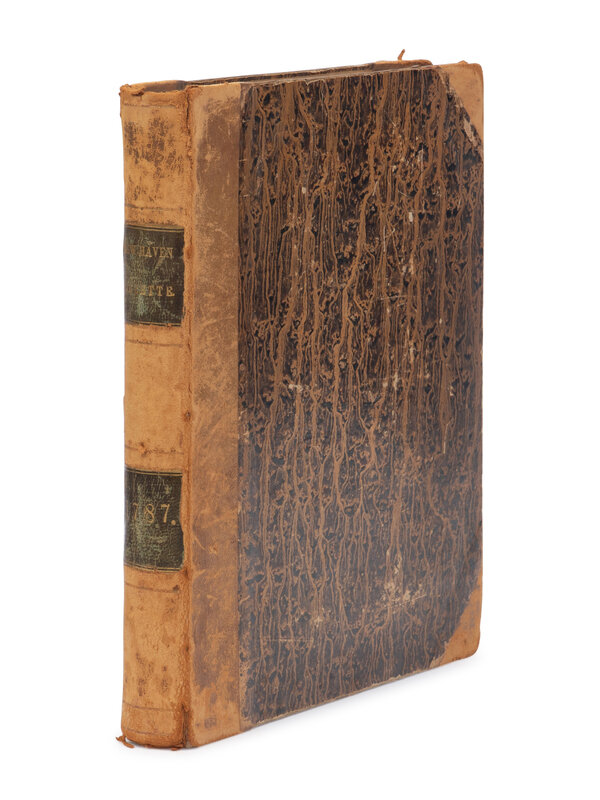
New Haven: Josiah Meigs, Thursday, September 27, 1787 (Vol. II, No. 32). Printed newspaper. 4to. 8 pp. Contemporary half sheep over marbled paper-covered boards, morocco spine labels, stamped in gilt, extremities rubbed, joints tender; light dampstaining to upper corner of first three leaves; scattered stains and toning throughout. Evans 20563; Lomazow 18b
Bound with a near-consecutive run of 41 other issues, including: Vol. II, Nos. 3-24, 26-28, [no. 29 crossed out by hand and noted as no. 30], 30-45; March 8-December 13, 1787. Lacking a few leaves; some bound out of order; staining and browning throughout.
Although considered by many to be the first Connecticut newspaper printing of the Constitution, former National Archives archivist Leonard Rapport states in his Printing the Constitution: The Convention and Newspaper Imprints, August-November 1787, in the Journal of the National Archives (2:2, 1970), that "The Constitution appeared in the New Haven Connecticut Journal, its first printing in that state" although we can find no examples of that printing. According to The Indiana University Bookman (The Lilly Library, September 1987, No. 16, pp. 30-31), "On September 27, The Norwich Packet carried the first of two installments of the Constitution. The same day, the Constitution appeared in The New-Haven Gazette, and The Connecticut Magazine. The New London Connecticut Gazette published the first installment on September 28. Three papers published the text of the Constitution on October 1: Middletown Middlesex Gazette, Hartford Connecticut Courant and Weekly Intelligencer, and the Hartford American Mercury."
This printing of the Constitution was printed only ten days after its adoption by the Constitutional Convention, held in Philadelphia from May 25 to September 17, 1787. After its adoption by the Convention, it was then debated by the Confederation Congress, then assembled in New York City, for two days before being officially sent to the individual states for ratification. Only one day after this printing, on September 28, 1787, the Confederation Congress voted unanimously to submit the Constitution to the states for ratification. It required that each state hold a ratifying convention and elect delegates to debate and then vote on adopting the text. As per the Confederation Congress rules, when nine states had voted to adopt, the Constitution would take effect. The ensuing state ratifying conventions were often dramatic affairs, pitting Federalists, who sought to adopt the Constitution, against Anti-Federalists, who viewed with alarm the extended powers the Constitution gave to the government. Connecticut delegates to the Constitutional Convention were instrumental in breaking a deadlock over legislative representation and devised the two-house legislative system we know today. On January 9, 1788, they became the fifth state to ratify the Constitution with a vote of 128-40, and their assent helped push the cause just over the halfway point toward adoption.
The Constitution is printed in full on the first three pages, with the Preamble printed in large type front and center on the first page, and is signed in type by George Washington and the 38 signing delegates. The Constitution is preceded by a printing of George Washington's letter transmitting the document to Congress, and is followed by a printing of the Constitutional Convention's resolution for ratification, as well as an opinion article in support of adopting the text. Further, on p. 254 is an article on the Constitution's reception in Pennsylvania, in which Benjamin Franklin's famous September 17th Convention speech is mentioned.
Complete collation available upon request.