





Condition Report
Contact Information
Auction Specialists
Lot 85
Sale 6388 - Western Manuscripts and Miniatures
Jul 8, 2025
10:00AM CT
Live / Chicago
Own a similar item?
Estimate
$1,300 -
1,500
Lot Description
REVEREND WILLIAM JOHN LOFTIE (born 25 July 1839, Tandragee, County Armagh, Ireland; died 16 June 1911)
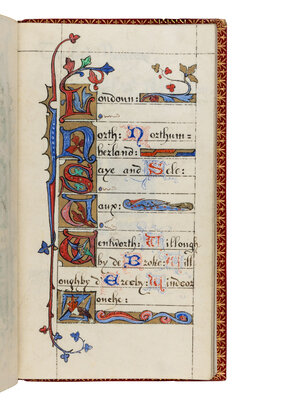
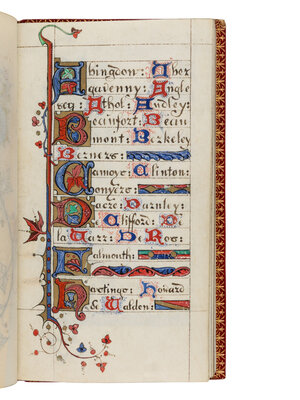
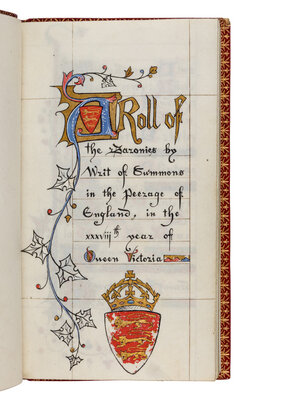
A Roll of the Baronies by Writ of Summons in the Peerage of England, in English, illuminated manuscript on parchment [England, c. 1875]
A Roll of the Baronies by Writ of Summons in the Peerage of England, in English, illuminated manuscript on parchment [England, c. 1875]
An illuminated neo-Gothic compendium of the English peerage conceived for the connoisseur’s library.
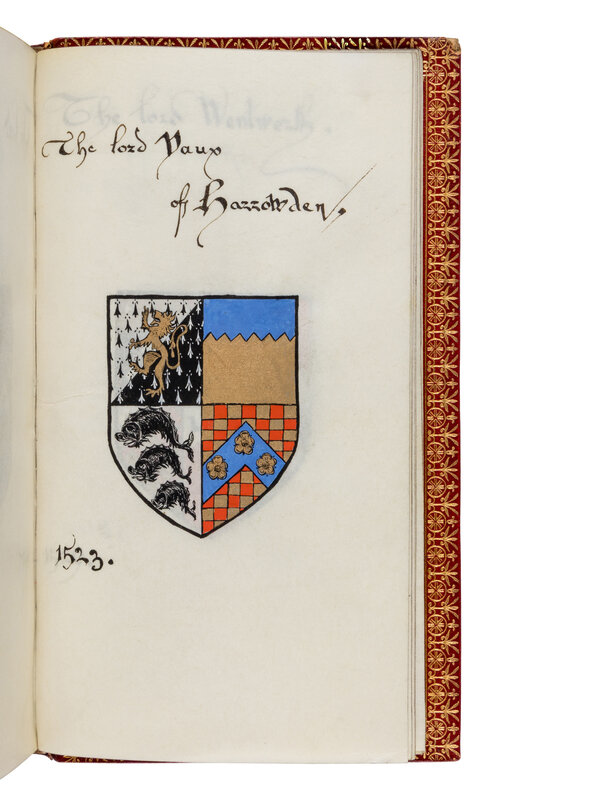
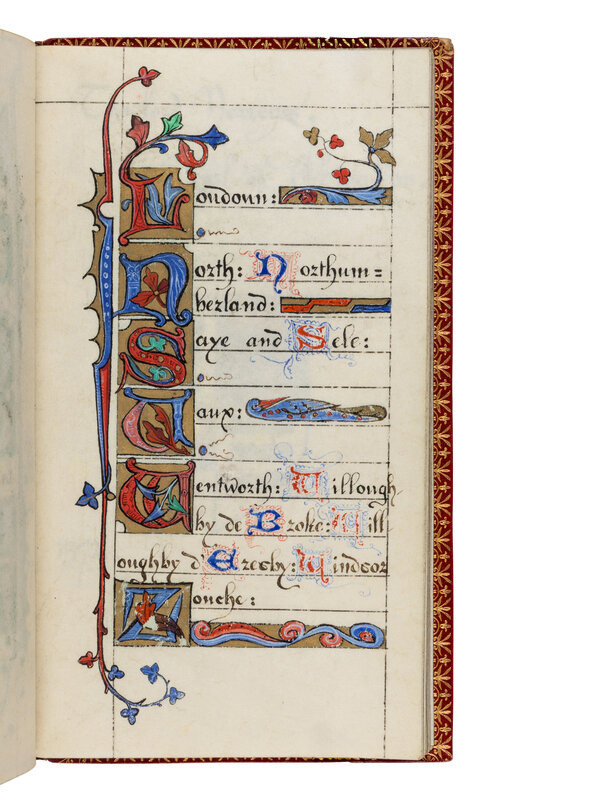
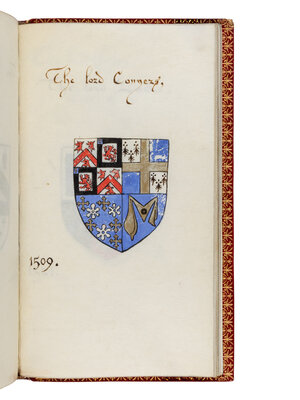
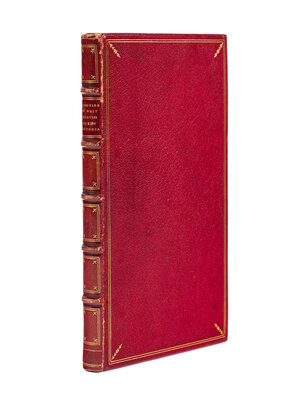
181 × 103 mm. 33 leaves (octavo format), ruled in black ink for single column of thirteen lines, featuring an illuminated title page, an alphabetical list of baronies, and thirty large coats of arms emblazoned in full color and gold, executed in a neo-medieval (fifteenth-century) style, each page is finely painted and heightened with gilt, imitating the ornamental flourishes of late medieval armorial manuscripts. The volume is bound in luxurious contemporary red morocco leather, elaborately gilt (“extra” binding), with vellum endpapers, gilt edges, and housed in a fitted case.
The artist-illuminator of this manuscript, Rev. William John Loftie (1839–1911), was a British clergyman, antiquarian, and prominent voice in the Victorian revival of medieval arts. A scholar of architectural and heraldic history, Loftie not only wrote extensively on the visual culture of the past but actively practiced it. His Lessons in the Art of Illuminating (1880) sought to revive the principles of medieval illumination for a modern audience, combining historical fidelity with practical instruction. In this heraldic compendium, Loftie deploys a refined visual vocabulary drawn from fifteenth-century armorial manuscripts: large coats of arms, finely executed in gold and color, are framed by scrolling foliate ornament and inscribed with Gothic lettering. The visual effect is one of deliberate archaism, designed to evoke the authority and splendor of the medieval peerage while also demonstrating the technical virtuosity of the modern scribe.
This manuscript exemplifies a broader antiquarian impulse in nineteenth-century England, in which the Gothic Revival intersected with renewed interest in genealogical and heraldic history. Within this cultural milieu, illuminated manuscripts, especially those documenting noble lineages, were prized both as scholarly resources and as aesthetic objects. Heraldic compilations such as this one were often privately produced for display in domestic libraries, where they signaled lineage, erudition, and taste. While official grants of arms continued to be issued by the College of Arms, works like Loftie’s functioned as scholarly tributes to the enduring legacy of the aristocracy, realized through the lens of Victorian neo-medievalism. The manuscript’s exquisite workmanship, bespoke binding, and historical subject matter suggest it was conceived as a collector’s object: a learned recreation of a medieval roll of arms, situated firmly within the visual and intellectual currents of late nineteenth-century England. The phenomenon of the revival of the manuscript arts in Europe and the United States has been most thoroughly surveyed in Hindman et al., 2001.
Provenance
(1) Rev. William John Loftie, the illuminator (c.1875–1880).
(2) J. & J. Leighton, London, booksellers, by the late nineteenth or early twentieth century; offered as item no. 137 in Catalogue of Manuscripts, Mostly Illuminated (London, c. 1900), describing the work as “executed by Rev. W. J. Loftie… 8vo, red morocco extra…”
(3) Heritage Book Shop, Los Angeles, late twentieth century (their inventory no. “HBS 15360” penciled on front flyleaf).
(4) Private Collection, California, USA.
LITERATURE
J. & J. Leighton, Catalogue of Manuscripts, Mostly Illuminated, …, London, ca. 1900, cat. 137; For additional literature see: W. J. Loftie, Lessons in the Art of Illuminating, London, 1880; John Ruskin, “Munera Pulveris,” Fraser’s Magazine (April 1862), p. 556; Sandra Hindman et al., Manuscript Illumination in the Modern Age: Recovery and Reconstruction, Evanston, IL, 2001; Jack Turton, “The Social and Cultural Significance of Victorian Heraldry” Victorian Web, 2017, digital publication.
We thank Senior Consultant Sandra Hindman and Peter Bovenmyer for their assistance in preparing this sale.
This lot is located in Chicago.