Condition Report
Contact Information
Auction Specialists
Lot 69
Sale 6388 - Western Manuscripts and Miniatures
Jul 8, 2025
10:00AM CT
Live / Chicago
Own a similar item?
Estimate
$1,500 -
2,000
Lot Description
AFTER JORG BREU THE ELDER (Augsburg, c. 1475-1537)
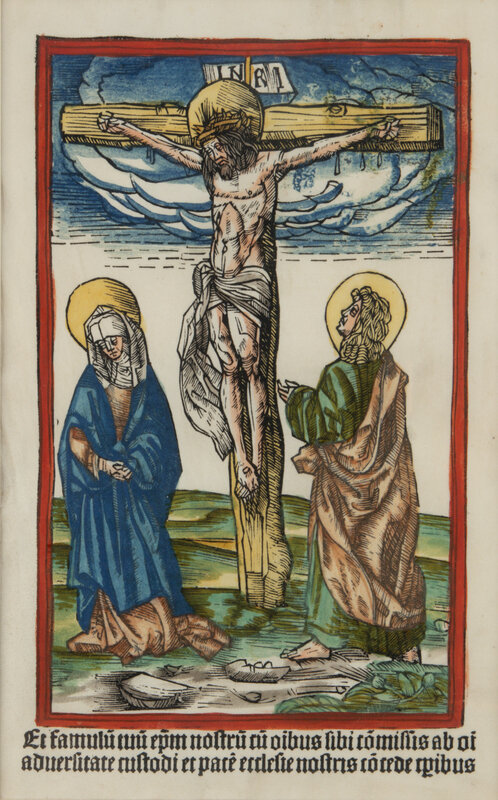
Christ on the Cross between the Virgin and St. John, woodcut with hand coloring, printed on parchment (sheet 308 x 182 mm.; image 222 x 139), Germany, Augsburg, 1504
Christ on the Cross between the Virgin and St. John, woodcut with hand coloring, printed on parchment (sheet 308 x 182 mm.; image 222 x 139), Germany, Augsburg, 1504
Jörg Breu the Elder, son of a weaver, became a leading artist of the Danube School. After a sojourn in Austria, he returned to Augsburg, becoming a master in 1502, travelled twice to Italy, in c. 1508 and 1514/15. His large and versatile workshop in Augsburg turned out history paintings, frescoes, woodcuts, and stained glass. His son Jörg Breu the Younger continued his workshop until 1547.
The composition comes from a print by Jörg Breu the Elder (Hollstein, no. 38) which was first used in a Constance Missal from 1504, then re-used in an Augsburg Missal of 1505. It is distinct from other contemporary images of the Crucifixion insofar as the figure of Saint John is turned towards the cross, showing the Christ’s favorite apostle in profile. The present print follows all the main features of Breu’s invention and copies them in a slightly simplified form. It was already used in the same year as Breu’s original, interestingly south of the Alps in the Missale Speciale printed by Luca Antonia Giunta in Venice in 1504. The poor impression in the Stadtbibliothek Augsburg published in the Heitz series, however, indicates that the block must have remained in use for a considerable time.
Blank on the verso, the present sheet is a very fine impression, impeccably printed on vellum. The printed inscription beneath the Crucifixion reads “Et famulum tuum episcopi nostrum cum omnibus sibi commissis ab omni adversitate custodi et pacem ecclesie nostris concede temporibus” (tr. And protect your servant, our bishop, together with all entrusted to him, from every adversity, and grant peace to the Church in our times). This is appropriate in a Missal that would have been used by a bishop to say Mass, and the leaf would have faced the opening text of the Mass, the “Te igitur.”
Provenance
(1) Private Collection, USA
LITERATURE
Victor Masséna, Prince d’Essling, Les Missels imprimés à Venise de 1481 à 1600, Paris 1896, pp. 271ff., no. 217; Richard Schmidbauer, Staats-, Kreis- und Stadtbibliothek Augsburg, Strasbourg 1909 (Paul Heitz, Einblattdrucke des fünfzehnten Jahrhunderts, vol. 18), pp. 8f., plate no. 6 (illustrating a very late impression from the worn and damaged block) ; F.W.H. Hollstein, eds. Guido Messling and Hans-Martin Kaulbach, The New Hollstein German Engravings, Etchings, and Woodcuts, 1400-1700: Jörg Breu the Elder and Jörg Breu the Younger, Ouderkerk aan den IJssel, The Netherlands, 2008; pp. 58ff., no. 38.
We thank Senior Consultant Sandra Hindman and Peter Bovenmyer for their assistance in preparing this sale.
This lot is located in Chicago.