
Condition Report
Contact Information
Auction Specialists
Lot 65
Sale 6388 - Western Manuscripts and Miniatures
Jul 8, 2025
10:00AM CT
Live / Chicago
Own a similar item?
Estimate
$500 -
1,000
Price Realized
$512
Sold prices are inclusive of Buyer’s Premium
Lot Description
CHANCERY OF ELIZABETH I (r. 17 November 1558–24 March 1603)
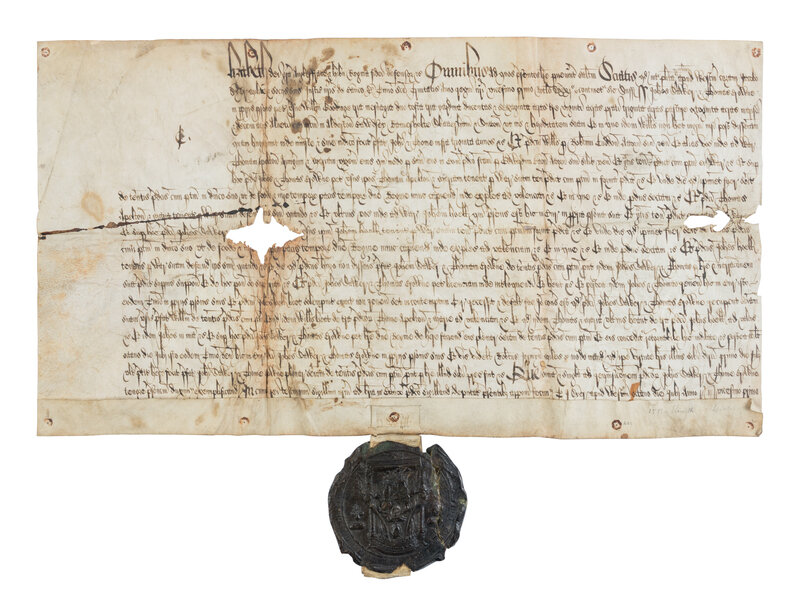
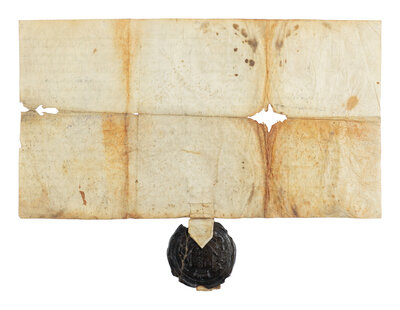
Single parchment sheet with Common Recovery under the Great Seal of Elizabeth I, involving lands in Suffolk, in Latin, manuscript on parchment [London, Court of King’s Bench, Trinity Term, 21 Elizabeth, 1579]
Single parchment sheet with Common Recovery under the Great Seal of Elizabeth I, involving lands in Suffolk, in Latin, manuscript on parchment [London, Court of King’s Bench, Trinity Term, 21 Elizabeth, 1579]
Issued by the Chancery of Elizabeth I and bearing her First Great Seal, this document offers a vivid testament to Elizabethan property law and royal authority.
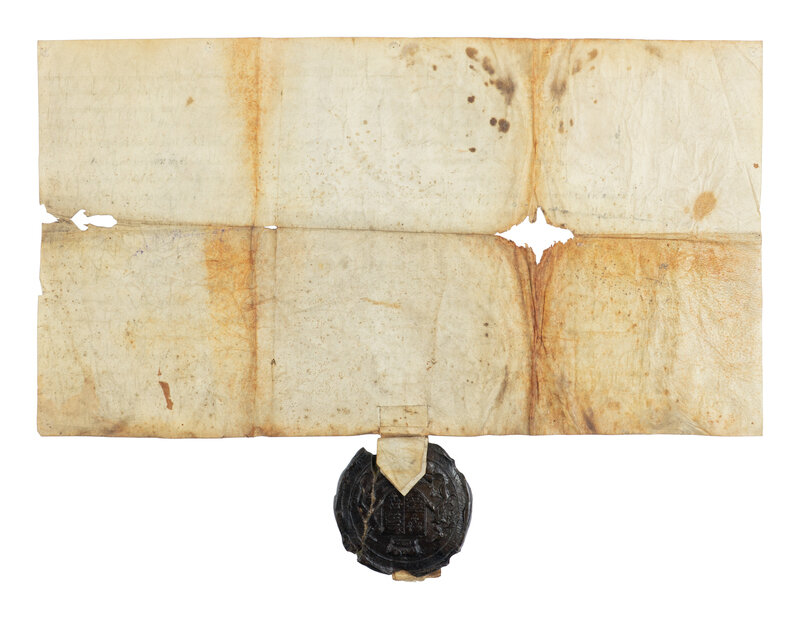
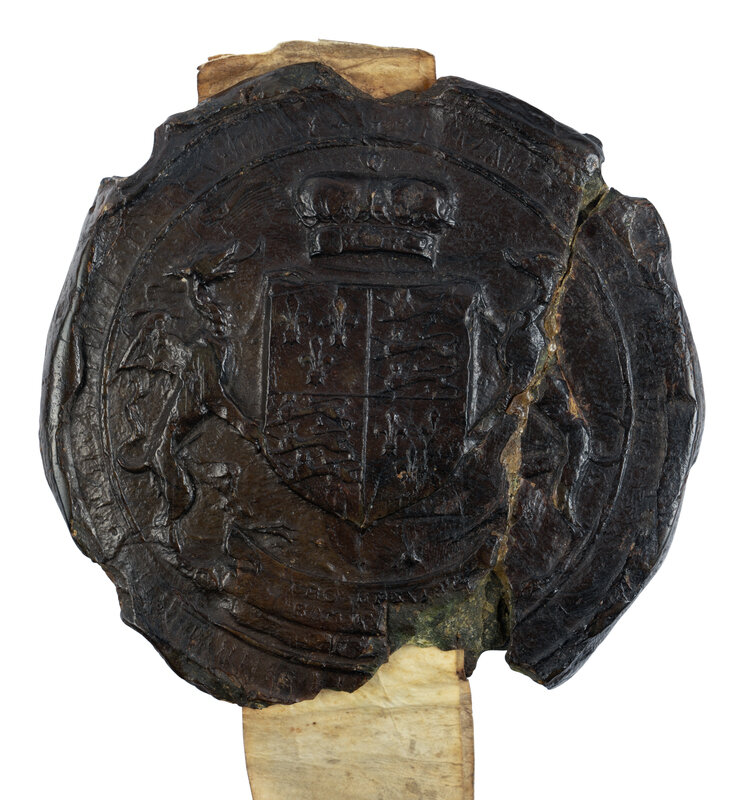
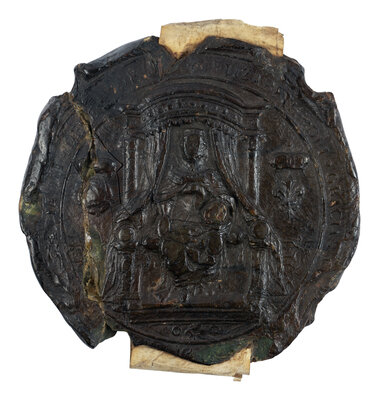
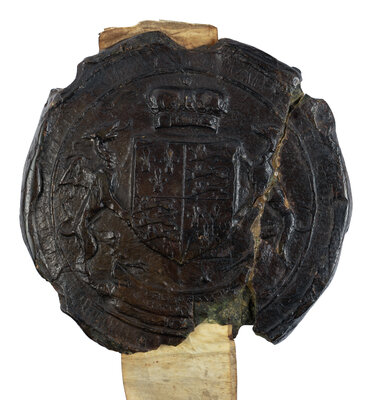
430 × 740 mm (parchment); ca. 135 mm diameter (seal). A single large legal document on parchment, written in nineteen lines of text in brown ink in a formal chancery script, and authenticated by the first Great Seal of Elizabeth I, cast in brown wax, and originally suspended from a parchment tongue, with the obverse showing the enthroned Queen holding orb and scepter, and the reverse the quarterly royal arms of England and France, surmounted by a crown and flanked by a collared greyhound (dexter) and a Tudor dragon (sinister), with portion of original legend “ELIZABETHA DEI GRACIA” visible on obverse. Parchment shows wear from its original folding pattern, having been creased vertically and horizontally into sixths, resulting in two tears along the central axis with partial loss of text, along with additional localized browning and minor discoloration, particularly along the folds and edges, FIRST GREAT SEAL broken free of parchment tongue, with cracking around the perimeter of the seal and chipping to the outer edge, and loss to most of the legend both the obverse and reverse, figure and heraldry retain definition with most of the iconography clearly visible.
This legal document was issued in 1579 by the Chancery of Elizabeth I and bears her First Great Seal, likely engraved by Nicholas Brigham (active under Henry VIII and Mary I) and in use from 1558 to 1586. The seal is notable for its retention of late-Gothic style, cast from a two-sided engraved matrix in metal—probably latten or silver—and impressed into a wax-resin mixture to form a large circular seal. It was affixed to parchment documents either by silk cords or, more commonly, by a parchment tongue (as here) cut from the lower margin of the deed. The First Great Seal was created early in Elizabeth’s reign to validate royal documents such as charters, pardons, land grants, and Common Recoveries. Surviving impressions are comparatively rare, but examples are preserved in the National Archives and other institutional collections.
The present document records a Common Recovery—a formal legal fiction employed to convert entailed property into a freely alienable estate—heard in the Court of King’s Bench during Trinity Term in the 21st regnal year of Elizabeth I (summer 1579). The case involves multiple parcels of land located in Alderton, Bawdsey, Ramsholt, Shottisham, and Sutton, all in Suffolk, England. Although the specific estates are not named, the principal parties are identified in the standard legal formula as Robert Crane and Thomas Golding: “inter Robertum Crane et Thomam Golding.” Despite its highly formulaic structure, the common recovery was central to the evolution of English land law, enabling the dissolution of restrictive feudal entails. Exemplifications of such judgments, like this one, served as conclusive legal instruments and were often preserved in manorial or family archives. This example stands out for its completeness and state of preservation, offering a vivid testament to the mechanisms of property transfer, legal ritual, and royal jurisdiction in the Elizabethan era.
Provenance
(1) Suffolk, England, with identified parcels of land in Alderton, Bawdsey, Ramsholt, Shottisham, and Sutton. Three persons are named in the document: Robert Crane, the demandant or plaintiff in the common recovery, who initiates the lawsuit to recover the land and thereby break the entail. Thomas Golding, the tenant in tail and defendant who agrees to suffer the recovery, allowing the entail on his Suffolk lands to be legally dissolved. John Carter, the vouchee, a nominal third-party defendant brought in to uphold title but who intentionally defaults, enabling judgment in favor of Crane and completing the legal fiction. An inheritance dispute over some of this land is also recorded in The National Archives, Kew, Prerogative Court of Canterbury, Wills, PROB 11/32/177.
(2) Private Collection.
LITERATURE
Unpublished; Related literature: Walter C. Richardson (ed.), Tudor Royal Proclamations: Volume II: The Later Tudors (1553–1587), New Haven, 1969; J. S. Cockburn A History of English Assizes, 1558–1714, Cambridge, 1972; P. D.A. Harvey and Andrew McGuinness, A Guide to British Medieval Seals, London, 1996; Elizabeth A. New, Seals and Sealing Practices, London, 2010.
We thank Senior Consultant Sandra Hindman and Peter Bovenmyer for their assistance in preparing this sale.
This lot is located in Chicago.