
Condition Report
Contact Information
Auction Specialists
Lot 62
Sale 6388 - Western Manuscripts and Miniatures
Jul 8, 2025
10:00AM CT
Live / Chicago
Own a similar item?
Estimate
$2,500 -
3,500
Price Realized
$2,432
Sold prices are inclusive of Buyer’s Premium
Lot Description
CIRCLE OF SIMON BENING (Bruges, c. 1483-1561) AND CALEB WILLIAM WING (1801-1875)
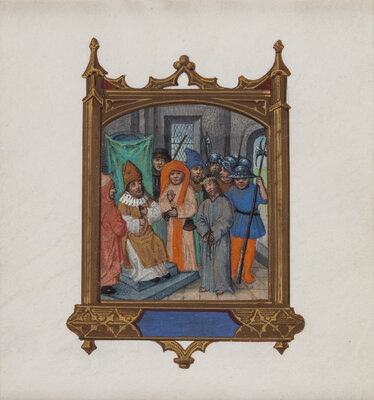
Single leaf, Christ before Caiaphas, tempera on vellum (c. 117 x 90 mm, sheet; c. 65 x 60 mm, outer edge of Gothic frame), Bruges, c. 1525, and London, c. 1850.
Single leaf, Christ before Caiaphas, tempera on vellum (c. 117 x 90 mm, sheet; c. 65 x 60 mm, outer edge of Gothic frame), Bruges, c. 1525, and London, c. 1850.
Remarkable survival from a famous flood, painstakingly restored by a skilled Victorian illuminator.
This tiny illumination, one of a group of some twenty-nine miniatures now mounted on separate parchment sheets, has been little studied. Long inaccessible in private collections, these works form part of an extraordinary tale of survival and restoration, which has obscured the more relevant question of their original production.
It comes from the collection of John Boykett Jarman (d. 1864). Living in the center of London in Mayfair, Mr. Jarman, a well-known manuscript collector of the nineteenth century, kept his many fine manuscripts in tin boxes on the ground floor of his house at 83 Grosvenor Street. Alas, his house, it turns out, was just a few yards from King’s Scholar’s Ponds Sewer, which had a long history of overflowing. When Jarman returned from an extended weekend, he was dismayed to discover that a flash storm on August 1, 1846, had caused torrential rain, flooding his ground floor and filling the tin boxes with water that soaked his medieval manuscripts over his three-day absence. He carefully separated and dried them sheet by sheet as best he could, and then he hired a rather well-known and remarkably skillful artist Caleb William Wing of 44 Dorset Street to “fix” them. Caleb Wing was a restorer, teacher, and printmaker who earned his living as a facsimilist of medieval manuscripts. Salvaging what he could, Wing cut the small scenes from their host manuscript, added elaborate Gothic frames nearly all different, painted small extensions to the rectangular originals to fill out the arch of the frame, mounted them on parchment leaves, and had them bound for his friend-employer (in a binding from another manuscript damaged in the flood). The new assemblage appeared in the sale of his manuscripts after his death as a group illustrating the life of Christ “delicately painted on vellum in gold and colours, in a small portfolio … Saec XVI” (Sotheby’s London 13 June 1864, lot 92).
When the reassembled manuscript appeared for sale in London (Sotheby’s, 25 April 1983, lot 243), Christopher de Hamel commented on its “very high” quality and declared it to be “Simon Bening or his workshop.” Characteristics of Bening include the palette, the composition, the poses, the lightly flecked liquid gold modeling of the garments, the lattice windows, the helmets and their white highlighting. De Hamel suggested comparisons with the Prayerbook of Albrecht of Brandenburg typically dated c. 1525 to 1530. Compare also the figure of Christ and the soldiers to a leaf from the Prayerbook of Enriquez de Ribera now datable around 1525 to 1530. Just what the original manuscript was cannot be determined, although isolated words read through transparent light indicate that it was in Dutch – perhaps a Life of Christ. In this respect, it would be worth comparing further small-scale commissions by Bening, such as the Rosary manuscript (Boston Public Library and Cambridge, Fitzwilliam Museum), suggested by de Hamel, as well as the Stein Quadriptych. Careful examination of the present leaf indicates that the original leaves were likely square, not oval, for Caleb Wing has filled in the top 5 mm. cutting off some of the tops of the spears. It is not entirely clear whether these were in the album or not. A sister leaf from the Voelkle Collection is now in Blackie House (Edinburgh, Scotland). The group is not included in the exhaustive, still-unpublished dissertation on the artist by Joris Corin Heyder who believes them to be by an artist in Bening’s circle, not by Bening himself.
Provenance
(1) John Boykett Jarman (1782-1864), London, his sale, Sotheby’s London 13 June 1864, lot 92;
(2) Edith Rosenbaum Collection, sold Sotheby’s London, 25 April, 1983, lot 243;
(3) Dr. Scott Schwartz, New York.
LITERATURE
Published: William Voelkle, Holy Hoaxes: A Beautiful Deception: Celebrating William M. Voelkle’s Collecting, Paris, London, New York, n.d. [2023], no. 48, pp. 178-181; Related literature: Janet Backhouse, “ A Victorian Connoisseur and His Manuscripts: The Tale of Mr. Jarman and Mr. Wing,” The British Museum Quarterly 32 (1968), pp. 76-92; Sandra Hindman et al., Manuscript Illumination in the Modern Age, Recovery and Reconstruction, Evanston, 2001 (on Wing, pp. 125-129, passim); Thomas Kren and Scot McKendrick, The Renaissance. The Triumph of Flemish Painting in Europe, Los Angeles and London, 2003, pp. 447-487; Joris Corin Heyder, “Simon Bening und die Kunst der Wiederholung – Zur Langlebigkeit der Motive in der Gent-Brugger Malerie,” Unpublished PhD dissertation, Free University of Berlin, 2017.
We thank Senior Consultant Sandra Hindman and Peter Bovenmyer for their assistance in preparing this sale.
Collection of Dr. Scott Schwartz
This lot is located in Chicago.