Condition Report
Contact Information
Auction Specialists
Lot 59
Sale 6388 - Western Manuscripts and Miniatures
Jul 8, 2025
10:00AM CT
Live / Chicago
Own a similar item?
Estimate
$800 -
1,200
Price Realized
$1,024
Sold prices are inclusive of Buyer’s Premium
Lot Description
ANONYMOUS SPANISH ILLUMINATOR
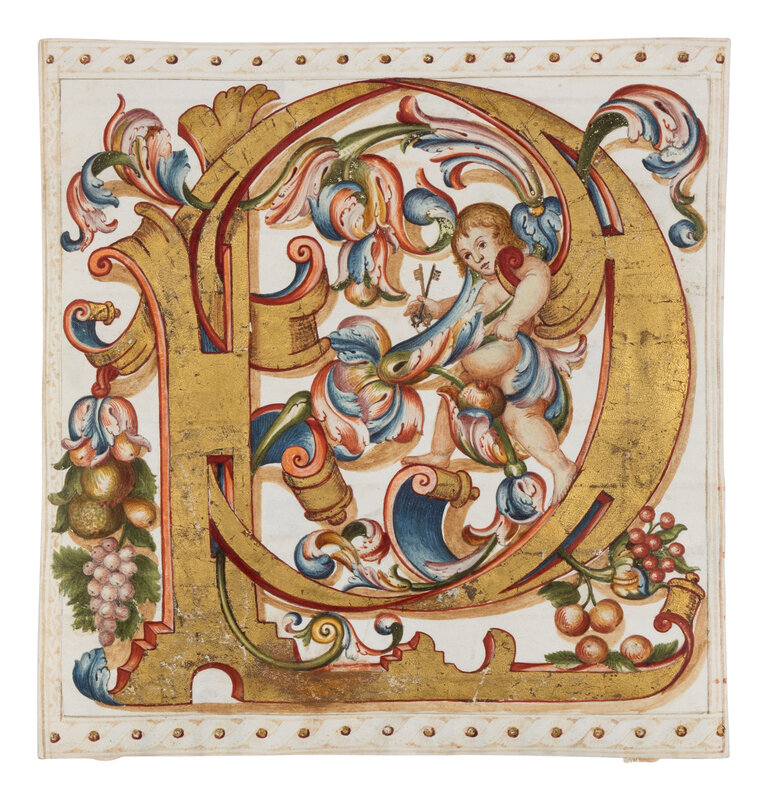
Cutting from a Gradual or Antiphonal with illuminated initial ‘P’ with putto holding Keys of Saint Peter, in Latin, illuminated manuscript on parchment [Spain, Seville? c. 1600]
Cutting from a Gradual or Antiphonal with illuminated initial ‘P’ with putto holding Keys of Saint Peter, in Latin, illuminated manuscript on parchment [Spain, Seville? c. 1600]
High-quality painting from an enormous Choir Book in the age of print, evidence that manuscript production – especially for music manuscripts – continued well after Gutenberg.
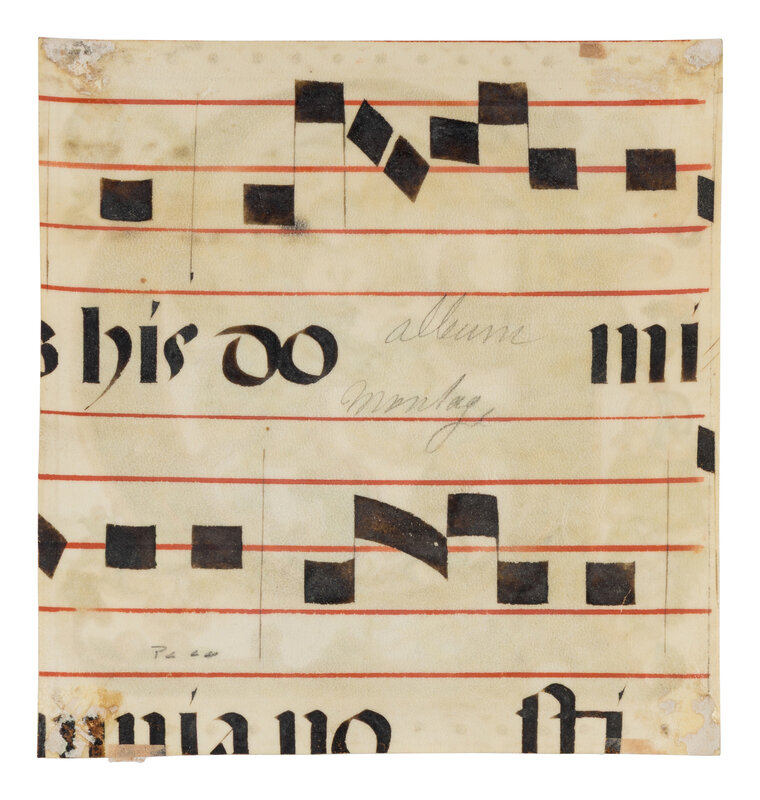
182 × 175 mm. Square cutting from an “elephant folio,” verso bears five-line staves in red (rastum 66 mm), written in black in gothic bookhand, ILLUMINATED INTIAL ‘P’ formed of pierced and interlacing bands of gold shaded in red and blue with scrolling ends and an architectural foot, softly colored sprays of fruit and acanthus leaves, supporting naked putto with blond hair holding the Keys of Saint Peter in his right hand. Small scuffs and craquelure to gold in places, else in fine condition.
This illuminated initial ‘P’ once opened a major feast in a Spanish Gradual or Antiphonal from the late sixteenth or early seventeenth century. Its preponderance of Renaissance motifs–putti, fruits, acanthus vines, and scrollwork–may link it to Seville whose workshops especially utilized these features in their decorative programs. The size of the initial indicates that it originated from a cantorale, an enormous Choir Book for liturgical use. The tradition of large-format Choir Books (often called elephant folios for their size) peaked during the sixteenth century following the Council of Trent (1545–1563), which produced a surge in demand for new liturgical documents. The Tridentine reforms standardized Catholic liturgy, prompting churches to update or replace their old manuscripts with ones reflecting the Roman rite. The dimensions of these cantorales were enormous, and some particularly large examples even had small wheels attached to their wooden covers so that two people could trundle them into place on the choir lectern. By the nineteenth century, a significant number of these books fell out of use and suffered neglect or repurposing, with many being dismembered and sold to private collectors.
Provenance
(1) Spain, c. 1600. The presence of the keys of Saint Peter in the hands of the putto might indicate the patronage of a prelate.
(2) An early twentieth-century pencil note on the reverse of this cutting notes its provenance as from an album “Marley,” indicating that it was once in the collection of Charles Brinsley Marlay (1831–1912) of Belvedere, Westmeath, Ireland, who lent forty-five of his Illuminations, principally of the Italian and French Schools, for an exhibition in the Burlington Fine Arts Club in 1886, and subsequently left many of them to the Fitzwilliam Museum, Cambridge.
(3) Private Collection
LITERATURE
Unpublished; for sixteenth-century cantorales see: Germán Bleiberg and Juan Manuel Rozas, Los cantorales españoles: Historia, arte y música, Madrid, 1970; Antonio Bonet Correa, “La miniatura española del Renacimiento,” Anuario del Departamento de Historia y Teoría del Arte 1 (1989), pp. 11–31; Concepción Herrero Carretero, ed., Liturgia y arte: Los cantorales del Monasterio de El Escorial, Madrid, 1992; Carmen Gómez García, “Miniatura y liturgia: Los libros corales en España en el siglo XVI,” Codices Illuminati Medii Aevi 5 (1997), pp. 73–90; Maria Teresa Chicote Pompanin, Los cantorales del Monasterio de las Descalzas Reales, Madrid, 2008; Mitchell A. Codding, ed., Glory of Spain: Treasures from the Hispanic Society of America, Houston, 2020.
We thank Senior Consultant Sandra Hindman and Peter Bovenmyer for their assistance in preparing this sale.
This lot is located in Cincinnati.