Condition Report
Contact Information
Auction Specialists
Lot 5
Sale 6388 - Western Manuscripts and Miniatures
Jul 8, 2025
10:00AM CT
Live / Chicago
Own a similar item?
Estimate
$1,800 -
2,500
Price Realized
$2,176
Sold prices are inclusive of Buyer’s Premium
Lot Description
MAGNIFICENT REMNANT OF ITALIAN ROMANESQUE MANUSCRIPT CULTURE
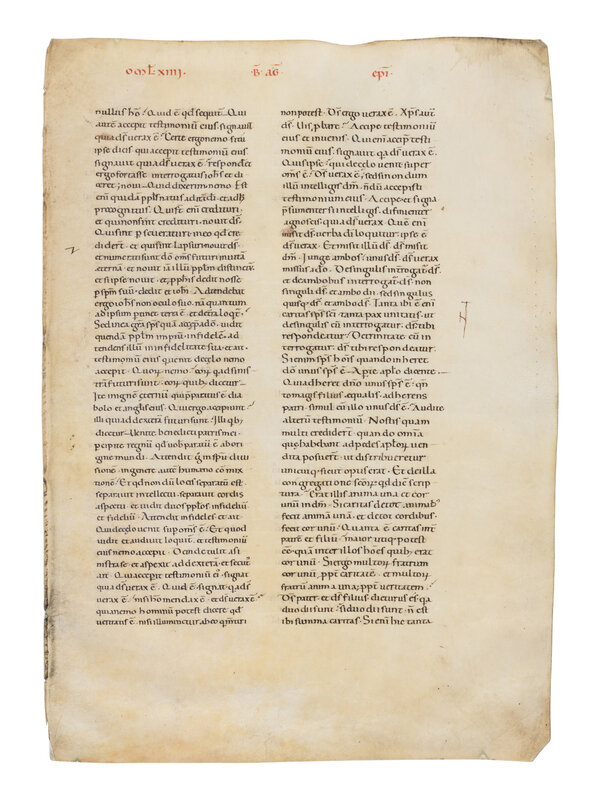
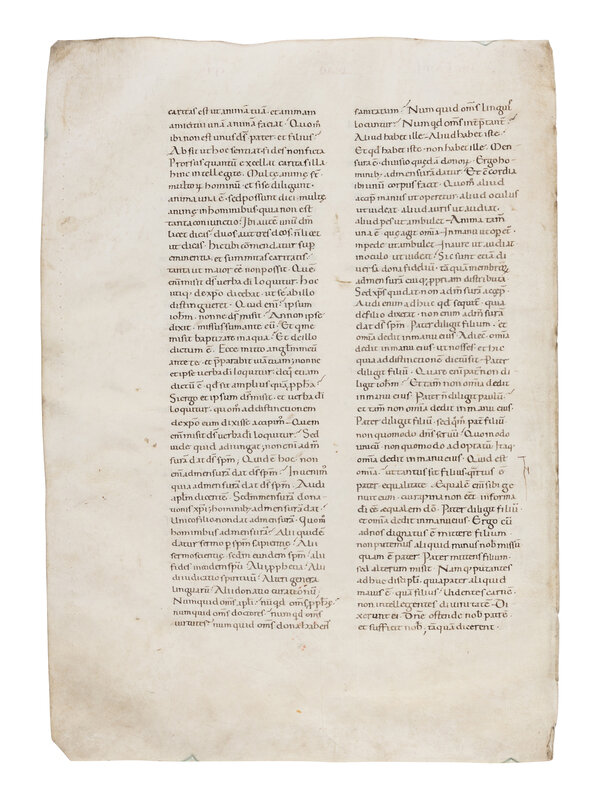
Florentine School, single leaf from a copy of Augustine’s Tractatus in euangelium Iohanem (Homily XIIII), in Latin, manuscript on parchment [Italy, Tuscany c. 1130–1150]
Florentine School, single leaf from a copy of Augustine’s Tractatus in euangelium Iohanem (Homily XIIII), in Latin, manuscript on parchment [Italy, Tuscany c. 1130–1150]
Related to sister leaves, all in important institutional collections, this monumental twelfth-century leaf comes from a dismantled grand Tuscan monastic manuscript.
438 × 310 mm. Single large folio on vellum, ruled in drypoint for two columns of forty-four lines (justification: 310 × 202 mm), prickings still visible in the outer margins, no foliation present, written in Carolingian minuscule in black ink, no rubrication (though present in sister leaves), running head in red “omelia xiiii beati augustini episcopi,” nota marks in the margins as well as some textual corrections or additions. Natural flaws and thinly scraped sections of skin, slight thumbing, else in good condition.
The parent manuscript from which this leaf derives was almost certainly produced in a monastic scriptorium in the region of Florence during the mid-twelfth century or slightly earlier. The so-called Florentine School of illumination is defined by its innovative ornamental style and its preservation of classical and Byzantine influences, shared across a closely connected network of monastic institutions in and around Florence. This distinctive style is most famously exemplified in the Bible of Corbolino (Biblioteca Medicea Laurenziana, Conv. Soppr. 630), produced in Florence around 1140. A hallmark of this school is the initiale geometrica transizionale—the “transitional geometric initial”—developed in Tuscany in the early 1100s. These refined foliate initials are often filled with volute scrolls and acanthus leaves, sometimes rendered as white vine patterns set against painted grounds. While the present leaf does not preserve illuminated initials, sister leaves at Stanford University Library (Inv. M0389) and the State Library of South Australia (Inv. b3270589) bear initials closely comparable to those in the Corbolino Bible and other manuscripts from the Florentine School. The script, a refined Carolingian minuscule, dates it to the first half of the century, before the advent of protogothic scripts that gained prominence in later decades.
The Tractatus in Iohannem by Augustine held particular importance in reform-minded monastic circles of mid-twelfth-century Italy. In Florence especially, monastic centers such as the Camaldolese (e.g., Camaldoli) and Vallombrosan (e.g., Passignano) communities actively copied and studied patristic texts. Augustine’s Tractatus was frequently included in compendia of exegetical writings or copied as a standalone volume, reflecting its central place in monastic theological training. Surviving manuscripts from this period, often in deluxe or carefully annotated formats, attest to the work’s widespread reproduction and high intellectual value.
Provenance
(1) Linked to a fragment of five leaves bought by English bibliophile Brian S. Cron (1913–2002), probably from the antiquarian bookseller H. M. Fletcher, Cecil Court, London c. 1966.
(2) Bernard Quaritch Ltd., London in March 1983.
(3) The collection of Hakon Halberg, curator of manuscripts at the Carolina Rediviva Library, University of Uppsala, Sweden.
(4) Private Collection.
Sister leaves
The following sister leaves have been identified to date: Minato, Japan, Keio University Library (uncatalogued), containing homilies XI–XII; Atlanta, Georgia, Emory University Pitts Theology Library, Inv. RG020-2, containing homilies XXV–XXVI; University Park, Texas, Southern Methodist University, Bridwell Library MS 36, containing homilies XLI–XLII; University of Colorado–Boulder Libraries, MS 333 OS, containing homilies XLVI–XLVII; Stanford, California, Stanford University Libraries, Inv. M0389, containing homilies L–LI; Adelaide, State Library of South Australia South, Inv. b3270589, containing homilies XXII–XXIII.
LITERATURE
Unpublished; Related literature see: Edward B. Garrison, Twelfth-Century Initials of the Corbolino Bible in Studies in the History of Mediaeval Italian Painting, vol. 3, Florence, 1955, pp. 87–112; Knut Berg, Studies in Tuscan Twelfth-Century Illumination, Oslo, 1968, esp. pp. 18–30; Annamaria Morandini, “La Bibbia di Corbolino,” in Miniatura e miniatori a Firenze dal Trecento al Quattrocento, Florence, 1992, pp. 23–29; Guglielmo Cavallo and Giovanni Orlandi, eds., Scrittura e Civiltà, vol. 10, Rome, 1986, pp. 43–61; Brian Stock, Augustine the Reader: Meditation, Self-Knowledge, and the Ethics of Interpretation, Cambridge (Mass), 1996, pp. 130–145; Constant J. Mews, Religious Thinkers in Italy and France in the Twelfth Century, Aldershot, 2004, esp. chapters 3 and 5.
We thank Senior Consultant Sandra Hindman and Peter Bovenmyer for their assistance in preparing this sale.
This lot is located in Chicago.