Condition Report
Contact Information
Auction Specialists
Lot 40
Sale 6388 - Western Manuscripts and Miniatures
Jul 8, 2025
10:00AM CT
Live / Chicago
Own a similar item?
Estimate
$600 -
800
Price Realized
$768
Sold prices are inclusive of Buyer’s Premium
Lot Description
FOUR ILLUMINATED LEAVES FROM ASSORTED BOOKS OF HOURS FROM FRANCE, ITALY, AND THE NETHERLANDS
(i)
MASTER OF THE MORGAN LIFE OF SAINT MARGARET (WORKSHOP) (active northern France, c. 1400)
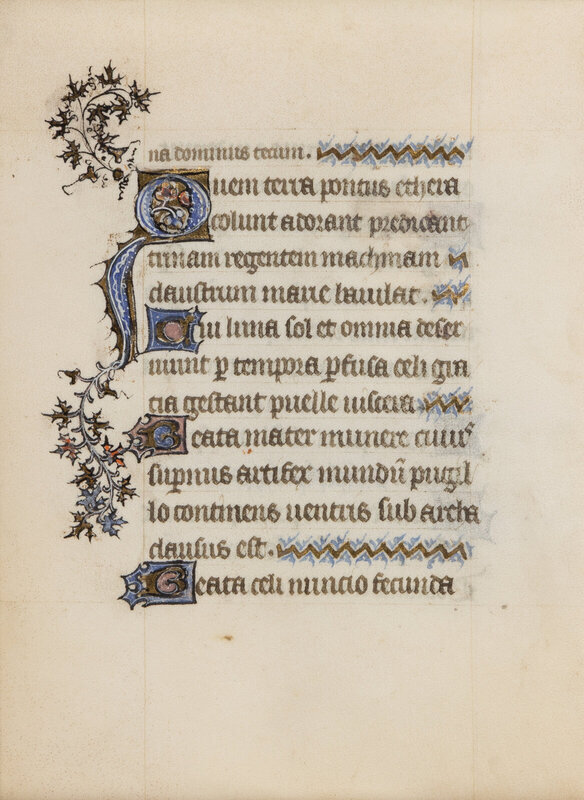
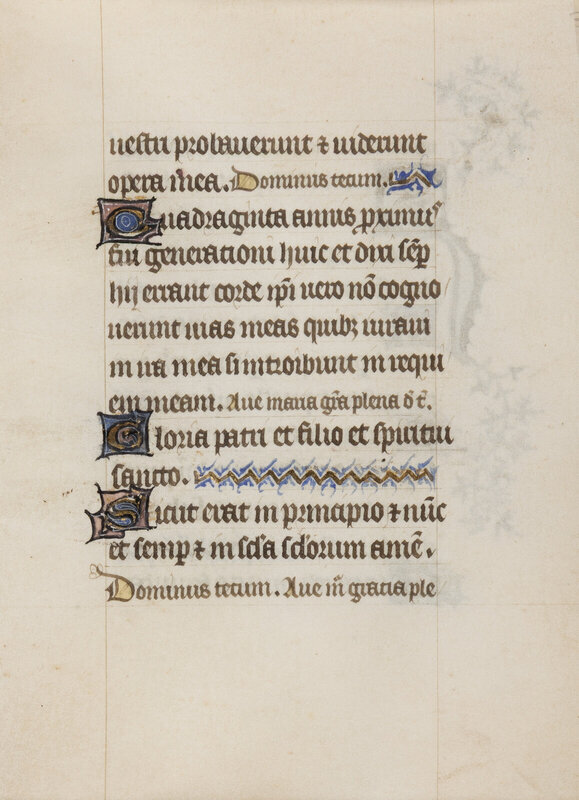
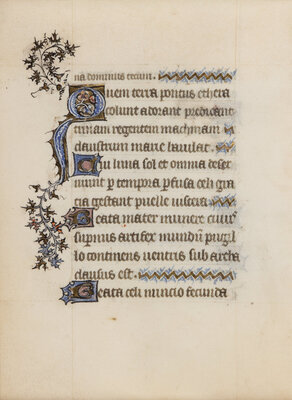
A leaf from the Bute-Soissons Hours, with illuminated initials, in Latin, illuminated manuscript on parchment [France, Soissons, c. 1400]
A rare text leaf from the famed Bute-Soissons Hours, dispersed in 1983 and displaying especially fine decoration evident in the dynamic ivy-leaf sprays.
153 × 117 mm. Single leaf, ruled in brown ink for single column of thirteen lines (justification: 78 × 56), foliated “35” in top right margin, written in brown ink, in a high-grade gothic bookhand, rubrics in red, three 2-line initials in gold on alternating blue and pink grounds heightened with white penwork, one 4-line initial in blue highlighted with white filigree with acanthus infill on gold ground with sprays of colored and gold ivy-leaf foliage in margins, line-fillers in gold offset with blue penwork. A few small smudges and spots, else excellent condition. Leaf is mounted in white matting with beveled mat window.
This leaf, originally from the renowned Bute-Soissons Hours, is identifiable by its lustrous illuminated initials featuring unique ivy-leaf foliage sprays and wavy gold line fillers outlined in blue. It was written and illuminated by the Master of the Morgan Life of St. Margaret, whose workshop was in northern France, likely near Thérouanne. Dominique Vanwijnsberghe (2007) places the master and his workshop within the “Thérouanne group” due to strong stylistic parallels with other regional Books of Hours. The artist takes its name from the appearance of these stylistic characteristics in a slightly earlier Prayer Book and Life of Saint Margaret in the Morgan Library and Museum (MS M. 947). The present leaf showcases the workshop’s characteristic techniques, including rich jewel tones, burnished gold, and dynamic ivy-leaf sprays. It contains the beginning of a Marian hymn from the Matins section of the Office of the Blessed Virgin Mary, often attributed to Venantius Fortunatus (a sixth-century Bishop of Poitiers), opening with a large, four-line ‘Q’ for the incipit Quem terra, pontus, aethera, with subsequent subsections marked by smaller two-line initials. The origins of the dramatic and moving style evident in the full-page illuminations should be sought in the fertile artistic experiments in the North and South Netherlands around 1400. Since the manuscript’s dispersal, leaves appearing on the market have been rare, making this leaf’s appearance a unique occasion.
Provenance
(1) Produced in or near Soissons for a prominent Soissons figure, either Enguerrand VII de Coucy (Count of Soissons 1367–1397) or his daughter Marie I de Coucy (Countess 1398–1404). No explicit arms or donor inscription survive, but the rare Soissons use implies an elite patron from that town.
(2) Owned by the Stuart/Crichton-Stuart family (Earls/Marquesses of Bute); recorded in the 1896 Bute library catalogue as MS 128.
(3) Sold at Sotheby’s London (June 13, 1983, lot 6) and acquired by H.P. Kraus, who subsequently dismembered the manuscript. The leaves were then kept in display drawers in Kraus’s shop and 34 of them were stolen over a period of weeks in late 1983 (The leaves were later recovered and sold by the insurance company to recover their losses). The remainder in Kraus’s ownership were then sold to Bruce Ferrini (this leaf likely among those) and dispersed to private collectors.
(4) Private Collection.
Sister leaves
Of the 184 original folios, twenty-three were full page illuminations, and only a handful have appeared on the market since the dispersal of the manuscript. These include: Cleveland Museum of Art (2005.203), Single leaf with Initial ‘D’ opening Domine labiamea; Bonhams & Butterfields (San Francisco), 25 Jun 2003, lot 3016, single text leaf with Matins for Hours of the Holy Trinity; Bloomsbury Auctions (London) 6 Jul 2021, lot 35, two illuminated text leaves from the Office of the Virgin; Millea Bros. Ltd. (Boonton, NJ), November 17, 2023, lot 3307, with Adoration of the Magi, full page illumination (now Private Collection, New York); Les Enluminures, two leaves with Christ Appearing to St. James and the Visitation (now Private Collection New York), full page illuminations, the former published in Les Enluminures, Manuscript Illumination and the Art of Collecting, 2025, no. 00).
LITERATURE
Unpublished; On the Bute-Soissons Hours see: Bruce Ferrini, Sandra Hindman, and Michael Heinlen (eds.), Important Western Medieval Illuminated Manuscripts and Illuminated Leaves, Chicago, 1987, no. 73; Stephen Fliegel, The Jeanne Miles Blackburn Collection of Manuscript Illuminations, Cleveland, 1999, no. 20; Dominique Vanwijnsberghe, “Moult Bons et Notables”: L’enluminure dans les Pays-Bas méridionaux (1400–1550), Brussels, 2007; Dominique Vanwijnsberghe and Erik Verroken, À l’Écu de France: Guillebert de Mets et la peinture de livres à Gand à l’époque de Jan van Eyck (1410–1450), 2 vols., Brussels, 2017, vol. I, no. 93.
(ii) LOMBARD ILLUMINATOR
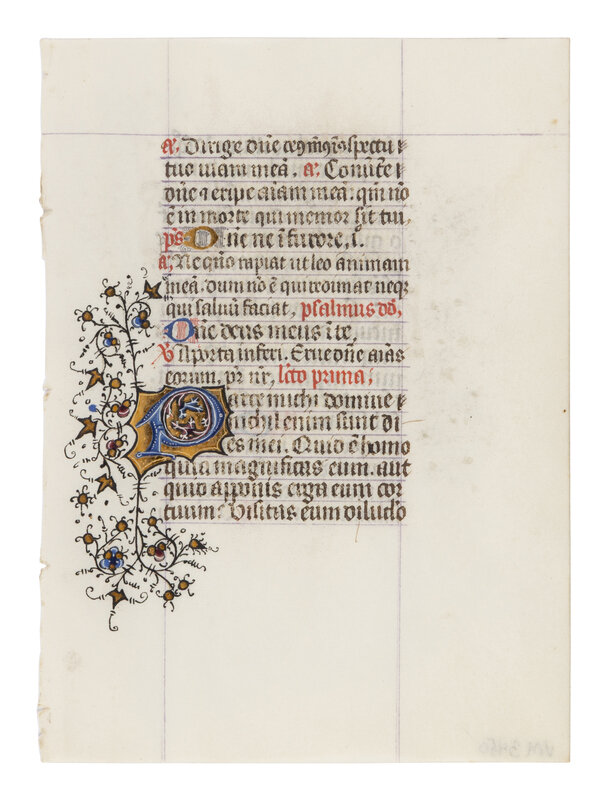
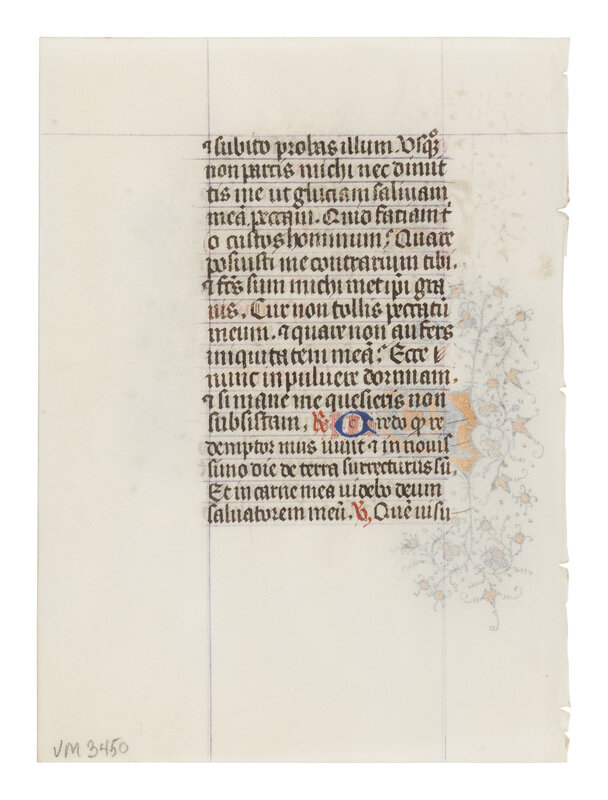
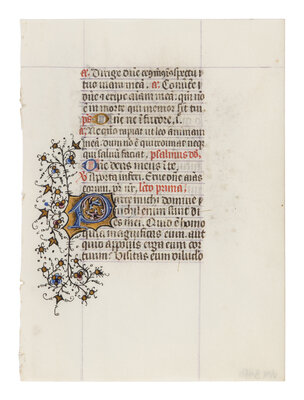
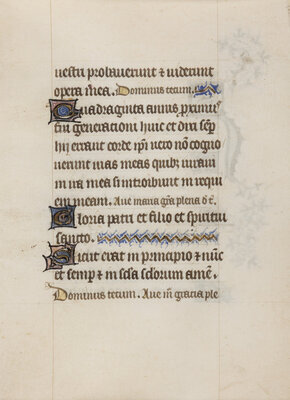
A leaf from a Book of Hours, with illuminated initial ‘P’, in Latin, illuminated manuscript on parchment [Northern Italy, Milan or Padua? c. 1425]
Clean leaf with generous borders and striking illustration from a Northern Italian Book of Hours, possibly produced in an elite Lombard workshop in Pavia or Milan.
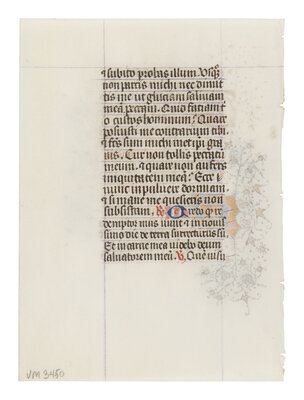
135 × 99 mm. Single leaf, ruled in red ink for single column of seventeen lines (justification: 78 × 46 mm), unfoliated, written in a small gothic textura script in black ink, rubrics in red, one illuminated three-line initial in blue with delicate white penwork and an internal floral motif on a burnished gold ground, extending into the margin with an elaborate rinceaux border of vines and flowers in red, blue and burnished gold. The parchment is fine, with little staining or wear, noticeable fading to the text ink, which remains nevertheless legible, else in good condition.
This leaf originated from a Book of Hours produced in Northern Italy, possibly in Pavia or Milan. It contains the incipit from the First Nocturn (Lectio prima) for Matins from the Office of the Dead: Parce mihi Domine: nihil enim sunt dies mei. The most striking feature on the recto is a large, decorated initial ‘P’ that forms the incipit, rendered in deep blue pigment on burnished gold ground with white vine-stem (“bianchi girari”) filigree overlaying slender, interlacing branches and stylized acanthus infill. Similar vine-scroll ornament extends into the outer margin as a partial rinceaux border of winding white stems with alternating red- and blue-flowered motifs, all on gilt grounds. This decoration is typical of early fifteenth-century Italian “white vine” decoration, which first became popular in Florence around 1400. In subsequent decades, such decoration became especially associated with the Lombard school of illumination such as the Visconti court of Milan and Pavia (including Belbello da Pavia and his circle) which used similar dramatic initials and vine-scroll borders in gold and azurite. The high quality of the workmanship suggests an elite workshop, possibly in the Visconti domains (Milan or Pavia) or in nearby Padua, where Belbello’s followers were active.
Provenance
1. Bruce Ferrini, Akron, OH. His inventory number “VM 3450” in lower left margin of verso.
2. Private Collection.
Sister leaves
Although we have been unable to identify the parent manuscript, sister leaves are to be found in institutional collections and on the market, of which a selection follows: University of California at Santa Barbara, Special Collections (Coll. SC 850), text unknown; Los Angeles, California, Loyola Marymount University (Ferrini Coll., Box 1 No. 11), text unknown; and Charles E. Puckett (Inventory IM‑10730), Vespers from the Office of the Dead, and (Inventory IM‑11529), Compline from the Office of the Virgin.
LITERATURE
Unpublished; Related literature: Lorenza Brambilla Ranise, Belbello da Pavia e la miniatura del primo Rinascimento, Modena, 1990; Giordana Mariani Canova, Miniatura a Padova dal Medioevo al Settecento, Milan, 1993; Franco Stella, Miniatura del Rinascimento in Lombardia, Milan, 1995.
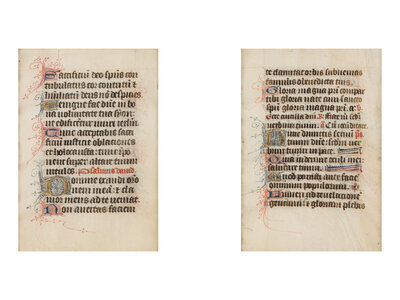
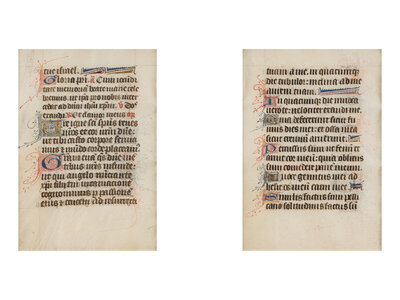
(iii) NETHERLANDISH WORKSHOP
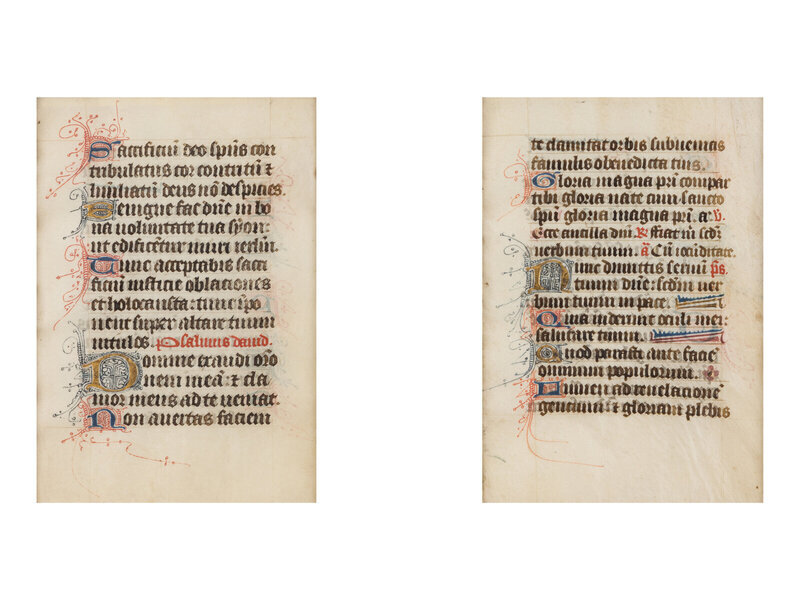
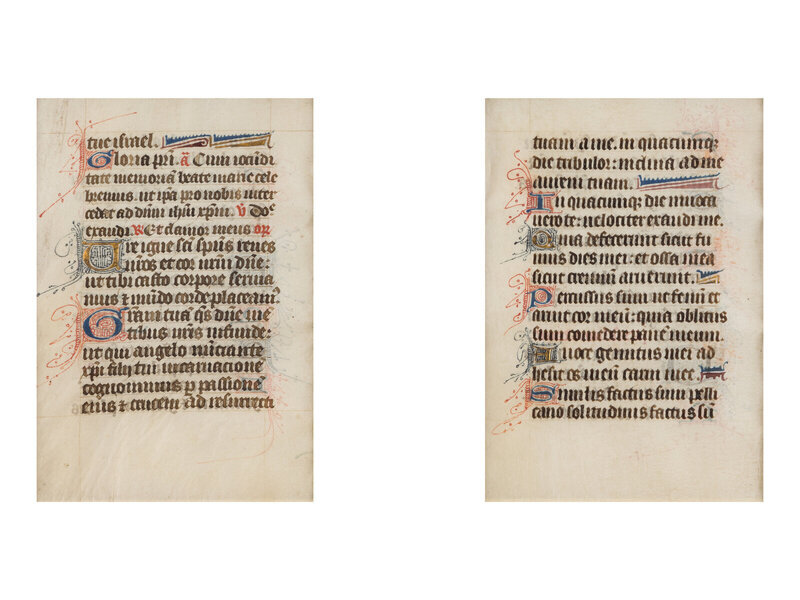
Pair of leaves from a Book of Hours, with illuminated initials in gold, in Latin, illuminated manuscript on parchment [Northern Netherlands, possibly Utrecht or Zwolle, c. 1450–1470]
Fine examples of mid-fifteenth-century Dutch manuscript production, reflecting the sophisticated artistry of the book trade fueled by the Devotio Moderna movement.
137 × 98 mm. Two leaves, ruled in brown ink for a single column of fifteen lines (justification: 90 × 66 mm), unfoliated, written in brown ink in a gothic textura, rubrics, versals, and responsories in red, text fillers of red and gold, fifteen single- and double-line illuminated initials in blue and gold decorated with extensive pen flourishes in red and blue extending deeply into left and lower margins. Slight cockling of the parchment, especially to the second leaf; some fading to script inks, though remaining legible; cracking and minor losses to gold, else in good condition.
These leaves likely originate from a mid to late fifteenth-century Dutch Book of Hours, produced in Utrecht or Zwolle around 1450–1470. The characteristic red and blue pen flourishing, multicolored line fillers, gold initials on colored grounds, and evenly spaced textura script are hallmarks of Netherlandish commercial manuscript production during this period, strongly associated with Utrecht workshops supplying devotional books for both domestic use and export. Each leaf comes from a different part of the parent manuscript: the first leaf from the Penitential Psalms, with a two-line initial ‘D’ opening Psalm 101, Domine exaudi orationem meam; the second from Compline of the Office of the Virgin, with a two-line initial ‘N’ beginning the Canticle of Simeon, Nunc dimittis servum tuum.
In the second half of the fifteenth century, Utrecht and Zwolle emerged as major centers of manuscript production in the northern Netherlands, fueled by the widespread influence of the Devotio Moderna movement. Its emphasis on private devotion and personal piety created a thriving market for devotional works, produced in large numbers by commercial workshops catering to an expanding urban clientele. Alongside flourishing penwork and decorative initials, the finest workshops in these cities also developed increasingly sophisticated miniature painting, blending local Netherlandish realism with the ornamental traditions of Paris and Flanders, reflecting both the spiritual ideals and the vibrant book trade that flourished in the Low Countries during this period.
Provenance
(1) Private Collection, United States.
LITERATURE
Unpublished; for manuscript illumination in Utrecht and Zwolle see especially: Anne Korteweg, Boekverluchters uit de omgeving van de Zwolse Broederschool (15e eeuw), Zwolle, 1984; Anne Korteweg, “Pen Flourishing in Manuscripts and Incunabula: Similarities and Differences,” in Incunabula and Their Readers: Printing, Selling and Using Books in the Fifteenth Century, ed. Kristian Jensen, London, 2003, pp. 1–22; Anne Korteweg, Splendour of the Burgundian Court: Art and Culture in the Netherlands in the Fifteenth Century, Antwerp, 2009.
We thank Senior Consultant Sandra Hindman and Peter Bovenmyer for their assistance in preparing this sale.
This lot is located in Chicago.