
Condition Report
Contact Information
Auction Specialists
Lot 35
Sale 6388 - Western Manuscripts and Miniatures
Jul 8, 2025
10:00AM CT
Live / Chicago
Own a similar item?
Estimate
$2,200 -
2,400
Price Realized
$2,560
Sold prices are inclusive of Buyer’s Premium
Lot Description
CIRCLE OF THE MASTER OF COËTIVY (COLIN D’AMIENS) (active Paris, c. 1450-1485)
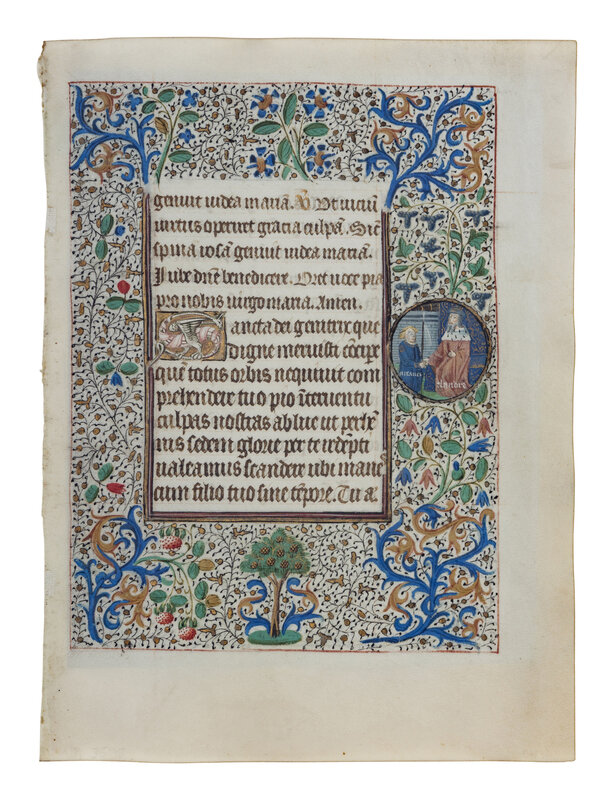
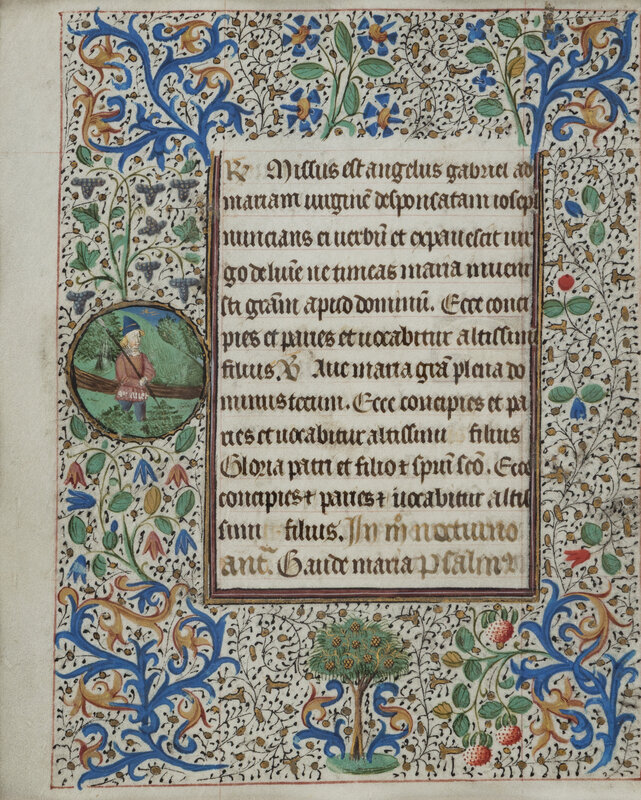
A leaf from the “Alexis Hours,” including two roundels with scenes from the Life of Saint Alexius, illuminated manuscript on parchment, in Latin [France, Paris, ca. 1460–1470]
A leaf from the “Alexis Hours,” including two roundels with scenes from the Life of Saint Alexius, illuminated manuscript on parchment, in Latin [France, Paris, ca. 1460–1470]
An elegant leaf with enchanting roundels by the circle of the Coëtivy Master, one of the great painters of the French court.
195 × 145 mm. Single leaf, ruled in red ink for a single column of thirteen lines (justification 84 × 61 mm): written in a fine Gothic book hand in dark brown ink, rubrics in burnished gold, one inhabited initial featuring a winged beast in pink and white on a gold ground, framed by a gold and pink bar border surrounding the text on three sides. EACH SIDE WITH EXTRAVAGANT FULL BORDERS of acanthus leaves, flowers, vinestem work, vegetation, gold bezants, and two oak trees with eight acorns each in the lower margins; TWO ROUNDEL MINIATURES DEPICTING THE LIFE OF ST. ALEXIUS in margins. Two faces in the roundels lightly chipped; remains of mounting tape on inner edge; a fine leaf, clean, with sparkling gold. Matted and framed under glass with gold frame and cream matting (frame: 420 × 345 mm).
This leaf once formed part of the lavish Alexis Hours, a luxury commission likely produced for a patron—or perhaps a married couple—of considerable wealth and standing. The parent manuscript contained an extensive cycle of roundels illustrating episodes from the lives of Saint Catherine of Alexandria and the less commonly venerated Saint Alexius, suggesting a program of personal devotional significance to its original owners. The narrative represented here remains somewhat enigmatic: one roundel depicts a crowned ruler receiving a kneeling figure bearing a spear, while the second shows a similar spear-bearing figure in motion—possibly representing a single episode in sequential stages. According to medieval hagiography, Saint Alexius abandoned his privileged life to embrace extreme asceticism, spending seventeen years in exile at Edessa before returning unrecognized to his father’s house in Rome, where he lived in anonymity as a beggar until his death and posthumous revelation. Though both figures in the present roundels are identified with white-lettered inscriptions, these legends are now largely illegible. The scene likely portrays the saint’s departure from his family at the outset of his renunciation. A two-line initial ‘S,’ inhabited by a dragon, introduces a collect from Matins in the Hours of the Virgin: Sancta Dei Genetrix, quae digne meruisti corpore quem totus orbis nequiit comprehendere.
The refined figure style points securely to the circle of the Coëtivy Master (Colin d’Amiens), one of the leading artists active in Paris during the third quarter of the fifteenth century. The manuscript’s elegant border designs, angular facial types, and nuanced landscape settings exemplify the distinctive visual vocabulary developed by the Coëtivy Master and his close collaborators. The use of narrative roundels in the Coëtivy Master’s manuscripts reflects a broader evolution in mid-fifteenth-century Parisian illumination, as marginal decoration increasingly took on a narrative function. These roundels permitted the insertion of supplementary content without disrupting the liturgical text, offering readers concurrent devotional narratives. The Coëtivy workshop’s sophisticated synthesis of text, miniature, and ornamental program represents one of the most innovative developments in later medieval Parisian book production.
Provenance
(1) Likely commissioned by an aristocratic or noble patron, possibly a married couple who venerated both Saint Catherine and Saint Alexius as personal patron saints. An oak tree bearing eight acorns in the lower margin may contain heraldic symbolism.
(2) Ezra Clark Stillman (1907–1995), a linguist and university professor who partnered with New York book dealer Lathrop C. Harper. The parent manuscript (cataloged as MS 246) appears to have been dismantled in the early 1980s, with numerous calendar and text leaves resurfacing in the mid-1980s.
(3) Private Collection.
Sister leaves
Many sister leaves have appeared at auction and in dealer’s catalogues over the last forty years, and many are now found in institutional collections. For leaves today in public collections: Boston Public Library (MS pb Med. 232; see Netzer 2006, no. 67); Cleveland Museum of Art (2005.2006a; see Fliegel 1991, no. 49); Emory University (James Parmelee Fund, 2022.102, acquired from Dreweatts, 6 July 2022, lot 81; University of Missouri (Museum of Art and Archaeology, Acc. 2003.2; see Hansen, Muse 39–41, 2005–2007, pp. 45–61); Utah Museum of Fine Arts (Acc. 1996.015.003). For leaves at auction or with dealers: Quaritch (Medieval Manuscript Leaves, London, 1984, no. 28); Schuster Gallery (Illuminated Manuscripts, 1987, nos. 36–37); Bruce P. Ferrini (Catalog One, 1987, nos. 83–84); Maggs Bros (Catalogue 1222, 1996, no. 5; Bulletin 21, 1997, no. 47; Catalogue 1262, 1998, no. 25; Catalogue 1319, 2001, no. 18); Charles Edwin Puckett (IM-1474, 4091, 4094, 4095); Sotheby’s, London (6 July 2000, lot 17); Phillip J. Pirages (Catalogue 74, no. 37); Bloomsbury (6 July 2021, lot 125 [1]); Christie’s, London (9 December 2020, lot 13).
LITERATURE
Stephen N. Fliegel, The Jeanne Miles Blackburn Collection of Medieval Manuscripts, 1991, no. 49; Nancy Netzer, ed., Secular/Sacred, 11th–16th Century. Works from the Boston Public Library and the Museum of Fine Arts Houston, Boston, 2006, no. 67. On the Coëtivy Master see: Jean Porcher, “Le Maître de Coëtivy et la peinture parisienne vers 1450,” Bibliothèque de l’École des Chartes 117 (1959), pp. 61–90; Carl Nordenfalk, “Les manuscrits enluminés de Coëtivy et la peinture parisienne autour de 1450.” Cahiers de civilisation médiévale 6 (1963), pp. 241–48; François Avril and Nicole Reynaud, Les Manuscrits à peintures en France 1440–1520, Paris, 1993, pp. 58–69; François Avril, “Autour du Maître de Coëtivy: Quelques manuscrits parisiens des années 1450,” Art de l'enluminure 14 (2005), pp. 2–31.
We thank Senior Consultant Sandra Hindman and Peter Bovenmyer for their assistance in preparing this sale.
This lot is located in Chicago.