Condition Report
Contact Information
Auction Specialists
Lot 29
Sale 6388 - Western Manuscripts and Miniatures
Jul 8, 2025
10:00AM CT
Live / Chicago
Own a similar item?
Estimate
$2,500 -
3,000
Lot Description
BOHUN GROUP ILLUMINATORS (active England, East Anglia, possibly Norwich, c. 1350s-1380s)
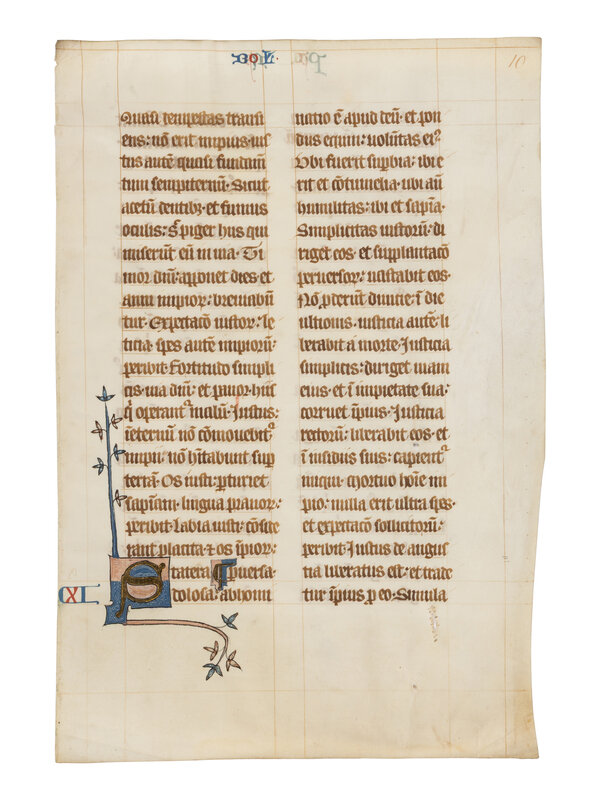
A leaf from the “Bohun Bible” with illuminated initial ‘S’, in Latin, illuminated manuscript on parchment [England, East Anglia, possibly Norwich, ca. 1350]
A leaf from the “Bohun Bible” with illuminated initial ‘S’, in Latin, illuminated manuscript on parchment [England, East Anglia, possibly Norwich, ca. 1350]
From the luxurious Bohun Bible, a magnificent four-volume work indicative of the high level of artistic achievement in fourteenth-century England
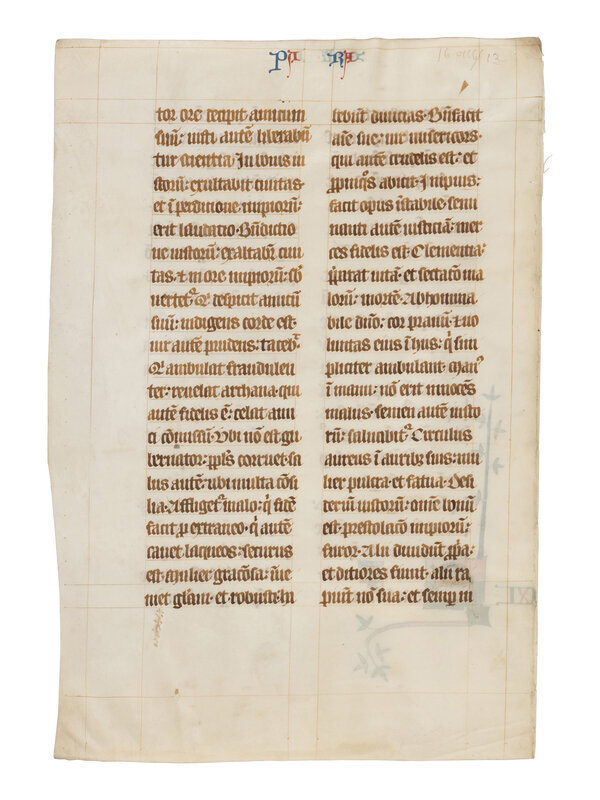
447 × 310 mm. Single leaf, ruled in brown ink for two columns of twenty-two lines (justification: 311 × 205 mm), early modern foliation “10” in top right margin, written in a gothic book hand in brown ink, ONE ILLUMINATED INITIAL ‘S’ of two lines beginning chapter heading, painted in gold and pink on blue ground with white penwork and colored ivy leaf extensions in the margins, gold pilcrow on red and blue grounds, red and blue chapter numbers in Lombard capitals and running heads. Prickings visible in outer margin and small parchment tear to lower margin, originally repaired with thread, now lacking, in excellent condition, the ink quite black and fresh, the initial nearly perfect, the vellum has a natural yellow tinge.
This leaf derives from the third volume of the Bohun Bible, a lavish four-volume work produced in East Anglia around 1350. It is named for an early (though uncertain) association with the Bohun family, a noble dynasty (Earls of Hereford) renowned for patronizing luxury manuscripts. Scholars have proposed that Edward the Black Prince, son of King Edward III, commissioned this Bible – possibly as a gift to the Carmelite House in Chester, which he endowed in 1353–1358. This theory is supported by the appearance of a Carmelite friar in one of the Bible’s illuminated initials and by the Bible’s early provenance in Cheshire. The Bohun family’s connection to the royal court was strong (the heiress Mary de Bohun married King Henry IV and was mother of King Henry V) and the Bible’s style links it to manuscripts owned by that family sometimes referred to as the “Bohun Group” – a cluster of deluxe manuscripts from 1350s to 1380s made for the Bohuns and their circle.
Containing portions of Proverbs 10–11, the present leaf features a finely illuminated initial ‘S’ whose intricate design exemplifies the exceptional characteristics of one of the finest manuscripts produced in fourteenth-century England. Volume three of the work, of which this leaf was the tenth folio, was comprised of a total of 413 leaves (foliated 1–413) which contained the typical Vulgate sequence for the Sapiential and Prophetic books. A similar leaf from volume three appears in the McCarthy Collection, opening the Book of Nahum (See Kidd 2019, pp. 86–90, no. 13). Like its sister leaves, this folio is written in two columns of twenty-two lines in a disciplined Gothic book hand. The two-line illuminated initial ‘S’ forms the incipit to Proverbs 11: Statera dolosa abominatio est apud Dominum quai tempestas. The illumination is of superb quality, although the exact workshop that produced it remains unidentified.
Well-studied by scholars, the Bohun Group is associated with the largest and most important group of English illuminated manuscripts of the period. According to Lucy Freeman Sandler (2014), “These books offer material evidence of the high level of the artistic accomplishment in fourteenth-century England. Even more, they supply evidence of the cultural tastes and world outlook — social, political, and religious — of their aristocratic reader-viewers, communicated by the designer-artists who were uniquely positioned to interpret their masters to themselves,” (p. 3). Professor Sandler goes on to say, “Our idea of the English manuscript illumination of the second half of the fourteenth century is defined by the Bohun manuscripts. No books as important as those illuminated for the Bohuns have survived from this period,” (p. 20). She proposed that these manuscripts were the product of an East Anglian workshop, possibly located in Norwich, where a number of elite commissions were produced in the mid-fourteenth century such as the Bohun Psalter (Vienna, ÖNB Cod. 1826) and related manuscripts like the Egerton Psalter (London, British Library, Egerton MS 3277).
Provenance
(1) Originally from the third volume of a four-volume set. Since one historiated initial from the Bible shows a Carmelite friar, and the earliest known provenance is in Cheshire, the Bible may have come from a Carmelite house in Chester. The manuscript was perhaps commissioned by the Edward the Black Prince, who endowed the foundation in 1353–1358.
(2) Probably Richard Legh of East Hall, High Legh, Cheshire, fl. 1613.
(3) Richard Maria Domville (d. 1667) of Lymme Hall, Cheshire, given by him in 1665.
(4) Sir Peter Leycester/Leicester (d. 1678), by which time a significant number of leaves were already missing.
(5) Owned and dismembered by Myers & Co., Bond St., London, from 1927 onward.
(6) Freeman's Auctions, Philadelphia, 4 April 2016, lot 269.
(7) Private Collection
Parent manuscript and sister leaves
The Bohun Bible today survives in scattered leaves and fragments around the world. The manuscript’s dispersal began in the early seventeenth century. By 1613, it was in private hands (Richard Legh of Cheshire), and by 1678 Sir Peter Legh (Leycester) noted that many leaves (especially those with miniatures) were already missing. The dismemberment of the remaining volumes was completed in 1927 by the London dealer Myers & Co. and sold individually to collectors. As a result, its pages are now dispersed across numerous libraries, museums, and private collections. Christopher de Hamel (2008) has painstakingly traced and identified hundreds of extant leaves, with known pieces in collections from Tokyo to New Zealand. Examples include: two large leaves in New Zealand’s Dunedin Public Library (Reed MS Fragments 16 and 17), the Bodleian Library, Oxford (MS. Lat. bib. d. 1), Harvard University (Houghton Library, MS Typ. 966), The University of Notre Dame (Special Collections, Frag. II.15), The University of Indiana Lily Library (see de Hamel 2009), the Huntington Library (see Kidd 2009).
LITERATURE
Published Peter Kidd, The McCarthy Collection, Vol. II, no. 17 pp. 86 and 90 n. 12.; for the Bohun Bible and its leaves see: Lucy Freeman Sandler, Gothic Manuscripts, 1285–1385, 2 vols., London, 1986, vol. 2, no. 132; Lynda Dennison, “‘The Fitzwarin Psalter and its Allies’: A Reappraisal,” in England in the Fourteenth Century, ed. W. M. Ormrod, Boydell, 1986, pp. 42–66; Margaret M. Manion, et al., Medieval and Renaissance Manuscripts in New Zealand Collections, Melbourne, 1989, no. 79; Christopher de Hamel, “The Bohun Bible Leaves,” Script & Print 32 (2008), pp. 49–63; Peter Kidd, “Supplement to the Guide to Medieval and Renaissance Manuscripts in the Huntington Library,” Huntington Library Quarterly 72 (2009), pp. 87–96; Christopher de Hamel, Gilding the Lilly: a Hundred Medieval and Illuminated Manuscripts in the Lilly Library, Bloomington, 2010, no. 47; Lucy Freeman Sandler, Illuminators and Patrons in Fourteenth-Century England: The Psalter and Hours of Humphrey de Bohun and the Manuscripts of the Bohun Family, Toronto, 2014.
We thank Senior Consultant Sandra Hindman and Peter Bovenmyer for their assistance in preparing this sale.
This lot is located in Chicago.