Condition Report
Contact Information
Auction Specialists
Lot 27
Sale 6388 - Western Manuscripts and Miniatures
Jul 8, 2025
10:00AM CT
Live / Chicago
Own a similar item?
Estimate
$2,000 -
2,500
Price Realized
$2,304
Sold prices are inclusive of Buyer’s Premium
Lot Description
JOHANNES GRUSCH ATELIER (active Paris, c. 1235–1270)
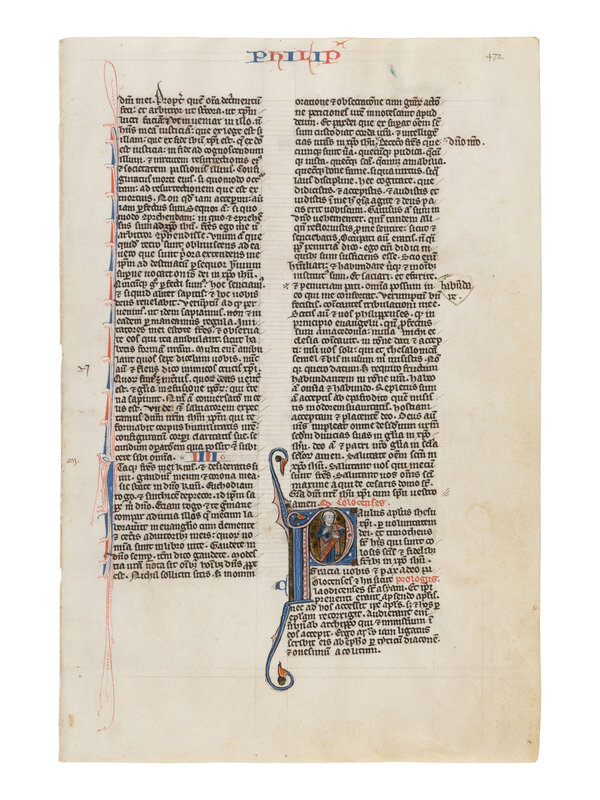
A leaf from the “Josephinum” Bible, with a historiated initial ‘P’ of Saint Paul holding a sword, in Latin, illuminated manuscript on parchment [France, Paris, c. 1250]
A leaf from the “Josephinum” Bible, with a historiated initial ‘P’ of Saint Paul holding a sword, in Latin, illuminated manuscript on parchment [France, Paris, c. 1250]
By the second artist from the esteemed Parisian workshop of Johannes Grusch responsible for the important folio-sized thirteenth-century Josephinum Bible.
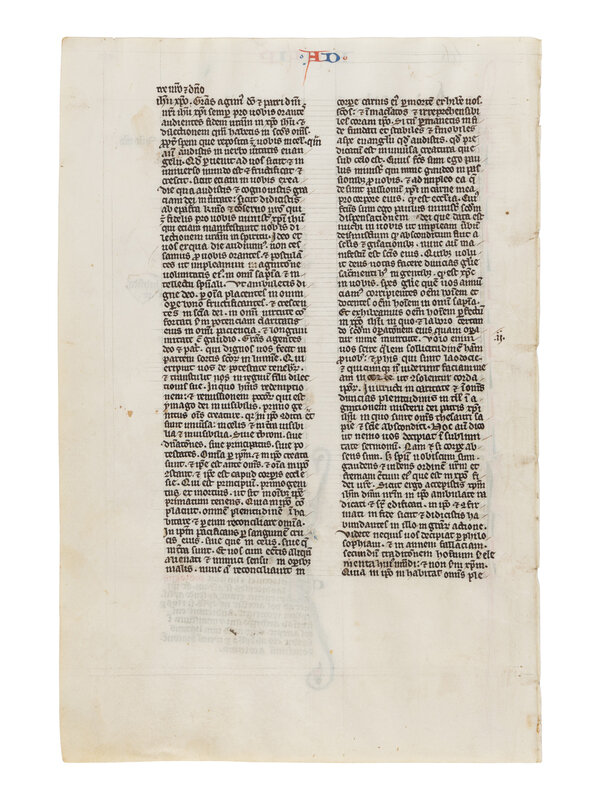
288 × 193 mm. Single leaf, ruled in plummet for two columns of fifty lines (justification: 195 × 129 mm) later foliation “472” in top right margin, written in a small gothic liturgical hand in black ink, with glosses and cross references in the margins, rubrics in red, 4-line chapter initial in red on verso, pen-flourished bar border in alternating red and blue with extensions to upper and lower margins on verso, ONE HISTORIATED INITIAL of ten lines painted on recto in blue and pink on burnished gold ground, with white tracery and lengthy scrolled extensions to lower margins, tape stains on the four corners of the verso, slight cockling of the parchment, else in good condition
This leaf comes from an important thirteenth-century Bible known as the “Josephinum” or sometimes “Saint Geneviève” Bible, a large fragment of which is now held by the Pontifical College Josephinum in Columbus, Ohio (Wehrle Memorial Library, Josephinum MS1). Its historiated initial ‘P’, portraying Saint Paul holding a sword, marks the incipit of the Book of Colossians, Paulus Apostolus Iesu Christi per voluntatem Dei. The illumination was painted in the atelier of Johannes Grusch, a prominent workshop active in Paris and named after the Canon whose name appears in a colophon of a Bible dated to 1267, now housed in Sarnen, Switzerland, at the Bibliothek des Benediktiner-Kollegiums (MS 16). The atelier, however, had its roots in the late 1230s and was perhaps a family-operated workshop. Several stylistic changes can be witnessed in the atelier as different illuminators matured and rose to prominence over the decades. In the middle of the century, two painters were especially precocious, and both hands were active in the Josephinum Bible. Robert Branner (1977, 82–93) identifies a first hand, the more refined of the two, who drew faces using only black outlines, while a second hand employed thicker, less regular lines and modeled faces. The artist responsible for this initial was the second hand, whose treatment of drapery and application of thick lines compares closely to other works of the atelier, such as a Bible made c. 1250, now in the Philadelphia Free Library (Lewis E 242).
Provenance
(1) Although traditionally linked to the Abbey of Saint Geneviève in Paris, recent research has cast doubt on this association. A document once pasted inside the front cover of the parent manuscript—addressed to the abbot and prior of the Abbey and dated 1224—was long thought to support the connection. However, analysis by Ohio State University, which holds the original binding and flyleaves, has revealed the document to be a modern facsimile. There is no direct evidence confirming that the Bible was ever associated with the Abbey. A fragment of another manuscript, pasted to the rear flyleaf, contains the word “volumine” and the date 1247. This date was also inscribed on the upper cover, likely in the nineteenth century.
(2) Additional nineteenth-century provenance in the parent manuscript includes an illegible library stamp and collation notes in Italian written inside the back cover.
(3) Parent manuscript sold at Christie's London, June 26, 1996, lot 14.
(4) Private USA Collection.
Parent manuscript and sister leaves
This leaf is folio 472 from what was once a largely intact thirteenth-century Bible sold at Christie’s London on 26 June 1996 (lot 14), described as comprising 552 leaves (lacking 24). The manuscript was broken up shortly after the Christie’s sale, most likely by the American manuscript dealer Bruce Ferrini. A substantial fragment of 73 leaves from this Bible is now housed at the Pontifical College Josephinum in Columbus, Ohio (Josephinum MS1). Additional leaves from the Bible are also dispersed across institutions and private collections worldwide. A comprehensive study by Rose McCandless (2021) documents the manuscript’s history and subsequent dispersal, identifying approximately fifty known leaves, with this leaf unlisted. Notably, additional leaves unidentified by McCandless with historiated initials surfaced at auction in Paris, May 2023, and Chicago, June 2024. And four additional leaves are in the McCarthy Collection (Kidd 2021, no. 36).
LITERATURE
On the parent manuscript, Rose McCandless, “Seeing the Exceptional in the Unexceptional: Reconstructing the Josephinum Bible,” Undergraduate Thesis, Ohio State University, 2021; Peter Kidd, The McCarthy Collection, London, 2021, vol. 3, no. 36; Robert Branner, Manuscript Painting in Paris During the Reign of Saint Louis: A Study of Styles, Berkeley, 1977, pp. 82–93; Related Literature: Laura Light, “French Bibles c. 1200–1230: A New Look at the Origin of the Paris Bible,” in The Early Medieval Bible: Its Production, Decoration and Use, ed. Richard Gameson, Cambridge, 1994, pp. 155–76; Laura Light, “The Thirteenth Century and the Paris Bible,” in The New Cambridge History of the Bible, ed. Richard Marsden and E. Ann Matter, Cambridge, 2012 vol. 2, pp. 380–9; Chiara Ruzzier, “The Miniaturisation of Bible Manuscripts in the Thirteenth Century: A Comparative Study,” in Form and Function in the Late Medieval Bible, ed. Laura Light and Eyal Poleg, Leiden, 2013, pp. 105–25.
We thank Senior Consultant Sandra Hindman and Peter Bovenmyer for their assistance in preparing this sale.
This lot is located in Chicago.