Condition Report
Contact Information
Auction Specialists
Lot 18
Sale 6388 - Western Manuscripts and Miniatures
Jul 8, 2025
10:00AM CT
Live / Chicago
Own a similar item?
Estimate
$5,000 -
6,000
Price Realized
$6,080
Sold prices are inclusive of Buyer’s Premium
Lot Description
SOUTHERN NETHERLANDISH ILLUMINATOR
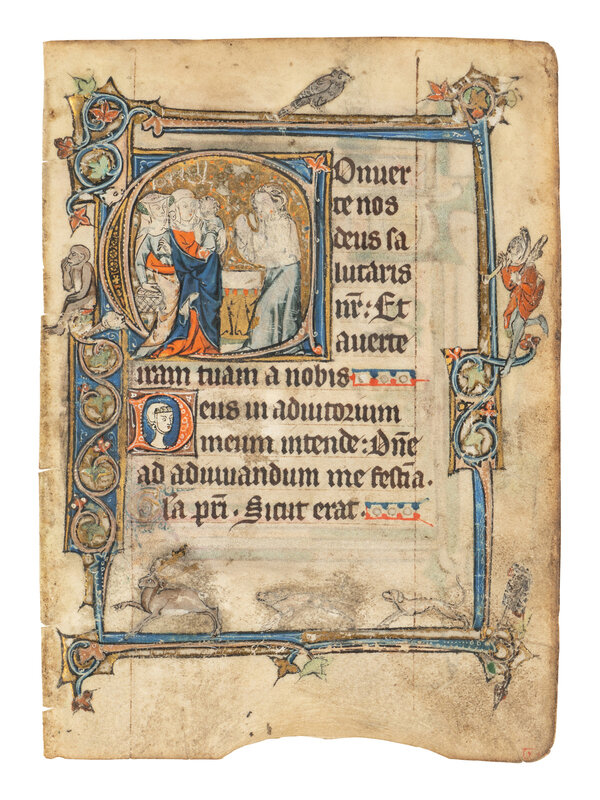
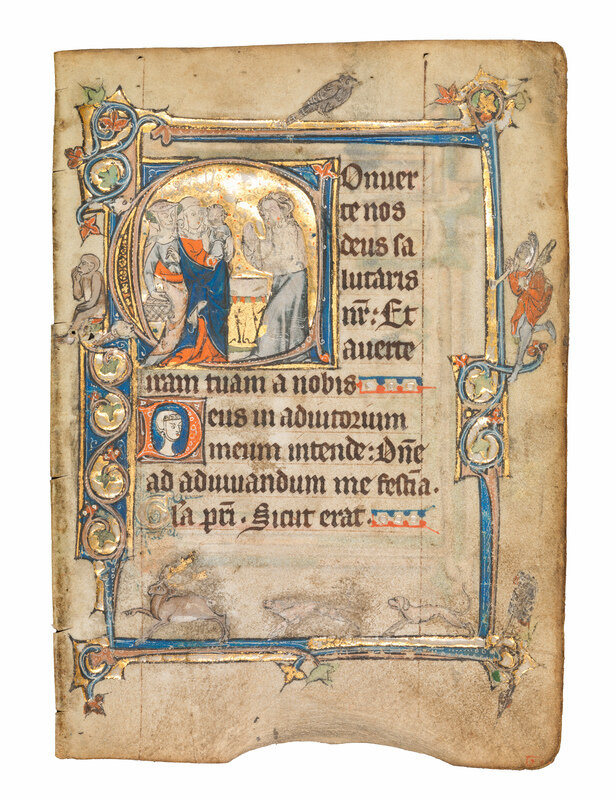
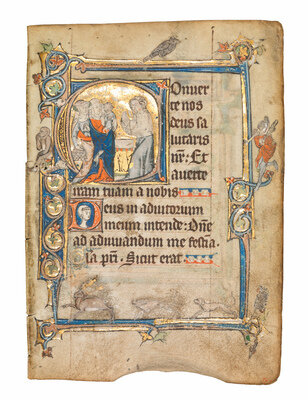
Leaf from the Ghistelles Hours with a historiated initial ‘C’, depicting the Presentation in the Temple, in Latin, illuminated manuscript on parchment [Southern Netherlands, ca. 1300]
Leaf from the Ghistelles Hours with a historiated initial ‘C’, depicting the Presentation in the Temple, in Latin, illuminated manuscript on parchment [Southern Netherlands, ca. 1300]
From the so-called “Ghistelles Hours,” a notable yet enigmatic Book of Hours possibly once owned by the important collector Sir Sydney Cockerell.
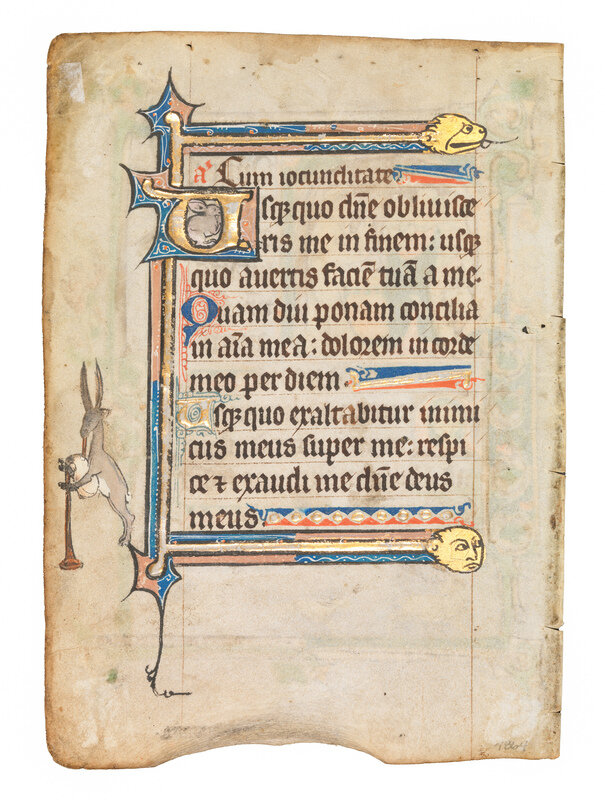
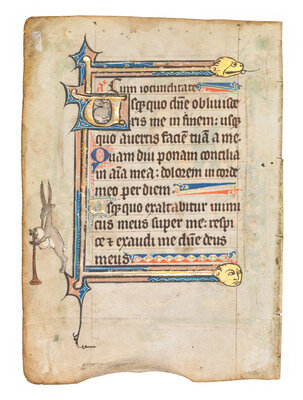
c. 120 × 90 mm, single leaf ruled in ink for single column of eleven lines, (justification: 61 × 47 mm) written in two sizes of Gothic book hand, single-line verse initials alternate between gold with blue penwork and blue with red penwork, two-line initials often historiated or inhabited with motifs such as a rabbit, a human head, and similar subjects and typically integrated into a three-sided border (open on the right) terminating in gold animal- or dragon-head terminals, major text divisions marked by ONE HISTORIATED INITIAL of six-lines on burnished gold grounds, accompanied by full four-sided borders populated with naturalistic birds, a monkey, human figures, and other marginalia, bas-de-page often containing narrative scenes, such as a stag chased by hounds, while the outer margins frequently include standing figures or animals approximately five lines tall, shown engaged in a variety of whimsical or symbolic activities. Significant wear to parchment with losses to pigments and gold in some places, else in fair condition.
This leaf originates from the so-called “Ghistelles Hours,” a distinguished and dismembered Book of Hours historically linked to the patron John III of Ghistelles. This attribution is based on a single leaf depicting a woman holding banners with the arms of Ghistelles and Flanders. However, this image appears within the Vespers of the Hours of the Virgin—an unusual placement for heraldic assertion of ownership. More significantly, other heraldic elements in the manuscript appear inconsistent or invented, including jousting monkeys bearing ambiguous arms and a soldier on a separate leaf (Philadelphia Museum of Art, 1945-65-14) carrying a shield with a lion contourné—a heraldic anomaly. These inconsistencies, combined with a lack of genealogical precision, suggest that the manuscript was not commissioned by a noble patron. Instead, internal evidence points to a more plausible West Flemish origin. The calendar includes southern Flemish saints and a practical list of annual market-fairs in Bruges, Torhout, Lille, and Mesen, indicating a patron more likely drawn from the wealthy merchant class. Active in the textile economy and attuned to the rhythms of trade fairs, such a figure would have had both the means and incentive to commission a Book of Hours of this caliber.
Further supporting this regional attribution is the manuscript’s highly distinctive iconographic program. At Compline, on this leaf, the artist depicts the Presentation in the Temple, diverging from both French and standard Flemish cycles. As Dominique Vanwijnsberghe has shown, most Flemish Books of Hours place the Presentation at None, with Vespers and Compline typically illustrating the Massacre of the Innocents and the Flight into Egypt, respectively. The parent manuscript instead follows Vanwijnsberghe’s rare “fifth Flemish variant,” in which the Presentation appears unusually at Compline—after the customary two episodes—further anchoring this work within a distinct West Flemish devotional context. As scholarship continues to refine our understanding of these patronage networks, future research will undoubtedly shed new light on the origins of this significant and remarkable manuscript.
Provenance
(1) The parent volume has long been associated with John III of Ghistelles (d. 1315), although this attribution is now considered tenuous. The manuscript is typically, and probably correctly, dated to c. 1299–1300, based in part on the inclusion of an Easter table covering the years 1300 to 1316. The presence of this Easter table, alongside a list of fair dates written in French rather than Latin or Dutch, may suggest that the original patron was culturally more “French” than “Flemish.”
(2) An unidentified early library once held the manuscript, as indicated by an 18th(?)-century ink inscription (“N° 739”) on the first page of the main text (cat. 22a).
(3) Sir Sydney Cockerell (1867–1962) has been proposed as an early modern owner; Rosy Schilling, who owned the calendar leaf in the 1940s, claimed that Cockerell was responsible for breaking up the manuscript. Christopher de Hamel has suggested that it may have been the “imperfect 13th c. French Horae” recorded in Cockerell’s diary as purchased from Maggs Bros. on 20 August 1912. However, in a more recent account, de Hamel does not identify Cockerell as a former owner and instead attributes the manuscript’s dispersal to Heinrich Eisemann (1890–1972), suggesting that the 1912 “Horae” may in fact be Fitzwilliam Museum MS 2-1996. Nonetheless, it seems likely that Cockerell did possess the calendar and possibly other leaves, given Schilling’s testimony and Cockerell’s known history of dismembering manuscripts.
(4) Eisemann, a prolific dealer, was likely responsible for dispersing much of the volume, either having acquired it incomplete from Cockerell or breaking it up himself and selling leaves throughout the early 1950s.
(5) Present leaf formerly in the collection of Bruce Ferrini, Akron, Ohio (1949–2010). Acquired from Les Enluminures in February 1998.
(6) Robert McCarthy, London, MS BM 1162
Parent manuscript and sister leaves
There is no known contemporary description of the Ghistelles Hours before its dismemberment, but much of its original content can be confidently reconstructed due to the large number of surviving leaves that have been identified. The decoration sequence for the Hours of the Virgin includes: Matins (The Annunciation), Lauds (The Visitation), Prime (The Nativity), Sext (The Adoration of the Magi), and Compline (The Presentation in the Temple). Other miniatures, now lost, likely depicted The Annunciation to the Shepherds at Terce, The Massacre of the Innocents at None, and The Flight into Egypt at Vespers. The Hours of the Cross are more fragmentary: surviving miniatures include Prime (Christ before Pilate) and Sext (Christ Carrying the Cross), while missing scenes probably included The Betrayal (Matins), The Flagellation (Terce), The Crucifixion (None), The Deposition (Vespers), and The Entombment (Compline). Additional surviving sections include the Mass of the Virgin (Virgin and Child) and Mass of the Trinity (The Trinity, fig. 22.3), as well as the Office of the Dead, represented by a Funeral Service scene (Philadelphia Museum of Art, inv. 1949-7-3). A partial reconstruction is offered by Peter Kidd (2021).
LITERATURE
Margaret M. Manion, Vera F. Vines, and Christopher de Hamel, Medieval and Renaissance Manuscripts in New Zealand Collections, Melbourne, 1989, no. 72; Christie’s, Valuable Printed Books and Manuscripts, Including Natural History, 4 June 2003, lot 5; Sotheby’s, Medieval Illuminated Miniatures and the Korner Hours from the Collection of the Late Eric Korner, sale no. L09740A, 7 July 2009, lot 105; Alison Stones, Gothic Manuscripts: 1260–1320, Part Two, A Survey of Manuscripts Illuminated in France, 2 vols., Turnhout, 2014, vol. 2, nos. 199, 206, and 209 n. 39; Florian Knothe, Illustrious Illuminations: Christian Manuscripts from the High Gothic to the High Renaissance (1250–1540), Hong Kong, 2015, nos. 9a–c; Peter Kidd, The McCarthy Collection: French Miniatures, London, 2021, no. 22.
We are grateful to Peter Kidd for permission to quote from his catalogue in this entry, and we thank Senior Consultant Sandra Hindman and Peter Bovenmyer for their assistance in the preparation of this sale.
The Collection of Robert McCarthy
This lot is located in Chicago.