Condition Report
Contact Information
Auction Specialists
Lot 11
Sale 6388 - Western Manuscripts and Miniatures
Jul 8, 2025
10:00AM CT
Live / Chicago
Own a similar item?
Estimate
$5,000 -
6,000
Price Realized
$5,120
Sold prices are inclusive of Buyer’s Premium
Lot Description
PONTIFICAL GROUP
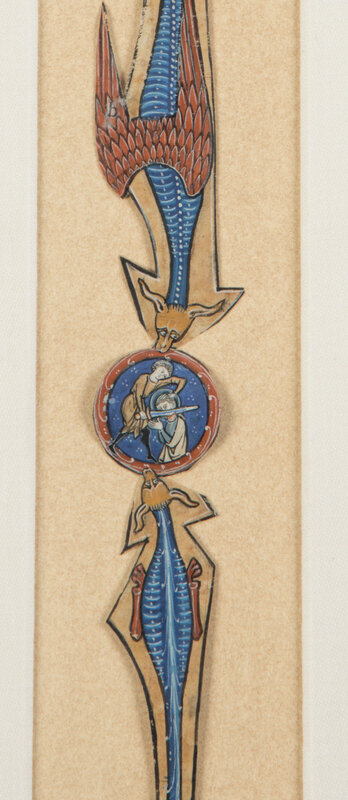
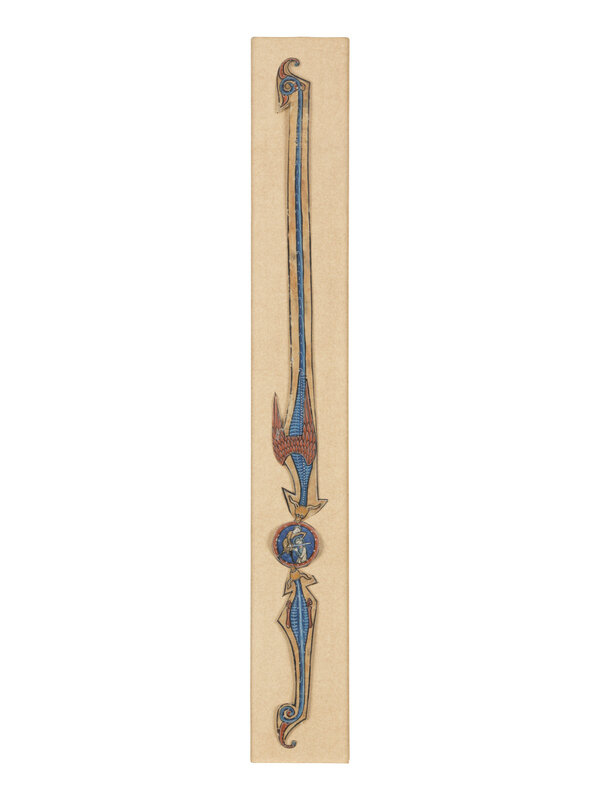
Cutting with an historiated initial from a Cistercian Antiphonary, illuminated manuscript on parchment [North France, Lille, Cambrai, Tournai, or Arras? ca. 1255–1291]
Cutting with an historiated initial from a Cistercian Antiphonary, illuminated manuscript on parchment [North France, Lille, Cambrai, Tournai, or Arras? ca. 1255–1291]
A rich and imaginative and very large illuminated fragment from a monumental Choir Book with sister leaves widely dispersed including in the Getty Museum.
c. 375 × 25 mm. Single cutting, trimmed to the edges of the decoration, original leaf likely ca. 500 × 350 mm based on dimensions of related leaves, cutting contains an illuminated initial ‘I’ featuring the martyrdom of a saint, within a central roundel, a man with a sword shown beheading a kneeling, nimbed, and apparently female saint in prayer, two dragons extending above and below the roundel with bodies and tails terminating in foliate ornament. Minor losses and tape stains to reverse, else in good condition.
This richly illuminated cutting is closely related to a larger group of leaves and cuttings—most now housed at the Getty Museum (e.g. MS 44)—all of which likely derive from the same monumental series of choir books. Often loosely associated with the so-called Pontifical Group of manuscripts and fragments—a term used by scholars to describe a cluster of lavishly decorated liturgical books produced in northern France or Flanders in the late thirteenth to early fourteenth century—these works are distinguished by their grand scale, vibrant palette, and a distinctive frontal depiction of figures, rather than the more typical side-facing profiles. A few comparable examples survive in matching volumes of similar date, most notably the renowned Beaupré Antiphonary (Walters MS W.759, MS W.760). This cutting features a large initial ‘I’ and may have introduced the Common of a Martyr, beginning with the introit Iste sanctus, though this remains unconfirmed due to the presence of only partial musical notation and letter fragments on the reverse. Rich and refined, this fragment preserves the liturgical opulence characteristic of the vibrant monastic communities of northern France and Flanders in the second half of the thirteenth century.
Provenance
(1) Produced ca. 1260–1290 (certainly between 1255 and 1291) at a Franco-Flemish center—possibly Lille, Cambrai, Tournai, or Arras—for a Cistercian house, as indicated by specific liturgical features. The cutting likely comes from one of a pair of matching Choir volumes, at least one of which remained in monastic use through the seventeenth or eighteenth century.
(2) In or around 1846, selected leaves from more than one volume appear to have been extracted and rebound in a French-speaking region. The group of cuttings to which the present example belonged survived into the twentieth century, likely through separate channels of transmission.
(3) This cutting offered by Davis & Orioli, London booksellers in 1927, along with other fragments.
(4) Eric George Millar (1887–1966), noted manuscript scholar and Keeper of Manuscripts at the British Museum (1944–1947).
(5) Mark Lansburgh (d. 2013), acquired together with other Millar cuttings, by 1962; the verso of the frame bears Lansburgh’s bookplate, inscribed “Mark Lansburgh Collection,” along with his handwritten notes, one apparently dated 1997.
(6) Robert McCarthey, London, MS BM 1146, acquired from Sam Fogg, London, in December 1997.
Parent manuscript and sister leaves
Elizabeth Teviotdale (2000) provides a detailed discussion and partial reconstruction of the 101 leaves and 91 cuttings known to her from the parent volume(s), noting an additional seven cuttings in a private collection and fourteen more known only through photographs. To the extensive list of fragments compiled by Teviotdale and Stones—now held in collections in Cleveland, Collegeville, Los Angeles, Stockholm, and elsewhere—can be added a cutting of an initial ‘P’ enclosing two fighting knights (c. 410 × 105 mm), auctioned in Paris in 2004 and later included in the Zeileis Collection.
LITERATURE
Mark Lansburgh and Elias Avery Lowe, An Illustrated Check List of Manuscript Leaves in the Collection of Mark Lansburgh, Santa Barbara, 1962, no. IX; David H. Turner, “List of the Medieval and Renaissance Manuscripts Owned by Eric Millar,” British Museum Quarterly 33 (1968), pp. 9–16; Alison Stones and Jan Steyaert, Medieval Illumination, Glass, and Sculpture in Minnesota Collections, Minneapolis, 1978, no. 4, p. 12 and fig. 10; Elizabeth Teviotdale, “A Pair of Franco-Flemish Cistercian Antiphonals of the Thirteenth Century and Their Programs of Illumination,” in Interpreting and Collecting Fragments of Medieval Books: Proceedings of the Seminar in the History of the Book to 1500, Oxford, 1998, ed. Margaret M. Smith and Linda L. London, 2000, pp. 230–58, at pp. 247 and 254; Alison Stones, Gothic Manuscripts: 1260–1320, Part One, A Survey of Manuscripts Illuminated in France, 2 vols., Turnhout and London, 2013, vol. 1, pp. 268–78, no. III-48, at p. 275, ills. 493–98, col. pls. 46–47; Peter Kidd, The McCarthy Collection: French Miniatures, London, 2021, no. 46.
We are grateful to Peter Kidd for permission to quote from his catalogue for this entry, and we thank Senior Consultant Sandra Hindman and Peter Bovenmyer for their assistance in preparing this sale.
The Robert McCarthy Collection
This lot is located in Chicago.