Condition Report
Contact Information
Auction Specialist
Lot 9
Sale 6330 - Fine Printed Books & Manuscripts, Including Americana
May 8, 2025
10:00AM CT
Live / Chicago
Own a similar item?
Estimate
$1,500 -
2,500
Price Realized
$2,176
Sold prices are inclusive of Buyer’s Premium
Lot Description
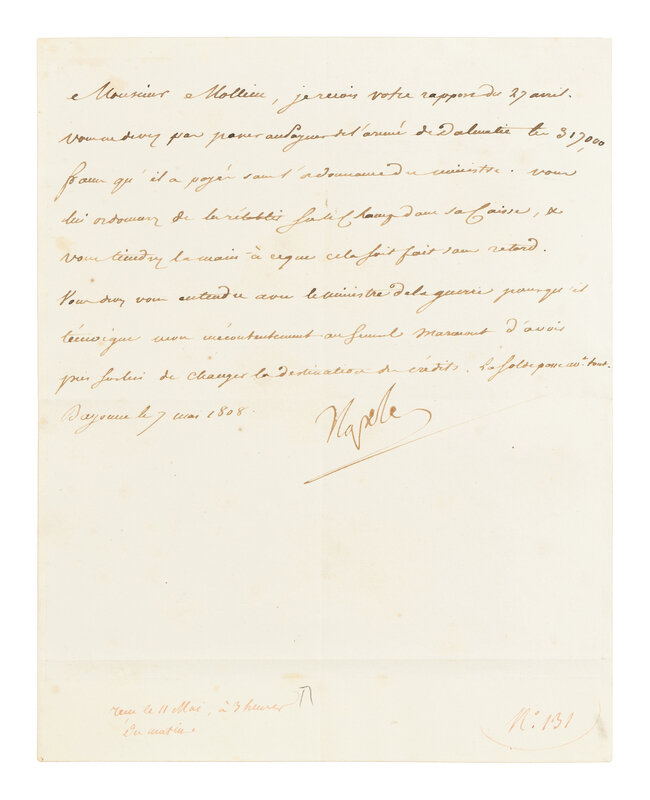
BONAPARTE, Napoleon (1769-1821). Autograph note signed ("Napoleon") to Nicolas-François, Count Mollein, Bayonne, 7 May 1808.
One page, 8vo (229 x 184 mm), docketed in red on recto, old creases, spotting, two small areas of transfer from old hinge mount; with an engraved portrait for framed display.
Transcribed, in full: "Monsieur Mollieu. I am in receipt of your report of April 27. You must not turn over to the Paymaster of the Army of Dalmatia the 317,000 francs which he paid without authorization of the minister. You will order him to restore it immediately in the treasury, and it will be your responsibility to see that this is done without delay. You must come to an understanding with the Minister of War, and have him indicate any displeasure with General Marmont for having taken the liberty of changing the destination of the credits. Disbursement of soldiers' pay must taken priority."
THE BEGINNING OF THE END FOR NAPOLEON.
Following the French invasion of its former ally Spain in February 1808, the Spanish government was thrown into chaos as it found itself battling not only Napoleon's invading forces but also uprisings from its own citizens. On 17 March the citizens of Aranjuez rose against King Charles IV in favor of his son Ferdinand VII, and Charles abdicated the throne two days later. Desperate to regain power, Charles appealed to Napoleon for help in overthrowing Ferdinand. In April Napoleon summoned father and son to Bayonne and on 7 May forced both Charles and Ferdinand to abdicate the Spanish crown, which he immediately granted to his brother Joseph. The Spanish people, already resistant to the French invasion, launched a fierce guerilla warfare campaign against their conquerors, a situation which led to an increased military presence in Spain which stretched Napoleon's military forces to the breaking point. The present letter, dated the same day as the forced abdications of Charles and Ferdinand and addressed to Napoleon's Minister of the Treasury, captures a moment of triumph which would ultimately lead to ruin; within eight years Napoleon's reign would come to a decisive end at the Battle of Waterloo.