Condition Report
Contact Information
Auction Specialist
Lot 464
Sale 6319 - American Historical Ephemera and Early Photography
May 1, 2025
10:00AM ET
Live / Cincinnati
Own a similar item?
Estimate
$600 -
800
Price Realized
$480
Sold prices are inclusive of Buyer’s Premium
Lot Description
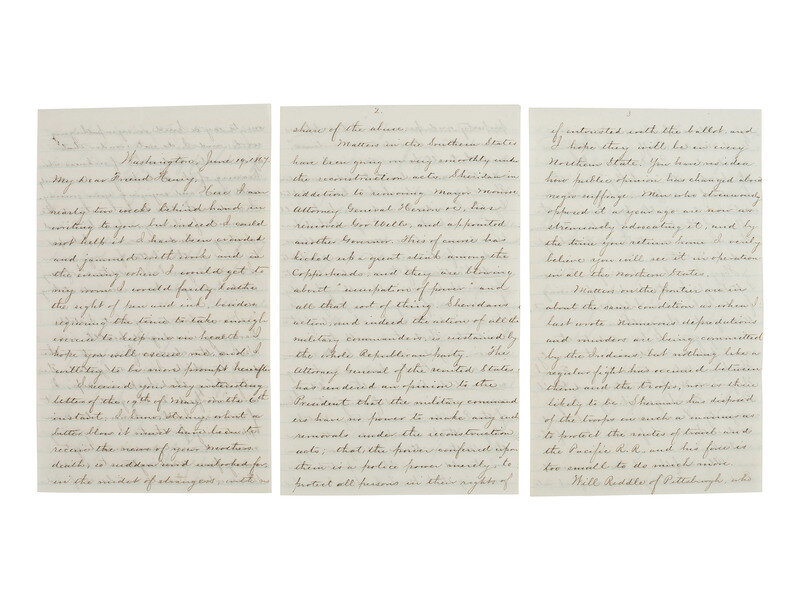
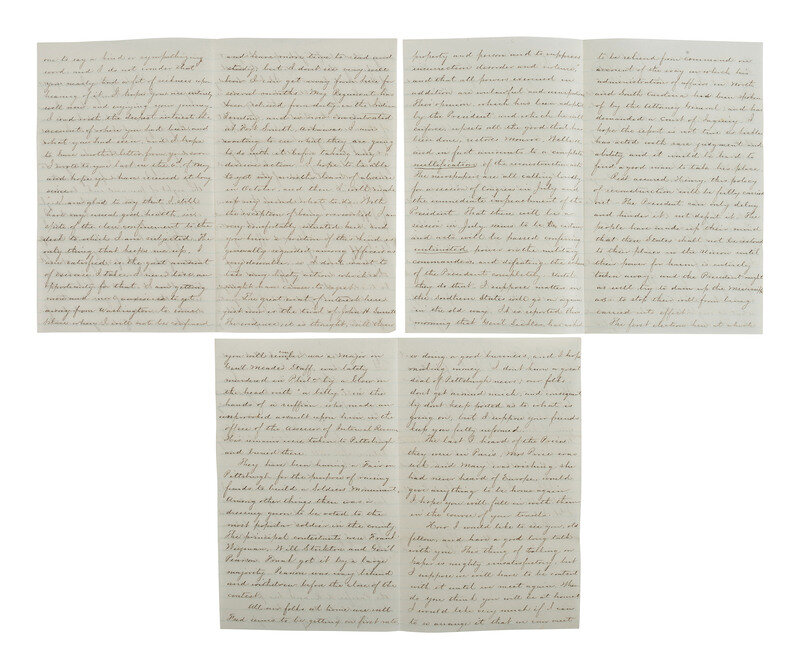
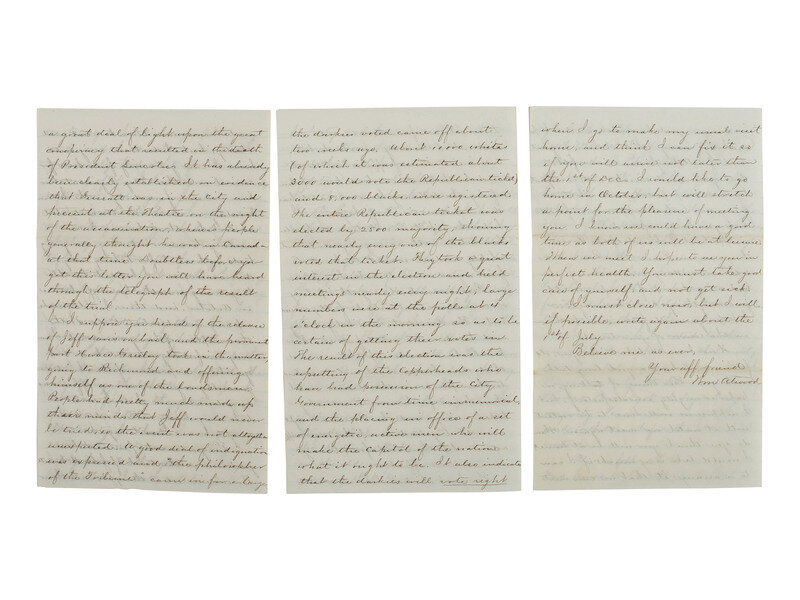
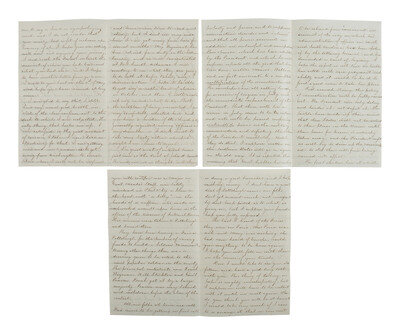
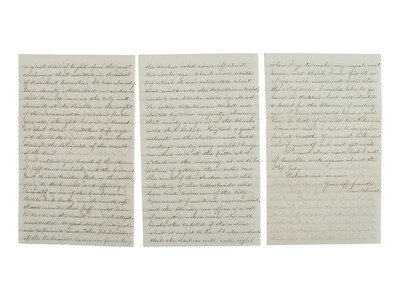
[RECONSTRUCTION -- AFRICAN AMERICAN SUFFRAGE]. Detailed letter regarding the John Surratt trial, Reconstruction politics, and the African American vote in action. Washington, 19 June 1867.
ATWOOD, William. ALS to a friend named Henry. Washington, 19 June 1867.
11 1/2 pages, 5 x 8 in. Creased at folds.
[AFRICAN AMERICANS] TOOK A GREAT INTEREST IN THE ELECTION AND HELD MEETINGS NEARLY EVERY NIGHT; LARGE NUMBERS WERE AT THE POLLS AT 4 O'CLOCK IN THE MORNING SO AS TO BE CERTAIN OF GETTING THEIR VOTES IN.
This remarkable letter goes into great detail about several important events and issues facing not only the capital city, but the nation in the post-bellum year of 1867.
From his office in Washington, William Atwood writes that his regiment was relieved from duty in the Indian Territory and is currently based in Fort Smith, Arkansas. He is still undecided regarding in what capacity he wants to work for the regiment, as he explains: "With the exception of being overworked I am very comfortably situated here, and you know a position of this kind is generally regarded among officers as very desirable, so I don't want to take any hasty action..."
Diving into current events, Atwood describes the John H. Surratt trial as "The great event of interest here." He writes that the popular notion is that the evidence "will throw a great deal of light upon the great conspiracy that resulted in the death of President Lincoln." He says that the evidence has already shown that Surratt was in the city and at Ford's theater on the night of the assassination, rather than in Canada as was previously thought. Despite this, the evidence in the case was judged to be not conclusive, and the trial ended in a hung jury just a few weeks after Atwood penned this letter.
Atwood then turns to events further south, mentioning the release of Jefferson Davis from prison, and the "good deal of indignation" expressed, largely against Horace Greeley who offered himself as a bondsman, as a result. He then discusses the Reconstruction Acts, under which he writes "Matters in the Southern States have been going on very smoothly," with General Philip Sheridan in charge of the 5th District encompassing Texas and Louisiana.
Sheridan had recently removed some important leaders in the area including Louisiana Governor James Madison Wells, to the chagrin of the Copperheads who Atwood writes, "are blowing about 'usurpation of power' and all that sort of thing." He maintains that the Republican Party is in full support of Sheridan and all of the military commanders in charge of the southern states, but that an opposition opinion from the US Attorney General, and recently adopted by President Andrew Johnson, holds that the military commanders have no power to make any removals and that the power conferred upon them is merely a police power to protect individual property and suppress insurrection.
Atwood writes that the enforcement of this opinion "upsets all the good that has been done, restores Monroe, Wells &c, and in fact amounts to a complete nullification of the reconstruction acts." He then writes that the newspapers are calling for the immediate impeachment of President Johnson, and that there will likely be acts passed "conferring unlimited power on the military commanders, and defeating the scheme of the President completely."
In an attempt to calm the mind of his friend on the whole matter, Atwood summarizes: "Rest assured, Henry, this policy of reconstruction will be fully carried out. The President can only delay and hinder it, not defeat it. The people have made up their mind that these states shall not be restored to their places in the Union until their power for harm is entirely taken away, and the President might as well try to dam up the Mississippi as to stop their will from being carried into effect."
Atwood then provides a fascinating level of detail about a municipal election that took place on 3 June. He writes: "The first election here at which the darkies voted came off about two weeks ago. About 10,000 whites (of which it was estimated about 3000 would vote the Republican ticket) and 8,000 blacks were registered. The entire Republican ticket was elected by 2500 majority, showing that nearly every one of the blacks voted that ticket. They took a great interest in the election and held meetings nearly every night; large numbers were at the polls at 4 o'clock in the morning so as to be certain of getting their votes in."
As for the results of the election, he continues: "The result of this election was the upsetting of the Copperheads who have had possession of the city Government from time immemorial, and the placing in office of a set of energetic, active men who will make the Capital of the nation what it ought to be. It also indicates that the darkies will vote right if entrusted with the ballot, and I hope they will be in every northern state. You have no idea how public opinion has changed bout negro suffrage. Men who strenuously opposed it a year ago are now as strenuously advocating it, and by the time you return home I verily believe you will see it in operation in all the northern states."
Atwood was not the only one to take note of this momentous occasion. An engraving by Andrew W. McCallum entitled, "Significant election scene at Washington, June 3, 1867" appeared in a Harper's issue dated 22 June, depicting a polling location with 3 African American men at the front of the line, including one dropping his ballot into the box before 3 men seated at a table, one of whom is also Black.
Included in the letter is a small section on frontier news, including Atwood's report that "Numerous depredations and murders are being committed by the Indians, but nothing like a regular fight has occurred between them and the troops, nor is there likely to be." He explains, "Sherman has disposed of the troops in such a manner as to protect the routes of travel and the Pacific R. R., and his force is too small to do much more."
Atwood wraps up with news from "home," which for both he and his recipient appears to be the Pittsburgh area.
Though we cannot be entirely certain of the identity of the William Atwood who wrote this letter, it seems likely that he is the William Atwood (1844-1871) who mustered into Battery F of the Pennsylvania Light Artillery as a private in August of 1862, and was commissioned a captain and assistant adjutant general in March of 1865. He was promoted to major later that month, and served in the US Army after the war until his untimely death aboard the steamer R. G. Coburn in Lake Huron. He is buried in Allegheny Cemetery in Pittsburgh, PA.
Estate of David O'Reilly, Old Bridge, New Jersey
This lot is located in Cincinnati.