Condition Report
Contact Information
Lot 215
Sale 2070 - American Historical Ephemera & Photography, including African Americana
Lots Open
Feb 14, 2025
Lots Close
Feb 27, 2025
Timed Online / Cincinnati
Own a similar item?
Estimate
$2,000 -
3,000
Price Realized
$11,400
Sold prices are inclusive of Buyer’s Premium
Lot Description
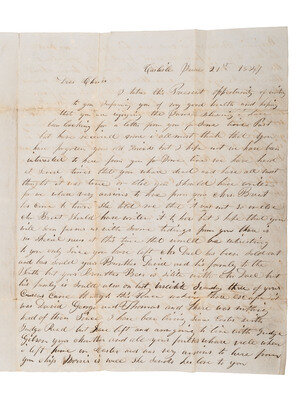
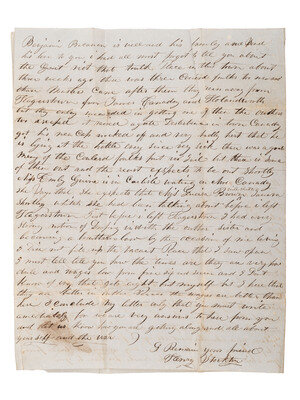
[UNDERGROUND RAILROAD - MCCLINTOCK RIOT]. Detailed ALS from a free Black man to a friend in Mexico.
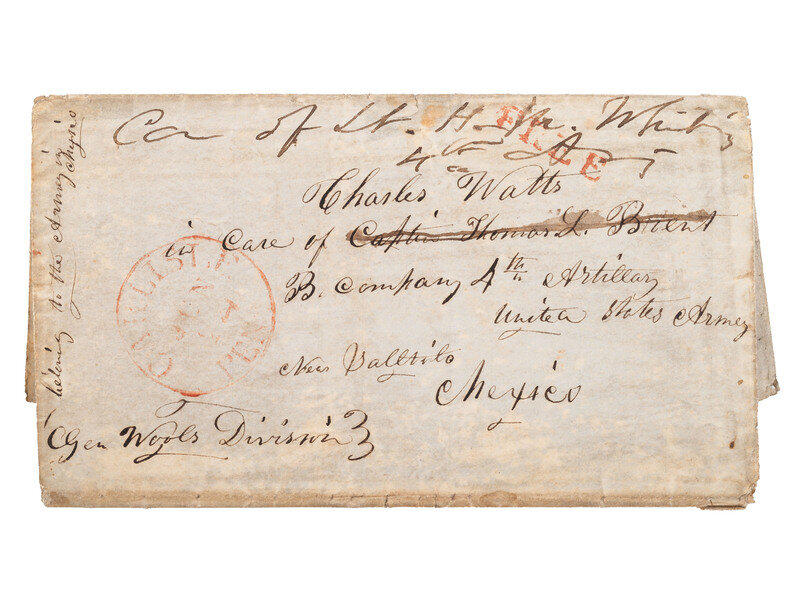
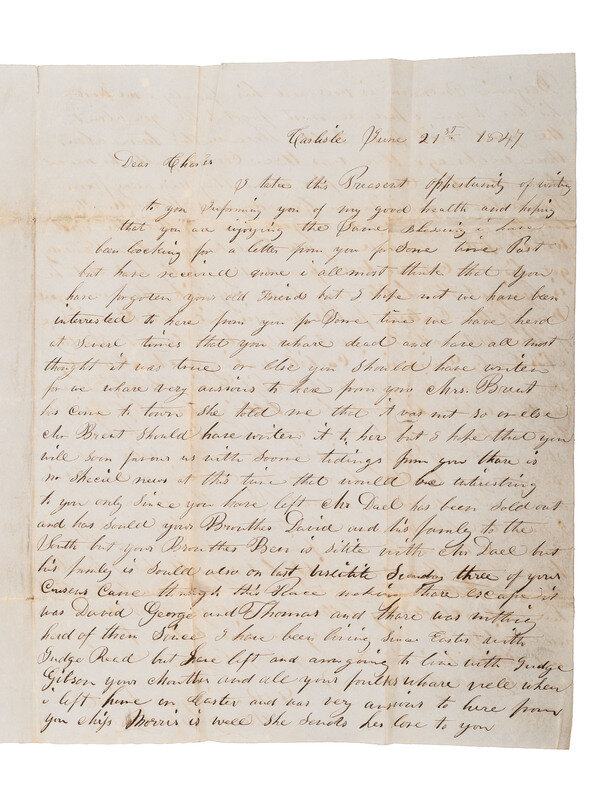
Autograph letter signed "Henry Stockton." Carlisle [Pennsylvania], 21 June 1847. 2pp, bifolium, 7 3/4 x 9 3/4 in., address panel on integral leaf. Addressed to Charles Watts, initially "in Care of Captain Thomas L. Brent / B. Company 4th Artillery / United States Armey [sic] / Near Saltillo Mexico" then readdressed instead in different hand to "Care of Lt. Henry M. Whiting / 4th Artillery."
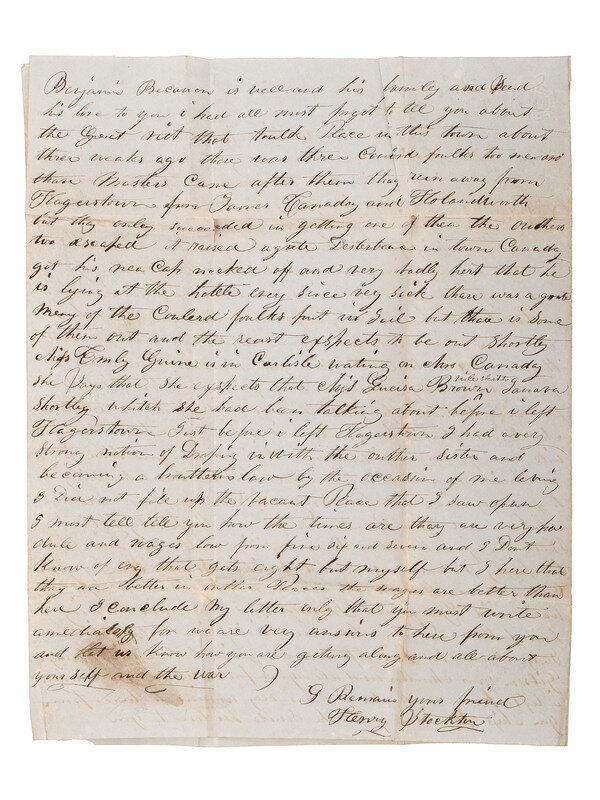
An extraordinary letter in which Stockton (dates unknown) details news of enslaved family and friends in Maryland, and of racial tensions boiling over into violence in the community of Carlisle, Pennsylvania. Stockton begins with news of Watts's family members: "...since you have left Mr. Dael has been sold out and and has sould your brother Brother David and his famly to the South but your brother Ben is still with Mr. Dael but his family is sould also...three of your cousens came through this place making thare escape it was David George and Thomas and there was nothing heard of them since...." Stockton then turns to news from Carlisle, "i had all most forgot to tell you about the great riot that toulk place in this town about three weeks ago there was three colored folks two men and thare Master came after them they ran away from Hagerstown from James Canaday and Holandworth but they only succeeded in getting one of them the others two escaped it raised a grate desterbence in town...." Stockton continues describing an injury sustained by "Canaday" and noting that many "coloured folks" were put in jail. Stockton concludes with more news regarding friends in Carlisle and Maryland, discussion of wages, and a request that Watts write soon with news of his well being and the war.
Situated near the border of the slave-holding state of Maryland, Carlisle was a stop on the Underground Railroad and a hub of abolitionism. The "great riot" referred to by Stockton in this letter references the June 2, 1847, McClintock Slave Riot which erupted when two Hagerstown enslavers entered Carlisle in search of three "fugitive" slaves. The enslavers, James Kennedy and his brother-in-law Howard Hollingsworth, came to Carlisle to claim Lloyd Brown, his young daughter Ann, and a woman named Hester, all of whom had been captured and taken to Carlisle. On the morning of 2 June, the local justice of the peace ruled that the enslavers had provided sufficient evidence for claims of ownership after which the three enslaved persons were to be taken to jail awaiting return to Maryland. After a series of rescue attempts and physical escalations between the enslavers and outraged community members, many of whom were free Blacks, violence erupted and Kennedy was mortally wounded. Dr. John McClintock, a well-known anti-slavery advocate and Dickinson College professor, was accused of instigating the antislavery resistance and put on trial for his actions. In a trial that captured the national spotlight, McClintock was acquitted for his actions but eleven Black men were convicted and sentenced to solitary confinement at the state penitentiary. Stockton notes in his letter that he was residing at the time of the riot with Judge Read (likely Judge Meredith Read, 1797-1874) and was soon to be residing with Judge Gibson (likely Judge John B. Gibson, 1780-1853), both of whom had strong connections to Carlisle, PA. Judge Read in particular had abolitionist sentiments, and was a founder of the Republican Party.
Though Charles Watts (ca 1817? - ?) could have served as a soldier in the Mexican War without being on a muster roll, the more likely scenario is that Watts accompanied Captain Thomas L. Brent (1813-1858) as a servant during the Mexican War. Brent graduated West Point in 1835. In the 1840s, laws allowed military officers to hire servants, and most were Black. As 1st Lt., 4th Artillery, Brent was stationed at Carlisle Barracks, PA, from 1844-46 prior to his departure for the Mexican War during which he was brevetted Captain for conduct at the Battle of Buena Vista. In February 1847, Brent was transferred to Quartermaster duty, which may account for the readdressing of the letter in care of Lt. Whiting. The 1844-1846 timeframe in which Brent was stationed at Carlisle links Stockton with Watts and Brent, though certainly Stockton and Watts may have had personal connections pre-dating this period. The exact identity of Charles Watts is unclear. The 1850 US Federal Census locates a Maryland-born Black male named Charles Watts working as "Servant" in "Private Households" in Quincy, Franklin County, Pennsylvania, a small town located between Carlisle, PA, and Hagerstown, MD.
A highly illustrative letter which sheds light on the tumultuous national environment leading up to the Civil War, as well as the interactions of the free and enslaved Black communities of PA/MD. Archival material related to the McClintock Riot is rare, as is material associated with the service of African American men during the Mexican-American War.
Property from the James Milgram, M.D., Collection of Ephemeral Americana and Historical Documents
This lot is located in Cincinnati.