Condition Report
Contact Information
Lot 210
Sale 2065 - Fine Printed Books and Manuscripts, Including Americana
Nov 14, 2024
9:00AM CT
Live / Chicago
Own a similar item?
Estimate
$10,000 -
15,000
Price Realized
$10,795
Sold prices are inclusive of Buyer’s Premium
Lot Description
[VEDDER, Elihu (1836-1923), illustrator]. Rubaiyat of Omar Khayyam: The Astronomer-Poet of Persia. Edward Fitzgerald, translator. Boston: Riverside Press for Houghton Mifflin and Company, 1884.
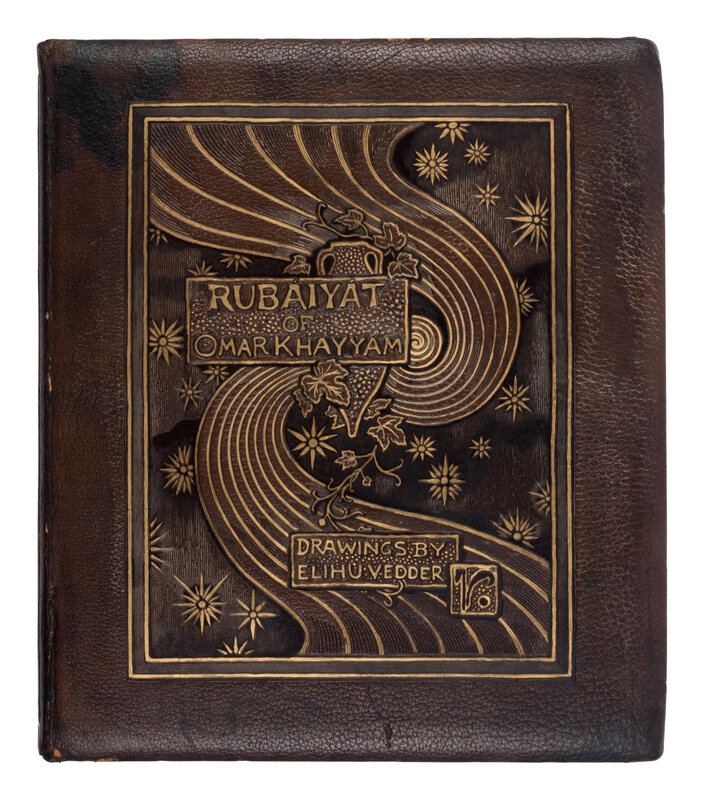
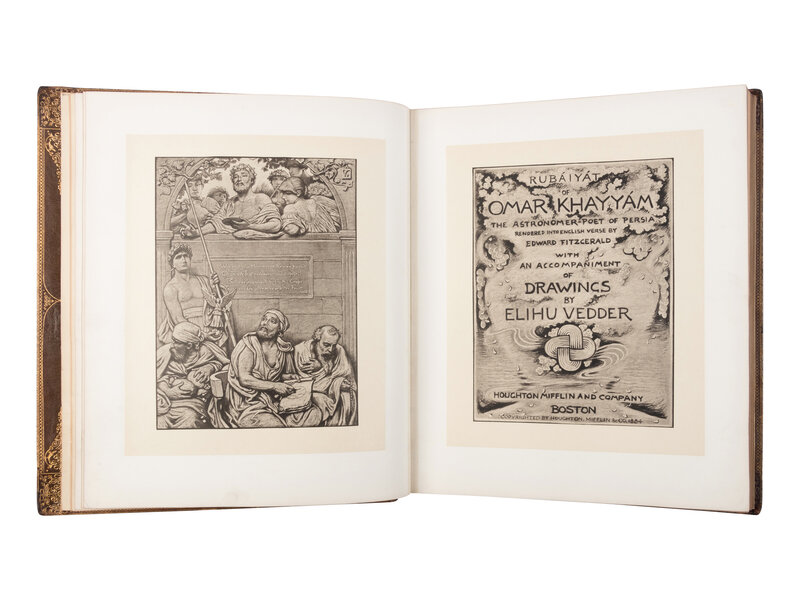
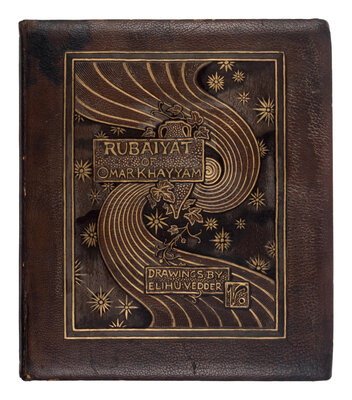
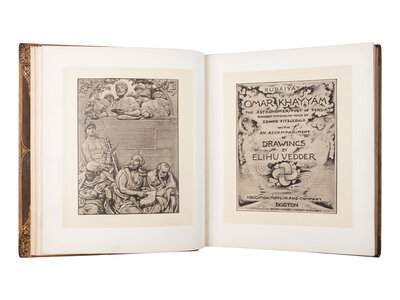
Large folio (432 x 381 mm). Letterpress index and notes at rear; 57 Art-Nouveau illustrated leaves reproduced by the Albertype process after drawings by Elihu Vedder on japanese paper, each with remarque, mounted on heavy wove paper as issued. Original publisher's deluxe full thick brown morocco gilt, decorated after a design by Vedder, gilt-lettered and decorated spine, all edges gilt, broad gilt dentelle turn-ins, floral silk doublures and free endpapers, stamp-signed by Riverside Press (slight split to lower front joint, slight darkening of the leather to one corner of the upper cover).
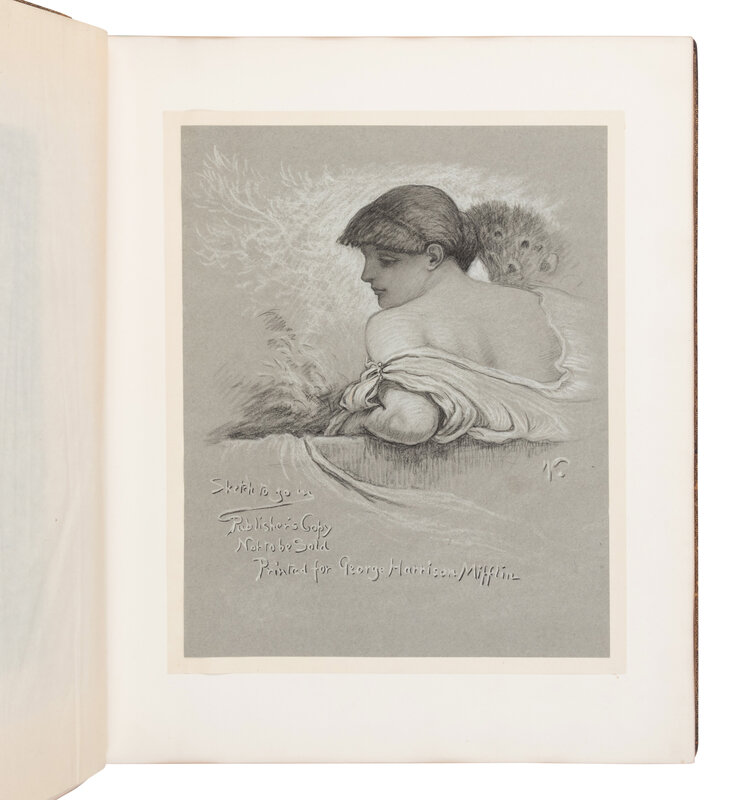
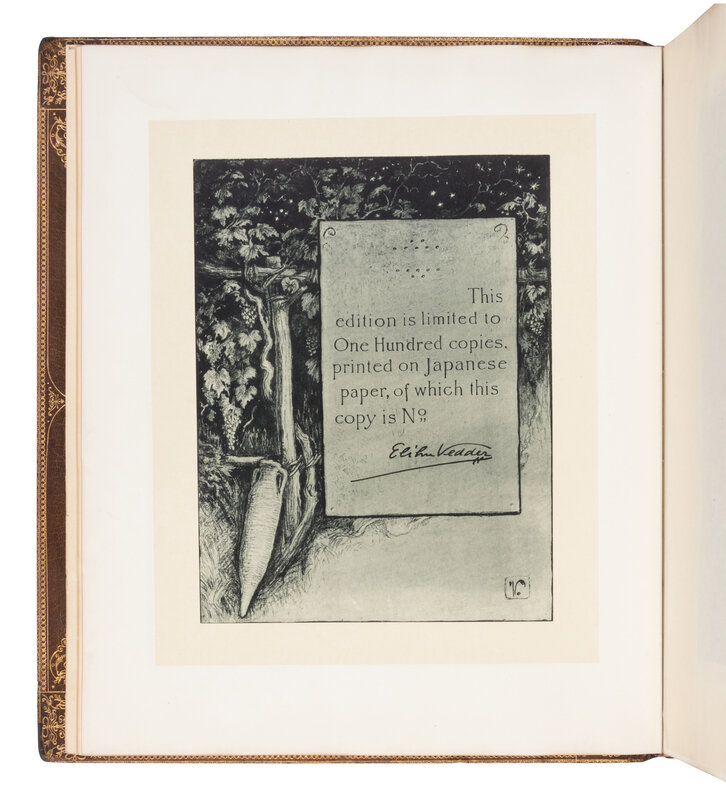
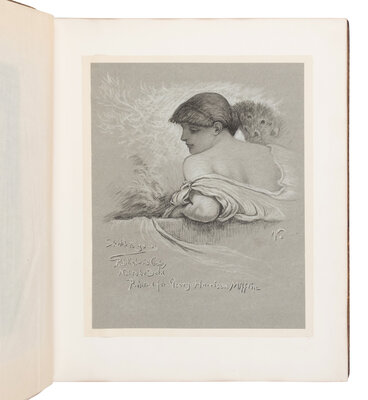
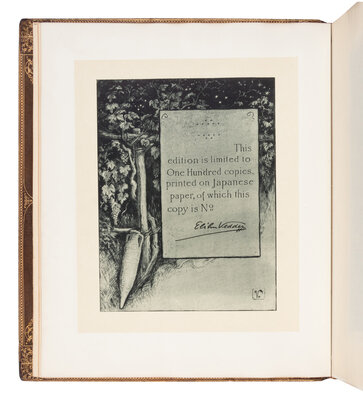
FIRST VEDDER EDITION, LIMITED ISSUE, one of 100 copies, SIGNED BY VEDDER on the limitation. THE PUBLISHER'S OWN UNNUMBERED COPY WITH A UNIQUE ORIGINAL DRAWING BY VEDDER INSCRIBED TO GEORGE HARRISON MIFFLIN: "Sketch to go in Publisher's Copy Not to be Sold, Printed for George Harrison Mifflin." Executed in charcoal and pastel on grey construction paper and initialed by Vedder in the lower corner, the sketch is of a beautiful young woman (314 x 254 mm) and does not appear in the printed list of illustrations.
THE MOST CELEBRATED EDITION OF THE RUBAIYAT, this Vedder first edition of Edward Fitzgerald's text is considered to be "unparalleled in American publishing history." Printed using an expensive screenless collotype (i.e. Albertype) process, "Vedder's goal was to create something to demonstrate in a grandiose way what American book production could achieve: an oversize book with high-quality illustrations by an American artist engraved by an American engraver and published by an American publisher" (Paas). Vedder rearranged Omar's stanzas to fall into three sections—joy (of life), death, and rebirth—and he channeled this conception into his art. Combining mystical imagery and the “cosmic swirls” with Christian and Classical figures, Vedder described his artwork as “gradual concentration of elements that combine to form life; the sudden pause through the reverse of the movement which marks the instant of life; and then the gradual, ever-widening dispersion again of those elements into space.”
Vedder's Rubaiyat was the first fully illustrated edition of the Rubaiyat to be published, and the 100 copies of Vedder's deluxe edition sold out within six days of production. The success of this deluxe edition quickly led to the issuance of trade editions that were cheaper and smaller in format. These cheaper editions used a "digital" half-tone printing process to reproduce Vedder's artwork, making the deluxe issue the only edition to reproduce Vedder's fine artwork with the vastly superior "analogue" Albertype process. “The Great Omar”, a manuscript magnificently calligraphed and bound in jewels by Sangorski and Sutcliffe – tragically lost aboard the Titanic – is said to have been composed using the same text block as Vedder’s edition.
A UNIQUE COPY BOUND of an important and most desirable copy of one of the great masterworks of modern fine printing and illustration. BOUND WITH AN UNPUBLISHED AUTOGRAPH DRAWING CREATED FOR THE PUBLISHER. Potter 201.