Condition Report
Contact Information
Auction Specialist
Lot 320
Lot Description
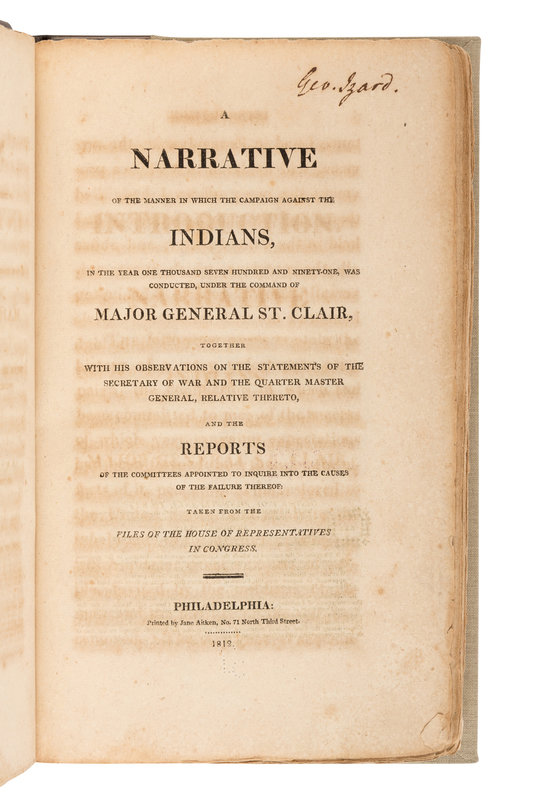
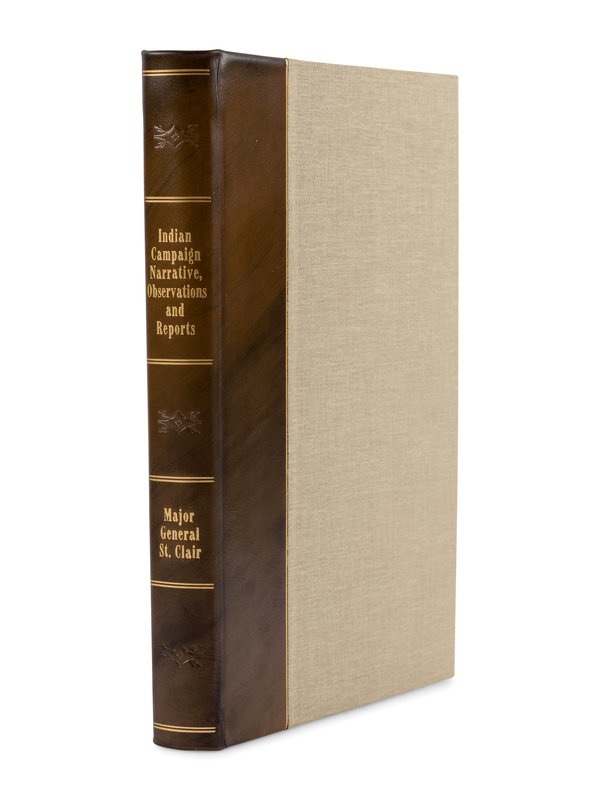
8vo (232 x 145 mm). Half-title, 18pp. subscriber's names, errata leaf, 1p. subscriber's names. (Some toning, offsetting, and spotting.) Modern dark brown calf-backed tan cloth, smooth spine decorated in blind and gilt; folding case. Provenance: George Izard (1776-1828), territorial governor of Arkansas and army officer (signature "Geo. Izard" on title); R.S. Jennings (clipped signature tipped to front pastedown); Library of Congress (duplicate stamp on half-title verso, unobtrusive perforated stamp to title-page); sold Christie's The Jay T. Snider Collection of Historical Americana Sale (1618), 21 June 2005, Lot 138 (tag laid in, pencil "138/1" to rear flyleaf).
FIRST EDITION, FIRST ISSUE, without the two leaves of "Additional Subscribers." St. Clair is most known for the Battle of the Wabash of 1791, also called "St. Clair's Defeat." In a poorly organized and woefully supplied expedition, the American forces were counterattacked by Native American Indians on 4 November 1791. The deadliest battle in American history between U.S. soldiers and Native Americans, the battle resulted in a casualty rate of 97 percent for the American forces, with the deaths of over 88 percent of the officers, 632 of 920 soldiers killed, and an additional 264 wounded. Only 24 Americans were uninjured. While President Washington and a congressional committee exonerated St. Clair, he resigned from his position; A Narrative is his account of the events.
THE GEORGE IZARD COPY. During 1791 and the events St. Clair describes, Izard attended Columbia College (then King's College), graduating a year later at the age of 15. By the publication of St. Clair's A Narrative in 1812, Izard was the Colonel of the Second Artillery Regiment in anticipation of war with England and was later promoted to Major-General. Following the War of 1812, Izard lived a secluded life of scholarship, actively participating in the American Philosophical Society. On 4 March 1825, President Monroe appointed him Governor of the Arkansas Territory, a role Izard held until his death in 1828. Izard's tenure was controversial due to his success in forcing the relocation of the Quapaw and Choctaw tribes to reservations, and condemnation by the "unruly frontier legislature" for his "dictatorial manner toward them"(ANB). Shaw and Shoemaker, American Imprints, 26682; Field 1349; Graff 3639; Howes S-24; Sabin 75020; Thomson Ohio 1012. A FINE ASSOCIATION COPY.
Property from the Collection of Robert S. Brown, Cincinnati, Ohio
This lot is located in Chicago.